

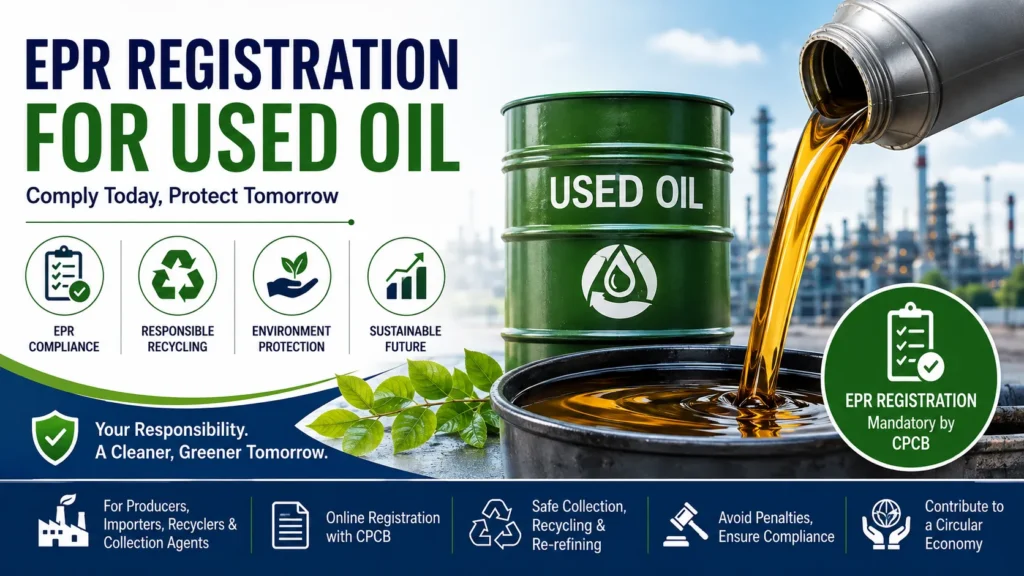
Used oil is generated after lubricating oils or petroleum-based oils have been utilized in engines, industrial machinery, hydraulic systems, gearboxes, compressors, turbines, and other mechanical equipment. During use, these oils become contaminated with dirt, metal particles, water, chemicals, and other impurities, making them unsuitable for their original purpose. If disposed of improperly, used oil can contaminate soil, groundwater, and water bodies, posing serious risks to public health and the environment.
To address these environmental concerns, the Ministry of Environment, Forest and Climate Change (MoEFCC) has introduced an Extended Producer Responsibility (EPR) framework for used oil under the Hazardous and Other Wastes (Management and Transboundary Movement) Rules, 2016. The regulations require eligible entities to obtain EPR Registration for Used Oil through the Central Pollution Control Board (CPCB) and ensure the environmentally sound collection, transportation, recycling, and re-refining of waste oil.
The EPR framework encourages businesses to take responsibility for the entire lifecycle of used oil, promoting sustainable waste management practices and supporting India’s circular economy objectives.
Bharati Global Compliances offers complete consultancy services for Used Oil EPR Registration, assisting producers, importers, recyclers, and collection agents with documentation, CPCB registration, compliance planning, application filing, and ongoing regulatory support across India.
What is Used Oil?
Used Oil refers to petroleum-based or synthetic lubricating oil that has become contaminated after being used in machinery, engines, industrial equipment, or other mechanical systems. Although it is no longer suitable for its original purpose, used oil can often be recycled or re-refined into valuable products through authorized recycling facilities.
Common sources of used oil include:
- Engine Oil
- Lubricating Oil
- Gear Oil
- Hydraulic Oil
- Compressor Oil
- Turbine Oil
- Industrial Lubricants
- Transmission Oil
- Marine Oil
- Petroleum-Based Oils
- Synthetic Oils
Proper collection and recycling of used oil help recover valuable resources while reducing environmental pollution and conserving natural resources.
What is EPR Registration for Used Oil?
EPR Registration for Used Oil is a mandatory environmental compliance requirement for businesses involved in the manufacture, sale, import, collection, or recycling of used oil in India.
Under the Extended Producer Responsibility (EPR) framework, producers and other regulated entities are responsible for ensuring that waste oil generated from their products is collected, transported, recycled, and re-refined through authorized facilities in accordance with CPCB guidelines.
The registration is administered by the Central Pollution Control Board (CPCB) through its online portal. Registered entities must comply with prescribed recycling targets, maintain records, submit periodic returns, and fulfill all applicable EPR obligations.
Objectives of EPR Registration for Used Oil
The Government of India introduced the Used Oil EPR framework to establish an organized system for the environmentally sound management of waste oil and to reduce pollution caused by improper disposal.
The primary objectives include:
- Promote environmentally responsible management of used oil.
- Encourage recycling and re-refining of waste oil.
- Reduce soil and groundwater contamination.
- Minimize hazardous waste disposal.
- Improve resource recovery and conservation.
- Strengthen regulatory compliance among stakeholders.
- Support India’s circular economy initiatives.
- Reduce dependence on virgin petroleum resources.
- Improve traceability in used oil collection and recycling.
- Promote sustainable industrial practices.
Why is EPR Registration for Used Oil Important?
Obtaining EPR Registration for Used Oil is not only a legal requirement but also an important step toward responsible environmental management. Businesses that comply with EPR regulations demonstrate their commitment to sustainability while reducing the environmental impact of hazardous waste.
Some of the key benefits include:
- Ensures compliance with CPCB regulations.
- Promotes environmentally safe recycling of used oil.
- Reduces pollution caused by improper disposal.
- Supports sustainable industrial operations.
- Encourages efficient resource recovery.
- Enhances corporate reputation and environmental credibility.
- Helps achieve national sustainability goals.
- Minimizes the risk of penalties and regulatory action.
- Strengthens waste management practices.
- Supports responsible recycling and re-refining of used oil.
With expert guidance from Bharati Global Compliances, businesses can complete the Used Oil EPR Registration process efficiently while ensuring full compliance with the latest CPCB guidelines and applicable environmental regulations.
Who Needs EPR Registration for Used Oil?
Under the Extended Producer Responsibility (EPR) framework for Used Oil, various businesses involved in the production, sale, collection, import, and recycling of used oil are required to obtain registration from the Central Pollution Control Board (CPCB). The objective is to ensure that used oil is collected, transported, recycled, and disposed of in an environmentally responsible manner.
The following entities are generally required to obtain Used Oil EPR Registration:
- Producers
- Importers
- Collection Agents
- Recyclers
Each category has specific compliance obligations under the applicable environmental regulations.
Applicability of Used Oil EPR Registration
The EPR framework applies to businesses dealing with petroleum-based or synthetic lubricating oils that generate used oil after consumption. Registration is mandatory for eligible entities operating anywhere in India.
The regulations generally apply to businesses engaged in:
- Manufacturing lubricating oil
- Selling base oil
- Selling lubricants
- Importing used oil
- Collecting waste oil
- Recycling or re-refining used oil
- Managing industrial waste oil
The framework ensures proper collection, recycling, and environmentally sound disposal of hazardous used oil.
Producer
A Producer is any individual or organization that manufactures, imports, or sells base oil or lubricating oil under its own brand in India.
A producer may include:
- Lubricating Oil Manufacturers
- Base Oil Suppliers
- Industrial Lubricant Manufacturers
- Engine Oil Manufacturers
- Automotive Lubricant Companies
- Industrial Oil Producers
Producers are responsible for fulfilling their annual EPR targets by ensuring that equivalent quantities of used oil are recycled through authorized recyclers.
Recycler
A Recycler is an authorized facility engaged in processing and re-refining used oil into reusable base oil or other approved products.
Their responsibilities include:
- Receiving used oil from registered entities.
- Recycling or re-refining waste oil.
- Maintaining recycling records.
- Issuing EPR certificates to eligible producers.
- Submitting periodic returns to CPCB.
- Following approved recycling technologies.
Only registered recyclers are permitted to process used oil under the EPR framework.
Collection Agent
A Collection Agent acts as an intermediary responsible for collecting used oil from industries, workshops, service centers, manufacturing units, and other generators before supplying it to authorized recyclers.
Their primary responsibilities include:
- Collection of used oil.
- Safe storage of waste oil.
- Transportation as per environmental norms.
- Supplying used oil only to authorized recyclers.
- Maintaining collection records.
- Filing prescribed compliance reports.
Collection agents play an important role in creating an organized used oil collection network across the country.
Importer
An Importer is any business importing used oil into India for the purpose of recycling or re-refining, subject to applicable environmental regulations.
Importers are responsible for:
- Registering with CPCB.
- Meeting applicable EPR obligations.
- Ensuring imported used oil is utilized only for approved recycling or re-refining purposes.
- Maintaining import records.
- Filing compliance returns.
- Working only with authorized recycling facilities.
Failure to comply with these obligations may result in regulatory action.

Documents Required for Used Oil EPR Registration
Applicants must submit complete and accurate documentation while applying for EPR Registration. Proper documentation helps ensure faster processing and approval.
The commonly required documents include:
- Certificate of Incorporation / Business Registration Certificate
- PAN Card of the Company
- GST Registration Certificate
- Import Export Code (IEC) (for Importers)
- CIN / LLP Registration Details
- Aadhaar and PAN of the Authorized Signatory
- Authorization Letter
- Business Address Proof
- Manufacturing Details
- Product Details
- Annual Sales or Production Data
- Used Oil Generation Details
- Proposed EPR Action Plan
- Previous Annual Returns (where applicable)
- Covering Letter
- Any additional documents required by CPCB
Depending on the applicant’s business category, CPCB may request additional supporting documents during the verification process.
Registration Fees for Used Oil EPR Registration
The application fee for Used Oil EPR Registration is determined based on the annual quantity of base oil or lubricating oil sold by the producer. Higher sales volumes attract a higher registration fee as prescribed by the regulatory authority.
In addition to the registration fee, registered entities are required to achieve their assigned EPR recycling targets within the specified compliance period. Failure to meet these targets or comply with the applicable regulations may lead to environmental compensation, penalties, suspension, or cancellation of the registration.
Before filing the application, businesses should verify the latest fee structure and compliance requirements issued by the Central Pollution Control Board (CPCB) to ensure accurate and timely registration.
EPR Registration Process for Used Oil
Obtaining EPR Registration for Used Oil involves a structured process prescribed by the Central Pollution Control Board (CPCB) under the applicable environmental regulations. Businesses dealing with the manufacture, sale, import, collection, or recycling of used oil must complete the registration process before commencing operations covered under the EPR framework.
Submitting a complete application with accurate documentation helps ensure faster approval and uninterrupted regulatory compliance.
Step 1: Determine Eligibility
The first step is to identify whether your business falls under the scope of the Used Oil EPR framework.
Registration is generally required for:
- Producers
- Importers
- Collection Agents
- Recyclers
Applicants should carefully determine their applicable registration category before initiating the application.
Step 2: Prepare Required Documentation
Applicants must gather and verify all mandatory documents before submitting the application.
The commonly required documents include:
- Company Registration Certificate
- PAN Card
- GST Registration Certificate
- Import Export Code (IEC), where applicable
- Business Profile
- Manufacturing or Trading Details
- Annual Sales Information
- Used Oil Generation Details
- EPR Action Plan
- Authorized Signatory Details
- Supporting Compliance Documents
Accurate documentation significantly reduces the chances of delays or rejection during the verification process.
Step 3: Register on the CPCB Portal
Eligible applicants are required to create an account on the designated CPCB online portal for Used Oil EPR Registration.
During registration, applicants provide:
- Company Information
- Business Category
- Contact Details
- Authorized Signatory Information
- Product Details
- Operational Information
After successful registration, login credentials are generated for filing the online application.
Step 4: Submit the Online Application
Applicants must complete the online application by providing all required business and compliance information.
The application generally includes:
- Company Details
- Product Information
- Manufacturing or Import Details
- Sales Data
- Used Oil Management Plan
- Compliance Declaration
- Supporting Information
Applicants should carefully review the application before final submission to avoid errors.
Step 5: Upload Supporting Documents
All mandatory documents must be uploaded in the prescribed format on the CPCB portal.
The regulatory authority verifies the submitted documents during the application review process.
Incomplete or incorrect documentation may result in clarification requests or processing delays.
Step 6: Payment of Registration Fee
Applicants are required to pay the applicable registration fee as prescribed by the Central Pollution Control Board.
The registration fee generally depends on:
- Annual sale of base oil
- Annual sale of lubricating oil
- Applicable business category
Applicants should verify the latest fee schedule before making payment.
Step 7: CPCB Verification
Once the application is submitted, CPCB reviews the information and verifies all supporting documents.
The verification process generally includes:
- Business Eligibility
- Document Verification
- Product Information
- Used Oil Management Plan
- Compliance Details
- Regulatory Assessment
If additional information is required, CPCB may request clarification before granting approval.
Step 8: Grant of EPR Registration
After successful verification, the Central Pollution Control Board (CPCB) issues the EPR Registration Certificate for Used Oil.
The certificate authorizes the applicant to operate under the Extended Producer Responsibility framework and carry out eligible business activities in compliance with applicable environmental regulations.
Following registration, businesses must continue fulfilling all EPR obligations, including recycling targets, reporting requirements, and record maintenance.
Processing Timeline
The registration timeline depends on the completeness of the application and CPCB verification.
The estimated timeline is:
- Documentation Preparation: 3–7 Working Days
- Online Application Submission: 1–2 Working Days
- CPCB Review & Verification: Up to 15 Working Days
- Grant of Registration: Subject to CPCB Approval
The actual processing time may vary depending on the complexity of the application and regulatory scrutiny.
Validity of EPR Registration
The EPR Registration remains valid for the period specified by the Central Pollution Control Board.
Registered entities must comply with all applicable EPR obligations during the validity period and ensure timely renewal to maintain uninterrupted compliance.
Renewal of Used Oil EPR Registration
Businesses should apply for renewal before the expiry of their registration.
The renewal application generally requires:
- Updated Company Details
- Compliance Reports
- EPR Performance Records
- Required Supporting Documents
- Applicable Renewal Fee
- Additional Information, if requested by CPCB
Submitting the renewal application well before the expiry date helps avoid disruptions in business operations.
Environmental Compensation for Non-Compliance
Businesses failing to comply with the Used Oil EPR Regulations may be liable to pay Environmental Compensation (EC) as determined by the Central Pollution Control Board.
Environmental compensation may be imposed in situations such as:
- Failure to achieve EPR targets.
- Operating without valid EPR Registration.
- Submission of false or misleading information.
- Use of invalid or incorrect EPR certificates.
- Failure to submit mandatory returns.
- Violation of applicable environmental regulations.
Payment of environmental compensation does not exempt a business from fulfilling its pending EPR obligations. Registered entities must continue meeting their recycling targets and comply with all applicable regulatory requirements.
How Bharati Global Compliances Can Help
Obtaining Used Oil EPR Registration requires technical expertise, proper documentation, and continuous regulatory compliance. Bharati Global Compliances offers complete consultancy services to simplify the registration process for producers, importers, recyclers, and collection agents across India.
Our services include:
- Eligibility Assessment
- Documentation Support
- CPCB Portal Registration
- Application Filing
- EPR Compliance Planning
- Regulatory Follow-up
- Renewal Assistance
- Post-Registration Compliance Support
Our experienced consultants ensure a smooth, transparent, and hassle-free registration process, helping your business achieve full compliance with the latest Used Oil EPR regulations while supporting sustainable environmental practices.
EPR Registration Process for Used Oil
Obtaining EPR Registration for Used Oil involves a structured process prescribed by the Central Pollution Control Board (CPCB) under the applicable environmental regulations. Businesses dealing with the manufacture, sale, import, collection, or recycling of used oil must complete the registration process before commencing operations covered under the EPR framework.
Submitting a complete application with accurate documentation helps ensure faster approval and uninterrupted regulatory compliance.
Step 1: Determine Eligibility
The first step is to identify whether your business falls under the scope of the Used Oil EPR framework.
Registration is generally required for:
- Producers
- Importers
- Collection Agents
- Recyclers
Applicants should carefully determine their applicable registration category before initiating the application.
Step 2: Prepare Required Documentation
Applicants must gather and verify all mandatory documents before submitting the application.
The commonly required documents include:
- Company Registration Certificate
- PAN Card
- GST Registration Certificate
- Import Export Code (IEC), where applicable
- Business Profile
- Manufacturing or Trading Details
- Annual Sales Information
- Used Oil Generation Details
- EPR Action Plan
- Authorized Signatory Details
- Supporting Compliance Documents
Accurate documentation significantly reduces the chances of delays or rejection during the verification process.
Step 3: Register on the CPCB Portal
Eligible applicants are required to create an account on the designated CPCB online portal for Used Oil EPR Registration.
During registration, applicants provide:
- Company Information
- Business Category
- Contact Details
- Authorized Signatory Information
- Product Details
- Operational Information
After successful registration, login credentials are generated for filing the online application.
Step 4: Submit the Online Application
Applicants must complete the online application by providing all required business and compliance information.
The application generally includes:
- Company Details
- Product Information
- Manufacturing or Import Details
- Sales Data
- Used Oil Management Plan
- Compliance Declaration
- Supporting Information
Applicants should carefully review the application before final submission to avoid errors.
Step 5: Upload Supporting Documents
All mandatory documents must be uploaded in the prescribed format on the CPCB portal.
The regulatory authority verifies the submitted documents during the application review process.
Incomplete or incorrect documentation may result in clarification requests or processing delays.
Step 6: Payment of Registration Fee
Applicants are required to pay the applicable registration fee as prescribed by the Central Pollution Control Board.
The registration fee generally depends on:
- Annual sale of base oil
- Annual sale of lubricating oil
- Applicable business category
Applicants should verify the latest fee schedule before making payment.
Step 7: CPCB Verification
Once the application is submitted, CPCB reviews the information and verifies all supporting documents.
The verification process generally includes:
- Business Eligibility
- Document Verification
- Product Information
- Used Oil Management Plan
- Compliance Details
- Regulatory Assessment
If additional information is required, CPCB may request clarification before granting approval.
Step 8: Grant of EPR Registration
After successful verification, the Central Pollution Control Board (CPCB) issues the EPR Registration Certificate for Used Oil.
The certificate authorizes the applicant to operate under the Extended Producer Responsibility framework and carry out eligible business activities in compliance with applicable environmental regulations.
Following registration, businesses must continue fulfilling all EPR obligations, including recycling targets, reporting requirements, and record maintenance.
Processing Timeline
The registration timeline depends on the completeness of the application and CPCB verification.
The estimated timeline is:
- Documentation Preparation: 3–7 Working Days
- Online Application Submission: 1–2 Working Days
- CPCB Review & Verification: Up to 15 Working Days
- Grant of Registration: Subject to CPCB Approval
The actual processing time may vary depending on the complexity of the application and regulatory scrutiny.
Validity of EPR Registration
The EPR Registration remains valid for the period specified by the Central Pollution Control Board.
Registered entities must comply with all applicable EPR obligations during the validity period and ensure timely renewal to maintain uninterrupted compliance.
Renewal of Used Oil EPR Registration
Businesses should apply for renewal before the expiry of their registration.
The renewal application generally requires:
- Updated Company Details
- Compliance Reports
- EPR Performance Records
- Required Supporting Documents
- Applicable Renewal Fee
- Additional Information, if requested by CPCB
Submitting the renewal application well before the expiry date helps avoid disruptions in business operations.
Environmental Compensation for Non-Compliance
Businesses failing to comply with the Used Oil EPR Regulations may be liable to pay Environmental Compensation (EC) as determined by the Central Pollution Control Board.
Environmental compensation may be imposed in situations such as:
- Failure to achieve EPR targets.
- Operating without valid EPR Registration.
- Submission of false or misleading information.
- Use of invalid or incorrect EPR certificates.
- Failure to submit mandatory returns.
- Violation of applicable environmental regulations.
Payment of environmental compensation does not exempt a business from fulfilling its pending EPR obligations. Registered entities must continue meeting their recycling targets and comply with all applicable regulatory requirements.
How Bharati Global Compliances Can Help
Obtaining Used Oil EPR Registration requires technical expertise, proper documentation, and continuous regulatory compliance. Bharati Global Compliances offers complete consultancy services to simplify the registration process for producers, importers, recyclers, and collection agents across India.
Our services include:
- Eligibility Assessment
- Documentation Support
- CPCB Portal Registration
- Application Filing
- EPR Compliance Planning
- Regulatory Follow-up
- Renewal Assistance
- Post-Registration Compliance Support
Our experienced consultants ensure a smooth, transparent, and hassle-free registration process, helping your business achieve full compliance with the latest Used Oil EPR regulations while supporting sustainable environmental practices.
Conclusion
EPR Registration for Used Oil is a mandatory environmental compliance requirement for businesses involved in the manufacture, sale, import, collection, or recycling of used oil in India. The EPR framework ensures that used oil is collected, transported, recycled, and re-refined through authorized facilities, minimizing environmental pollution and promoting sustainable resource management.
By obtaining Used Oil EPR Registration, businesses not only comply with the applicable environmental regulations but also contribute to the conservation of natural resources, reduction of greenhouse gas emissions, and development of a circular economy. Proper management of used oil prevents contamination of soil and water while enabling valuable petroleum resources to be recovered and reused.
The registration process involves eligibility assessment, documentation, CPCB registration, compliance planning, periodic reporting, and fulfillment of prescribed EPR obligations. Timely compliance helps businesses avoid environmental compensation, regulatory penalties, and operational disruptions.
Bharati Global Compliances provides end-to-end consultancy services for Used Oil EPR Registration across India. Our experienced compliance experts assist producers, importers, recyclers, and collection agents with documentation, online application filing, CPCB registration, regulatory compliance, renewal, and post-registration support, ensuring a smooth and hassle-free registration process.
If your business deals with used oil in any capacity, obtaining Used Oil EPR Registration is essential to remain compliant with environmental regulations while demonstrating your commitment to sustainable and responsible business practices.