
Manufacturing quality products is no longer enough to succeed in today’s competitive market. Businesses must also demonstrate that their products comply with recognized safety and quality standards before they can be legally manufactured, distributed, or sold. In India, the Bureau of Indian Standards (BIS) plays a vital role in ensuring that products available in the market meet prescribed quality, safety, and performance requirements.
For manufacturers producing products notified under the mandatory certification scheme, obtaining a BIS ISI Mark Certification is not merely a regulatory formality—it is a legal requirement. The ISI Mark represents conformity with Indian Standards and assures consumers that the product has been independently assessed and manufactured under an approved quality management system.
At Bharati Global Compliances, we provide comprehensive consultancy services for BIS ISI Mark Certification for domestic manufacturers across India. Our experienced consultants assist businesses with product eligibility assessment, documentation, factory audit preparation, laboratory testing coordination, application filing, licence approval, and post-certification compliance.
Whether you are a startup, MSME, established manufacturer, or multinational company operating manufacturing facilities in India, our team ensures a smooth and efficient BIS certification process with complete regulatory support.
What is BIS ISI Mark Certification?
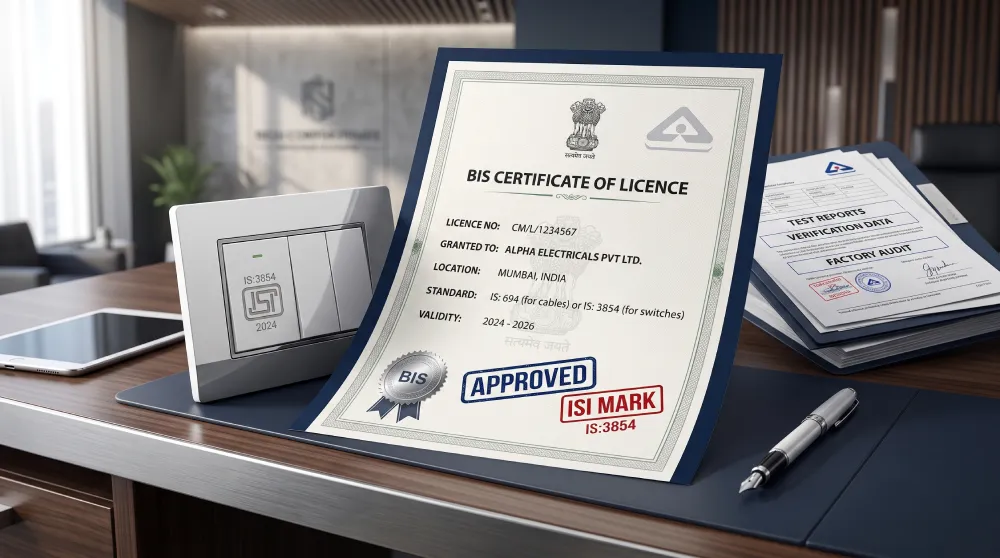
BIS ISI Mark Certification is a product certification scheme administered by the Bureau of Indian Standards (BIS) under Scheme-I of the BIS (Conformity Assessment) Regulations, 2018. It authorizes manufacturers to use the ISI Standard Mark on products that comply with the applicable Indian Standards (IS).
The ISI Mark is one of India’s most recognized quality symbols. It indicates that a product has undergone rigorous evaluation, including factory inspection, product testing, and quality system assessment, and has been found compliant with the relevant Indian Standard.
The Bureau of Indian Standards grants a BIS Licence only after verifying that the manufacturer has the necessary production infrastructure, testing facilities, qualified personnel, and quality control processes to consistently manufacture products meeting the prescribed standards.
For products covered under mandatory Quality Control Orders (QCOs), manufacturers cannot legally produce, distribute, or sell products in the Indian market without obtaining the BIS Licence and using the ISI Mark.
Understanding the Bureau of Indian Standards (BIS)
The Bureau of Indian Standards (BIS) is the National Standards Body of India, functioning under the Ministry of Consumer Affairs, Food and Public Distribution, Government of India. It is responsible for developing Indian Standards, promoting standardization, certifying products, and ensuring that goods available in the market meet established quality and safety benchmarks.
BIS was established under the Bureau of Indian Standards Act, 1986, replacing the former Indian Standards Institution (ISI). The organization now operates under the BIS Act, 2016, which strengthened its regulatory framework and expanded its role in product conformity assessment.
The responsibilities of BIS include:
- Developing Indian Standards (IS)
- Granting Product Certification Licences
- Conducting Factory Inspections
- Performing Product Testing
- Promoting Consumer Safety
- Monitoring Product Quality
- Carrying Out Surveillance Activities
- Enforcing Quality Control Orders
Through these activities, BIS plays a crucial role in maintaining product quality, protecting consumer interests, and supporting industrial development in India.
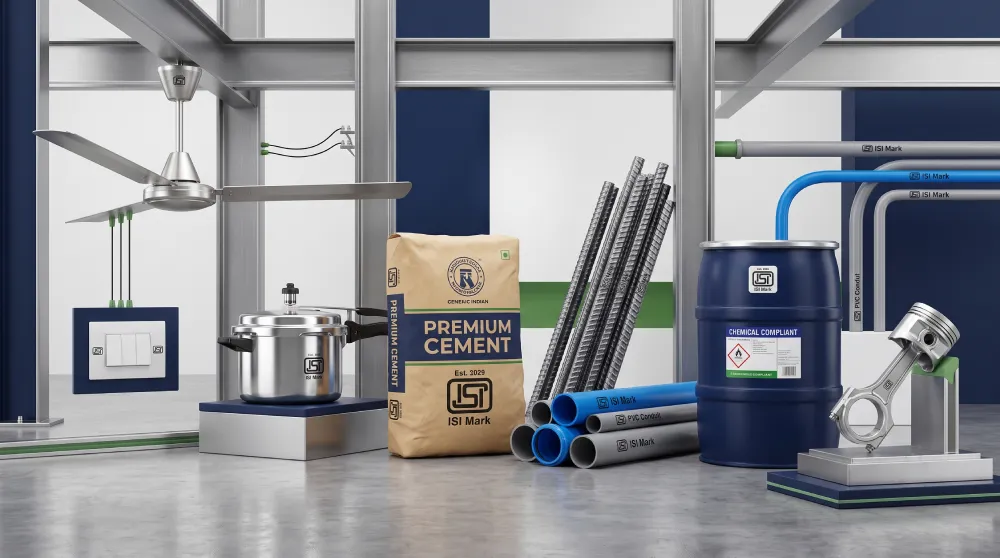
What is the ISI Mark?
The ISI Mark is the official standard mark issued by the Bureau of Indian Standards to manufacturers whose products conform to the applicable Indian Standards.
Originally introduced by the Indian Standards Institution (ISI), the mark has remained a trusted symbol of quality and safety even after the organization was renamed as the Bureau of Indian Standards.
The ISI Mark signifies that:
- The product complies with the relevant Indian Standard.
- The manufacturing facility has been inspected and approved by BIS.
- The product has successfully passed the required laboratory tests.
- The manufacturer follows an approved Scheme of Inspection and Testing (SIT).
- The product is subject to continuous surveillance by BIS.
Consumers, government agencies, institutional buyers, and procurement organizations often prefer ISI-certified products because the mark represents reliability, consistency, and compliance with national quality standards.
Difference Between BIS and ISI Mark
Many manufacturers mistakenly believe that BIS and ISI Mark are the same. Although closely related, they have different meanings.
| Bureau of Indian Standards (BIS) | ISI Mark |
|---|---|
| National Standards Body of India | Product Quality Mark |
| Develops Indian Standards | Indicates conformity with Indian Standards |
| Issues BIS Licences | Displayed on certified products |
| Conducts inspections and testing | Represents compliance and quality assurance |
| Regulates certification schemes | Used only after licence approval |
In simple terms, BIS is the authority, while the ISI Mark is the certification symbol that manufacturers are permitted to use after obtaining a valid BIS Licence.
Why is BIS ISI Mark Certification Important?
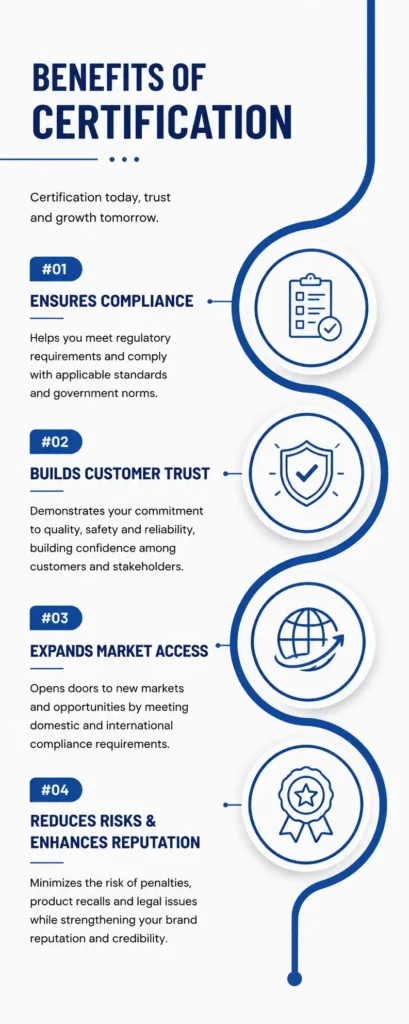
Obtaining a BIS Licence is more than a legal obligation—it is a strategic investment in product quality, customer trust, and long-term business growth. Certification demonstrates a manufacturer’s commitment to maintaining consistent production standards and complying with Indian regulations.
For businesses operating in competitive industries, the ISI Mark serves as a powerful differentiator that enhances credibility and strengthens market acceptance.
Ensures Legal Compliance
Many products are covered under mandatory Quality Control Orders issued by the Government of India. Manufacturers must obtain BIS Certification before these products can be legally manufactured or sold in the Indian market.
Builds Consumer Confidence
Consumers recognize the ISI Mark as a symbol of quality and safety. Products carrying the mark inspire greater confidence and influence purchasing decisions.
Demonstrates Product Quality
BIS certification confirms that products have been manufactured in accordance with established Indian Standards and have successfully passed technical evaluations.
Supports Business Growth
Certified products are often preferred by distributors, institutional buyers, government departments, and large procurement organizations, creating additional business opportunities.
Reduces Compliance Risks
Maintaining compliance with BIS requirements helps manufacturers avoid regulatory penalties, product recalls, and disruptions in business operations.
Enhances Brand Reputation
Displaying the ISI Mark reflects a manufacturer’s commitment to quality, reliability, and regulatory compliance, strengthening brand image in the marketplace.
Is BIS ISI Mark Certification Mandatory?
Whether BIS Certification is mandatory depends on the product category.
The Government of India has notified several products under mandatory Quality Control Orders (QCOs). Manufacturers producing these products must obtain BIS Certification before manufacturing, storing, selling, importing, or distributing them.
For products not covered under mandatory certification, manufacturers may voluntarily apply for BIS Certification to demonstrate product quality and gain a competitive advantage.
Therefore, before starting production or launching a product, manufacturers should verify whether their product falls under the mandatory BIS certification scheme.
At Bharati Global Compliances, we help businesses identify the applicable Indian Standard, determine certification requirements, and prepare the complete compliance roadmap.
Who Needs BIS ISI Mark Certification?
BIS ISI Certification is required by a wide range of manufacturers operating across different industries.
This includes:
- Domestic Manufacturers
- MSMEs
- Large Manufacturing Companies
- Public Sector Enterprises
- Consumer Goods Manufacturers
- Electrical Equipment Manufacturers
- Construction Material Manufacturers
- Automotive Component Manufacturers
- Chemical Manufacturers
- Steel Product Manufacturers
- Household Appliance Manufacturers
If your product is covered under a mandatory Quality Control Order, obtaining BIS Certification is a legal requirement regardless of the size of your business.
Why Choose Bharati Global Compliances?
Navigating the BIS certification process requires technical expertise, careful documentation, and a thorough understanding of regulatory procedures. At Bharati Global Compliances, we simplify the entire process by providing end-to-end consultancy tailored to your product and industry.
Our experts assist with product standard identification, documentation, factory audit readiness, application filing, laboratory coordination, BIS query resolution, and licence approval. We also support manufacturers with licence renewals and ongoing compliance to ensure uninterrupted business operations.
Products Covered Under BIS ISI Certification, Eligibility Criteria & Documents Required
Obtaining a BIS ISI Mark Licence begins with understanding whether your product falls under the mandatory certification scheme and whether your manufacturing facility is prepared to meet the technical and regulatory requirements prescribed by the Bureau of Indian Standards (BIS).
Many manufacturers assume that the certification process starts with submitting an application. However, the success of a BIS application depends largely on the preparation completed before the application is filed. Identifying the correct Indian Standard, establishing proper testing facilities, preparing technical documentation, and ensuring factory readiness are all essential steps that significantly improve the chances of obtaining a BIS Licence without unnecessary delays.
At Bharati Global Compliances, we help manufacturers evaluate their product eligibility, identify applicable Indian Standards, assess factory readiness, and prepare complete documentation to ensure a smooth certification process.
Products Covered Under BIS ISI Certification
The Bureau of Indian Standards has notified hundreds of products under the Product Certification Scheme (Scheme-I). These products must comply with the applicable Indian Standards before they can be manufactured and sold in India.
The Government of India regularly introduces Quality Control Orders (QCOs) to bring additional products under mandatory certification. Therefore, manufacturers should always verify the latest regulatory requirements before commencing production.
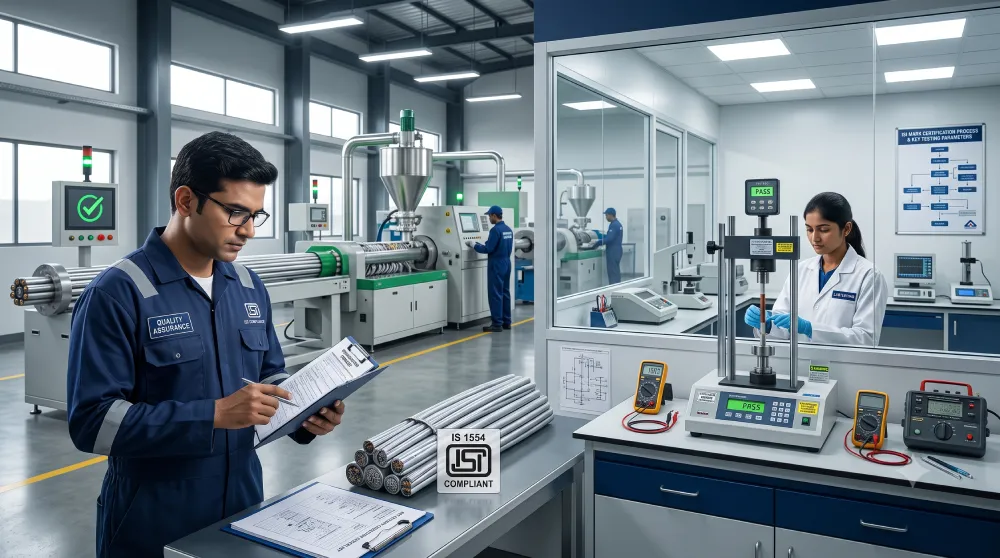
Major Product Categories Covered Under BIS Certification
Electrical Products
A large number of electrical products require mandatory BIS ISI Mark Certification due to their direct impact on consumer safety.
Examples include:
- Electric Irons
- Immersion Water Heaters
- Electric Geysers
- Room Heaters
- Electric Fans
- Switches
- Socket Outlets
- Circuit Breakers
- Distribution Boards
- Electric Motors
Household Appliances
Various household products require BIS certification before being manufactured and sold.
These include:
- Pressure Cookers
- LPG Gas Stoves
- Kitchen Appliances
- Domestic Water Heating Equipment
- Household Utensils
Cement & Construction Materials
Construction products are covered under mandatory certification to ensure structural safety and quality.
Examples include:
- Ordinary Portland Cement
- Portland Pozzolana Cement
- White Cement
- Concrete Products
- Building Materials
- Construction Chemicals
Steel Products
Several steel products are notified under mandatory Quality Control Orders.
Examples include:
- Steel Bars
- Structural Steel
- Steel Pipes
- Stainless Steel Products
- Steel Plates
- Wire Rods
PVC & Plastic Products
Many polymer products require BIS certification.
Examples include:
- UPVC Pipes
- CPVC Pipes
- PVC Fittings
- Agricultural Pipes
- Drainage Pipes
Chemical Products
Numerous industrial chemicals and fertilizers are regulated under BIS certification requirements.
Automotive Components
Several automotive safety components require BIS approval before being supplied to the Indian market.
Footwear & Leather Products
Selected footwear and leather goods are also covered under mandatory BIS certification.
How to Check Whether Your Product Requires BIS Certification?
One of the most common questions manufacturers ask is:
“Is BIS Certification mandatory for my product?”
The answer depends on several factors, including:
- Applicable Indian Standard (IS)
- Product Category
- Government Quality Control Order (QCO)
- Manufacturing Process
- Product End Use
- Relevant Ministry Notification
Some products require:
- BIS ISI Certification
- BIS CRS Registration
- Voluntary BIS Certification
While others may not currently require BIS approval.
To avoid incorrect applications and unnecessary delays, it is advisable to conduct a product eligibility assessment before starting the certification process.
Bharati Global Compliances assists manufacturers in identifying the correct certification scheme applicable to their products.
Eligibility Criteria for BIS ISI Mark Certification
Only manufacturers that satisfy the eligibility requirements prescribed by BIS are granted a licence.
Before submitting an application, manufacturers should ensure that their factory complies with all technical, testing, and quality requirements.
Manufacturing Unit Must Be Located in India
The Domestic ISI Certification Scheme applies only to manufacturing facilities located within India.
Foreign manufacturers are required to obtain certification under the Foreign Manufacturers Certification Scheme (FMCS) instead.
Factory Must Be Operational
The manufacturing unit should be fully operational with complete production infrastructure.
BIS generally does not issue licences to factories that are still under construction or have not commenced commercial production.
Adequate Manufacturing Infrastructure
The factory should possess all machinery required for manufacturing the certified product.
Production equipment should be permanently installed within the factory premises and capable of consistently producing products conforming to the applicable Indian Standard.
Complete Manufacturing Process
Ideally, all manufacturing activities—from raw material inspection to final packing—should be carried out within the same factory.
Where outsourcing is necessary, BIS approval may be required depending on the product category and applicable regulations.
In-House Testing Laboratory
One of the most important requirements under the BIS Product Certification Scheme is the availability of an adequately equipped testing laboratory within the factory.
The laboratory should contain:
- Required testing instruments
- Calibrated equipment
- Qualified laboratory personnel
- Test records
- Standard operating procedures
Routine quality testing should be conducted as specified under the applicable Scheme of Inspection and Testing (SIT).
Qualified Technical Personnel
Manufacturers should employ competent technical staff responsible for:
- Production Supervision
- Quality Assurance
- Laboratory Testing
- Inspection Activities
- Calibration Management
Qualified personnel help maintain product consistency and ensure compliance with BIS requirements.
Quality Management System
Although ISO 9001 certification is not mandatory for every product, manufacturers should establish an effective quality management system covering:
- Incoming Material Inspection
- Production Control
- In-Process Inspection
- Final Product Testing
- Non-Conforming Product Control
- Corrective & Preventive Actions
- Record Maintenance
Compliance with Indian Standards
Every product should fully comply with the applicable Indian Standard before the BIS application is submitted.
Manufacturers should verify product conformity through internal testing and quality evaluation before applying.
Basic Requirements for Obtaining a BIS Licence
Before granting a licence, BIS evaluates whether the manufacturing facility satisfies several basic requirements.
These include:
- Manufacturing facility located in India
- Operational production line
- Complete manufacturing machinery
- In-house testing laboratory
- Calibrated testing equipment
- Qualified technical staff
- Product conformity with Indian Standards
- Proper quality control procedures
- Factory inspection readiness
- Availability of technical documentation
Meeting these requirements significantly improves the likelihood of obtaining timely certification.
Documents Required for BIS ISI Mark Certification
Documentation is one of the most important stages of the certification process.
The Bureau of Indian Standards carefully verifies every document submitted with the application. Incorrect or incomplete documentation often leads to delays, technical queries, or rejection.
Company Documents
Manufacturers should prepare:
- Certificate of Incorporation
- GST Registration
- Factory Licence
- Udyam Registration (if applicable)
- Company PAN
- Organization Details
Factory Documents
These documents establish the manufacturing capabilities of the applicant.
Examples include:
- Factory Layout
- Manufacturing Process Flow Chart
- Machinery List
- Production Capacity Details
- Factory Address Proof
Product Documents
Manufacturers should submit complete technical details relating to the product.
These generally include:
- Product Specification
- Product Drawings
- Product Catalogue
- Technical Datasheet
- Bill of Materials (where applicable)
Quality Control Documents
BIS evaluates the manufacturer’s quality management procedures.
Typical documents include:
- Quality Manual
- Inspection Procedures
- Internal Testing Procedures
- Calibration Certificates
- Quality Records
- Test Registers
Laboratory Documents
The in-house laboratory should be properly documented.
Required information generally includes:
- Laboratory Layout
- Equipment List
- Calibration Certificates
- Testing Procedures
- Equipment Photographs
Test Reports
Depending upon the product category, manufacturers may be required to submit laboratory test reports prepared in accordance with the applicable Indian Standard.
Authorized Signatory Documents
The applicant should also provide:
- Authorization Letter
- Identity Proof
- Address Proof
- Signature Specimen
- Contact Details
Why Proper Documentation Matters
Many BIS applications are delayed not because the product fails technical requirements but because the documentation submitted is incomplete, inconsistent, or does not accurately represent the manufacturing process.
Preparing documents in accordance with BIS guidelines helps:
- Reduce technical queries.
- Improve application processing.
- Minimize delays.
- Ensure faster inspections.
- Increase the likelihood of licence approval.
At Bharati Global Compliances, our experts review every document before submission to ensure it meets BIS requirements and aligns with the applicable Indian Standard.
How Bharati Global Compliances Can Help
Our consultancy team provides complete assistance in assessing product eligibility, identifying the correct Indian Standard, preparing documentation, evaluating factory readiness, establishing testing requirements, and filing BIS applications. We work closely with manufacturers to simplify the certification process and reduce avoidable delays through expert regulatory guidance.
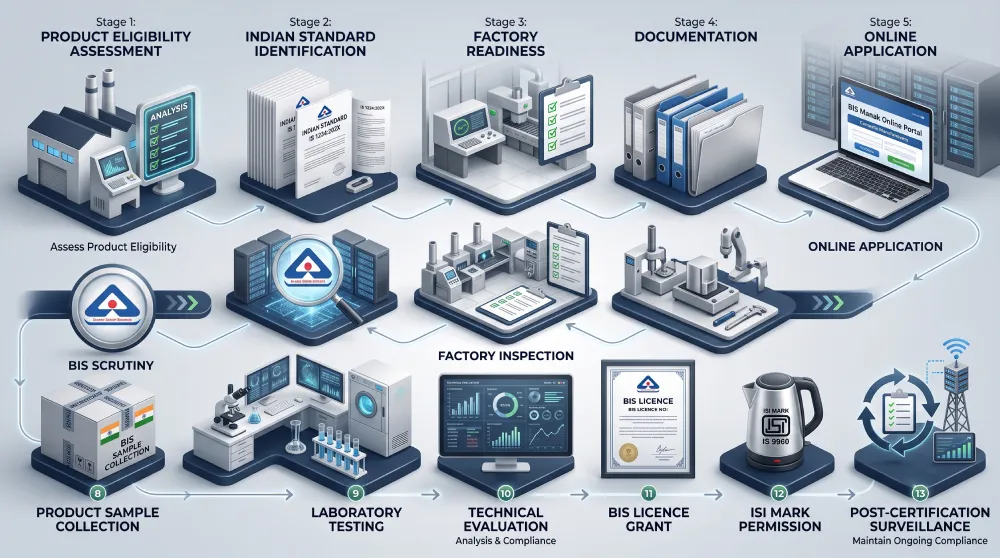
Complete BIS ISI Mark Certification Process for Domestic Manufacturers
Obtaining a BIS ISI Mark Licence involves much more than submitting an application. The Bureau of Indian Standards (BIS) follows a structured conformity assessment process to evaluate whether a manufacturing unit has the infrastructure, technical capabilities, quality management system, and testing facilities required to consistently produce products that comply with the applicable Indian Standard (IS).
Every application undergoes detailed scrutiny before a licence is granted. BIS verifies the manufacturer’s production process, factory infrastructure, laboratory facilities, quality control procedures, and product performance through inspections and testing.
For domestic manufacturers, understanding each stage of the certification process helps avoid delays, reduce compliance risks, and improve the chances of obtaining the BIS Licence successfully.
At Bharati Global Compliances, we guide manufacturers through every stage of the certification process—from identifying the applicable Indian Standard to obtaining the BIS Licence and maintaining ongoing compliance.
Step-by-Step BIS ISI Certification Process
Although the exact process may vary depending on the product category and applicable Indian Standard, the BIS ISI Certification process generally includes the following stages:
- Product Eligibility Assessment
- Identification of Applicable Indian Standard (IS)
- Factory Readiness Assessment
- Documentation Preparation
- Online Application Submission
- Application Scrutiny by BIS
- Factory Inspection by BIS Officer
- Product Sample Collection
- Laboratory Testing
- Technical Evaluation
- Grant of BIS Licence
- Permission to Use the ISI Mark
- Post-Certification Surveillance
Each stage is equally important and contributes to the final approval of the BIS Licence.
Step 1: Product Eligibility Assessment
Before initiating the application, manufacturers should verify whether their product falls under the mandatory BIS Product Certification Scheme.
This assessment includes:
- Identifying the product category.
- Verifying the applicable Quality Control Order (QCO).
- Determining whether BIS Certification is mandatory or voluntary.
- Identifying the relevant Indian Standard (IS Code).
- Understanding product-specific testing requirements.
Starting with the correct product classification helps avoid unnecessary delays and ensures that the application is submitted under the appropriate certification scheme.
Step 2: Identification of the Applicable Indian Standard (IS)
Every product certified under the BIS Product Certification Scheme must conform to a specific Indian Standard.
The applicable IS Standard defines:
- Product specifications
- Safety requirements
- Performance criteria
- Sampling procedures
- Testing methods
- Marking requirements
- Quality control requirements
Selecting the wrong IS Standard can lead to technical objections or rejection of the application. Therefore, manufacturers should carefully verify the correct standard before proceeding.
Step 3: Factory Readiness Assessment
Before filing the application, manufacturers should ensure that the factory is fully prepared for BIS inspection.
This includes reviewing:
- Manufacturing machinery
- Production process
- Factory layout
- Laboratory infrastructure
- Testing equipment
- Calibration records
- Technical manpower
- Quality management procedures
A factory readiness assessment helps identify compliance gaps and provides sufficient time to implement corrective actions before the BIS inspection.
Step 4: Documentation Preparation
Documentation forms the foundation of the BIS certification process.
Manufacturers should prepare comprehensive technical and regulatory documents, including:
Company Documents
- Certificate of Incorporation
- GST Registration
- Factory Licence
- Company PAN
- Udyam Registration (if applicable)
Factory Documents
- Factory Layout
- Manufacturing Process Flow Chart
- Machinery Details
- Production Capacity
- Factory Address Proof
Product Documents
- Product Specifications
- Product Drawings
- Technical Datasheets
- Product Catalogue
- Bill of Materials (where applicable)
Quality Documents
- Quality Manual
- Inspection Procedures
- Standard Operating Procedures
- Calibration Records
- Test Reports
Proper documentation significantly improves the efficiency of the application review process.
Step 5: Online BIS Application Submission
After preparing all required documents, the manufacturer submits the BIS application through the prescribed BIS online portal.
The application generally includes:
- Manufacturer details
- Factory information
- Product details
- Applicable Indian Standard
- Technical documentation
- Laboratory details
- Required declarations
- Prescribed application fee
Before final submission, every document should be carefully reviewed to ensure consistency and accuracy.
Step 6: Scrutiny of Application by BIS
Once the application is received, BIS conducts a detailed review of the submitted information.
The authority verifies:
- Product category
- Applicable IS Standard
- Manufacturing capability
- Laboratory facilities
- Documentation completeness
- Quality management procedures
If any information is incomplete or inconsistent, BIS may raise technical queries requesting clarification or additional documents.
Timely responses help avoid unnecessary delays in processing the application.
Step 7: Factory Inspection by BIS
One of the most important stages of the certification process is the factory inspection conducted by a BIS officer.
The objective of the inspection is to verify whether the manufacturing facility has the capability to consistently produce products conforming to the applicable Indian Standard.
The inspection is not limited to product quality alone; it also evaluates the manufacturer’s production controls and quality assurance system.
What Does BIS Inspect?
Manufacturing Infrastructure
The BIS officer examines whether the factory has adequate production machinery and equipment required to manufacture the certified product.
Production Process
The complete production process is reviewed to verify that manufacturing is carried out in a systematic and controlled manner.
This includes:
- Raw material inspection
- Production activities
- Assembly operations
- Packaging
- Final inspection
Quality Management System
The officer evaluates the effectiveness of the manufacturer’s quality control procedures.
This includes reviewing:
- Incoming material inspection
- In-process quality checks
- Final product inspection
- Non-conforming product handling
- Record maintenance
Laboratory Facilities
The in-house laboratory is carefully inspected.
BIS verifies:
- Availability of required testing equipment
- Calibration certificates
- Laboratory environment
- Test procedures
- Laboratory personnel competency
The laboratory should be capable of conducting routine quality tests prescribed under the applicable Indian Standard.
Technical Personnel
BIS also evaluates the competency of production engineers, laboratory technicians, and quality control personnel responsible for maintaining product quality.
Step 8: Product Sample Collection
During the factory inspection, BIS officers collect product samples directly from the production line or finished goods inventory.
The samples are:
- Randomly selected
- Properly sealed
- Officially documented
- Sent to a BIS-recognized laboratory
Random sampling ensures that the tested products accurately represent normal production.
Step 9: Laboratory Testing
The collected product samples undergo detailed laboratory testing according to the applicable Indian Standard.
Testing may include evaluation of:
- Product dimensions
- Safety parameters
- Mechanical strength
- Electrical performance
- Chemical composition
- Material quality
- Functional performance
Every product category has specific testing requirements defined in its respective Indian Standard.
Only products that successfully meet all prescribed parameters proceed to the next stage.
Step 10: Technical Evaluation by BIS
After receiving the laboratory test reports, BIS conducts a comprehensive technical evaluation.
The authority reviews:
- Factory inspection observations
- Product test reports
- Manufacturing capability
- Quality control system
- Compliance with Indian Standards
- Technical documentation
If any non-conformities are identified, manufacturers may be asked to implement corrective actions before further processing.
Step 11: Grant of BIS Licence
When BIS is satisfied that:
- The manufacturing unit complies with applicable requirements.
- Product samples meet Indian Standards.
- Factory infrastructure is adequate.
- Testing facilities are satisfactory.
- Documentation is complete.
The Bureau grants the BIS ISI Mark Licence.
The licence authorizes the manufacturer to use the ISI Mark on certified products manufactured at the approved factory.
Step 12: Permission to Use the ISI Mark
Once the licence is granted, the manufacturer is authorized to display the ISI Standard Mark on certified products.
However, the ISI Mark may only be used:
- On products covered under the licence.
- At the approved manufacturing facility.
- In accordance with BIS marking guidelines.
- While maintaining continuous compliance with Indian Standards.
Any misuse of the ISI Mark may result in regulatory action, suspension, or cancellation of the licence.
Normal Procedure vs Simplified Procedure
BIS allows manufacturers to apply through two different certification routes, depending on the readiness of the product and availability of test reports.
Normal Procedure
Under the Normal Procedure:
- Application is submitted to BIS.
- Factory inspection is conducted.
- Product samples are collected during inspection.
- Samples are tested in a BIS-recognized laboratory.
- BIS reviews the inspection and test reports.
- Licence is granted upon successful compliance.
This route is generally followed when the manufacturer has not obtained pre-tested product reports.
Simplified Procedure
The Simplified Procedure is designed to reduce processing time for eligible applicants.
Under this procedure:
- Product samples are tested in advance at a BIS-recognized laboratory.
- The manufacturer submits the test reports along with the application.
- BIS conducts the factory inspection.
- Documentation and test reports are reviewed together.
- If all requirements are satisfied, the licence is issued in a shorter timeframe.
This procedure is often preferred by manufacturers who have already completed product testing and wish to accelerate the certification process.
How Bharati Global Compliances Simplifies the Process
The BIS certification process involves multiple technical, administrative, and regulatory stages. Even minor errors in documentation, testing, or factory preparation can result in delays or repeated observations.
Bharati Global Compliances provides complete support throughout the certification journey, including product eligibility assessment, Indian Standard identification, documentation preparation, application filing, factory audit readiness, laboratory coordination, technical query resolution, and licence approval. Our experts ensure that manufacturers are fully prepared before every stage of the BIS evaluation process.
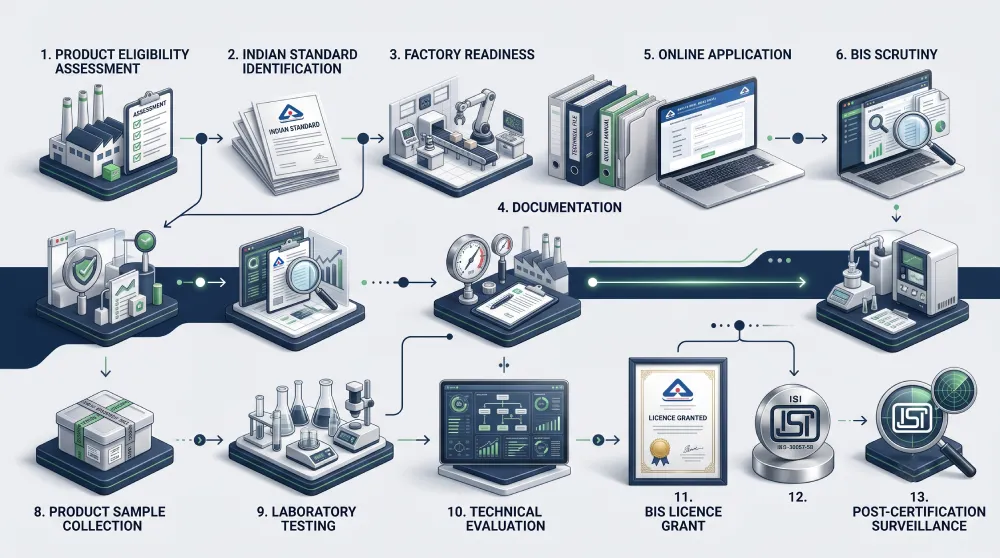
BIS ISI Certification Timeline, Fees, Licence Validity, Renewal & Post-Certification Compliance
Obtaining a BIS ISI Mark Licence is only the beginning of your compliance journey. After the licence is granted, manufacturers must continue to comply with the applicable Indian Standards, maintain their quality management system, conduct regular product testing, and follow the Scheme of Inspection and Testing (SIT) prescribed by the Bureau of Indian Standards (BIS).
Maintaining compliance is essential because BIS conducts periodic surveillance inspections to ensure that certified products consistently meet the required quality and safety standards. Failure to comply with licence conditions may result in suspension or cancellation of the licence, affecting business operations and market access.
At Bharati Global Compliances, we provide continuous support not only for obtaining the BIS Licence but also for renewal, surveillance preparation, documentation updates, and post-certification compliance.
BIS ISI Certification Timeline
One of the first questions manufacturers ask is:
“How long does it take to obtain a BIS ISI Licence?”
The timeline varies depending on the product category, complexity of the applicable Indian Standard, readiness of the manufacturing facility, availability of laboratory testing, and the completeness of the application.
For most products, the certification process generally takes 30 to 90 working days, provided all documents are complete, the factory is fully prepared, and the product successfully passes laboratory testing.
However, applications involving complex products or additional technical clarifications may require additional time.
Typical BIS Certification Timeline
| Stage | Estimated Duration |
|---|---|
| Product Eligibility Assessment | 1–3 Days |
| Identification of Indian Standard | 1–2 Days |
| Documentation Preparation | 1–2 Weeks |
| Online Application Submission | 1 Day |
| BIS Application Scrutiny | 7–10 Days |
| Factory Inspection | 1–3 Days |
| Product Sample Testing | 2–4 Weeks |
| Technical Evaluation | 1–2 Weeks |
| Grant of BIS Licence | 5–10 Days |
Estimated Overall Timeline
Approximately 30–90 Working Days
(The actual timeline depends on product category, laboratory testing, BIS workload, and timely responses to technical queries.)
Factors Affecting BIS Certification Timeline
Several factors influence the overall processing time of a BIS ISI Certification application.
These include:
- Incorrect product classification
- Selection of the wrong Indian Standard
- Incomplete documentation
- Factory not ready for inspection
- Calibration certificates not available
- Product failing laboratory testing
- Delay in responding to BIS queries
- Changes in manufacturing process
- Additional information requested by BIS
Manufacturers who prepare thoroughly before applying generally experience faster approvals and fewer compliance issues.
BIS ISI Certification Fees
Unlike many business registrations, there is no single fixed cost applicable to all BIS Certification applications.
The total cost depends on several factors such as the product category, number of products, applicable Indian Standard, laboratory testing requirements, inspection activities, and professional consultancy services.
Manufacturers should plan their certification budget by considering both government charges and project-related expenses.
Cost Factors for BIS Certification
Government Application Fee
BIS charges prescribed fees for processing certification applications.
Factory Inspection Charges
Inspection charges may vary depending on the scope of certification, product category, and duration of the factory assessment.
Product Testing Charges
Testing charges depend on:
- Applicable Indian Standard
- Number of tests
- Product complexity
- Laboratory selected
- Sample quantity
Annual Licence Fee
After obtaining the BIS Licence, manufacturers are required to pay the applicable annual licence fee as prescribed by BIS.
Marking Fee
Manufacturers using the ISI Standard Mark are also required to pay the applicable marking fee based on BIS guidelines.
Consultancy Charges
Many businesses engage professional consultants to manage documentation, application filing, factory preparation, and BIS coordination.
Professional consultancy often reduces certification delays and prevents costly mistakes during the application process.
Validity of BIS ISI Licence
Once granted, the BIS Licence remains valid for the period specified by the Bureau of Indian Standards, subject to continuous compliance with all licence conditions.
During the validity period, manufacturers must:
- Continue manufacturing products according to the applicable Indian Standard.
- Maintain approved manufacturing facilities.
- Conduct routine product testing.
- Preserve production and testing records.
- Follow the approved Scheme of Inspection and Testing (SIT).
- Cooperate with BIS surveillance inspections.
Any significant changes in manufacturing processes, machinery, factory location, or product design should be reported to BIS before implementation.
Renewal of BIS ISI Licence
Manufacturers intending to continue producing certified products after the expiry of their existing licence must apply for renewal within the prescribed timeline.
Timely renewal helps avoid interruptions in production, product sales, and regulatory compliance.
BIS Licence Renewal Process
The renewal process generally includes:
Step 1 – Review Existing Licence
Verify the validity period, scope of certification, and compliance status.
Step 2 – Update Documentation
Prepare updated records related to production, testing, quality control, and calibration.
Step 3 – Submit Renewal Application
Submit the renewal application with the prescribed documents and applicable fees.
Step 4 – BIS Review
BIS evaluates the manufacturer’s compliance history, surveillance records, production details, and licence conditions.
Step 5 – Licence Renewal
If the manufacturer continues to satisfy all applicable requirements, BIS renews the licence for the prescribed period.
Scheme of Inspection and Testing (SIT)
One of the most important obligations after obtaining a BIS Licence is compliance with the Scheme of Inspection and Testing (SIT).
The SIT defines the quality control procedures that manufacturers must follow during routine production.
It specifies:
- Raw material inspection
- In-process inspection
- Routine product testing
- Frequency of testing
- Acceptance criteria
- Record maintenance
- Sampling procedures
- Corrective actions
Manufacturers are required to maintain complete records of all inspections and tests conducted under the SIT.
Surveillance Inspection by BIS
To ensure continuous compliance, BIS conducts periodic surveillance inspections at licensed manufacturing facilities.
These inspections verify that manufacturers continue to produce products in accordance with the applicable Indian Standard and maintain the quality systems approved during certification.
Objectives of Surveillance Inspection
The primary objectives are to:
- Verify continued product conformity.
- Review manufacturing processes.
- Examine quality control systems.
- Inspect laboratory facilities.
- Check calibration of testing equipment.
- Review production and testing records.
- Collect product samples for independent testing.
Market Sample Testing
Apart from factory inspections, BIS may also collect product samples directly from the market.
These samples are tested independently to verify whether products available to consumers continue to comply with Indian Standards.
Consistent compliance helps maintain the credibility of the ISI Mark and protects consumer interests.
Responsibilities of the Licence Holder
Every BIS licence holder is responsible for maintaining compliance throughout the licence period.
Manufacturers should:
- Maintain consistent product quality.
- Conduct routine quality testing.
- Keep calibration certificates updated.
- Maintain production and inspection records.
- Use the ISI Mark only on certified products.
- Inform BIS of any significant manufacturing changes.
- Cooperate during surveillance inspections.
Proper compliance management helps ensure uninterrupted certification.
Suspension or Cancellation of BIS Licence
The Bureau of Indian Standards may suspend or cancel a licence if the manufacturer fails to comply with the provisions of the BIS Act, applicable regulations, or licence conditions.
Common Reasons for Suspension
A licence may be suspended due to:
- Failure to maintain product quality.
- Non-conforming laboratory test results.
- Misuse of the ISI Mark.
- Inadequate quality control procedures.
- Failure to conduct routine testing.
- Non-cooperation during surveillance.
- Submission of false information.
- Non-payment of applicable BIS fees.
Suspension may continue until the manufacturer satisfactorily resolves the identified non-conformities.
Common Reasons for BIS Application Rejection
Many applications are delayed or rejected due to avoidable mistakes made during preparation.
Common reasons include:
- Incorrect Indian Standard selection.
- Incomplete documentation.
- Missing factory records.
- Inadequate laboratory facilities.
- Expired calibration certificates.
- Unqualified laboratory personnel.
- Product failing laboratory tests.
- Inconsistent manufacturing process.
- Delay in responding to BIS observations.
- Factory not ready for inspection.
Careful planning and professional guidance significantly reduce the likelihood of rejection.
Best Practices for Faster BIS Approval
Manufacturers can improve their chances of timely certification by following these best practices:
- Verify product eligibility before applying.
- Identify the correct Indian Standard.
- Establish a fully equipped testing laboratory.
- Calibrate all testing equipment.
- Train production and quality control staff.
- Prepare complete documentation.
- Conduct internal quality audits.
- Perform trial testing before BIS inspection.
- Respond promptly to BIS queries.
- Engage experienced BIS consultants.
Following these practices minimizes delays and enhances the overall certification experience.
How Bharati Global Compliances Supports You After Certification
At Bharati Global Compliances, our commitment extends beyond obtaining your BIS Licence. We provide comprehensive post-certification support, including licence renewal, surveillance inspection readiness, Scheme of Inspection and Testing (SIT) implementation, compliance audits, documentation updates, product scope extension, and regulatory advisory services. Our experts help manufacturers maintain continuous compliance, reduce operational risks, and ensure uninterrupted use of the ISI Mark.
Why Choose Bharati Global Compliances, Our BIS ISI Certification Services, & Get Started Today
Obtaining a BIS ISI Mark Licence is a crucial milestone for manufacturers seeking to establish credibility, ensure regulatory compliance, and expand their business in the Indian market. However, navigating the certification process requires a thorough understanding of BIS regulations, applicable Indian Standards, documentation requirements, factory inspections, and ongoing compliance obligations.
A well-planned certification strategy not only reduces approval timelines but also minimizes the risk of application rejection and costly delays. This is where an experienced BIS consultancy can make a significant difference.
At Bharati Global Compliances, we help manufacturers across India simplify the entire BIS ISI certification journey with expert guidance, technical support, and end-to-end project management.
Why Choose Bharati Global Compliances?
Bharati Global Compliances is a trusted compliance consultancy providing professional BIS certification services for manufacturers across India. Our team understands the complexities of BIS regulations and works closely with clients to ensure a smooth and efficient certification process.
Whether you are applying for your first BIS Licence or renewing an existing one, we provide practical solutions tailored to your product category and manufacturing operations.
Expert BIS Consultants
Our experienced consultants possess in-depth knowledge of:
- Bureau of Indian Standards (BIS)
- Product Certification Scheme (Scheme-I)
- Indian Standards (IS)
- Quality Control Orders (QCOs)
- Factory Inspection Requirements
- Product Testing Procedures
- Licence Renewal Process
We stay updated with the latest BIS notifications and regulatory changes to provide accurate and reliable guidance.
End-to-End BIS Certification Support
We manage every stage of the certification process, including:
- Product Eligibility Assessment
- Identification of Applicable Indian Standard
- Documentation Preparation
- Online Application Filing
- Factory Audit Preparation
- Product Testing Coordination
- BIS Query Resolution
- Licence Approval Assistance
- Renewal & Compliance Support
With our structured approach, manufacturers can focus on production while we handle the regulatory process.
Dedicated Project Manager
Every project is assigned to a dedicated compliance specialist who serves as a single point of contact throughout the certification process.
This ensures:
- Faster communication
- Timely updates
- Better coordination
- Efficient document management
- Prompt resolution of queries
Faster Documentation Support
One of the most common reasons for delays in BIS applications is incomplete or incorrect documentation.
Our experts prepare and review all required documents before submission, helping manufacturers reduce technical observations and improve approval timelines.
Factory Inspection Preparation
We help manufacturers prepare for the BIS factory inspection by reviewing:
- Manufacturing infrastructure
- Testing laboratory
- Quality management system
- Technical documentation
- Production process
- Scheme of Inspection and Testing (SIT)
Proper preparation significantly improves inspection readiness and reduces non-conformities.
Post-Certification Compliance
Our services continue even after the licence is granted.
We assist clients with:
- Licence Renewal
- Surveillance Inspection Support
- Product Scope Extension
- Additional Product Certification
- Ongoing Regulatory Compliance
- BIS Advisory Services
Our objective is to help manufacturers maintain uninterrupted compliance throughout the licence validity period.
Our BIS ISI Certification Services
At Bharati Global Compliances, we offer a complete range of BIS certification solutions for manufacturers operating in diverse industries.
Our services include:
BIS ISI Mark Certification
Complete consultancy for obtaining BIS Licences under the Product Certification Scheme.
Product Eligibility Assessment
Identification of whether your product falls under mandatory BIS certification requirements.
Indian Standard Identification
Selection of the correct Indian Standard (IS Code) applicable to your product.
Documentation Preparation
Preparation and verification of all documents required by BIS.
Factory Readiness Assessment
Evaluation of manufacturing facilities before the BIS inspection.
Product Testing Coordination
Assistance with testing through BIS-recognized laboratories.
BIS Application Filing
Preparation and submission of the online BIS application.
BIS Query Management
Professional support in responding to observations raised by BIS officers.
Licence Renewal
Complete assistance with renewal applications before licence expiry.
Ongoing Compliance Services
Support for surveillance inspections, documentation updates, and regulatory compliance.
Industries We Serve
We provide BIS certification consultancy across a wide range of industries, including:
Electrical & Electronics
- Electrical Appliances
- Switches
- Cables
- Circuit Breakers
- Electric Motors
- Distribution Equipment
Construction Materials
- Cement
- Steel Products
- Pipes
- Building Materials
- Construction Chemicals
Consumer Products
- Pressure Cookers
- LPG Gas Stoves
- Kitchen Appliances
- Household Equipment
Chemical Industry
- Industrial Chemicals
- Fertilizers
- Specialty Chemicals
- Chemical Products
Automotive Industry
- Automotive Components
- Vehicle Safety Parts
- Engineering Products
Plastic & Polymer Industry
- PVC Pipes
- CPVC Pipes
- Plastic Fittings
- Polymer Products
Engineering Industry
- Industrial Machinery
- Mechanical Components
- Valves
- Engineering Equipment
Frequently Asked Questions (FAQs)
What is BIS ISI Mark Certification?
BIS ISI Mark Certification is a product certification scheme under which the Bureau of Indian Standards grants manufacturers permission to use the ISI Mark on products that comply with the applicable Indian Standards.
Is BIS Certification mandatory?
Yes. For products covered under mandatory Quality Control Orders (QCOs), BIS Certification is legally required before manufacturing or selling them in India.
Who can apply for BIS Certification?
Any manufacturer with a production facility in India manufacturing products covered under the BIS Product Certification Scheme can apply.
How long does BIS Certification take?
The certification process generally takes 30 to 90 working days, depending on the product category, documentation, testing requirements, and BIS processing.
Is factory inspection mandatory?
Yes. BIS conducts a factory inspection to verify the manufacturing process, testing facilities, quality control system, and production capabilities.
Is product testing compulsory?
Yes. Product samples are tested as per the applicable Indian Standard before the licence is granted.
Can one licence cover multiple factories?
No. A separate BIS Licence is generally required for each manufacturing unit.
What is the validity of a BIS Licence?
The licence remains valid for the period prescribed by BIS, subject to continuous compliance with all applicable licence conditions.
Can the BIS Licence be renewed?
Yes. Manufacturers must apply for renewal before the expiry of the existing licence to continue using the ISI Mark.
What happens if my product fails laboratory testing?
If the product does not comply with the applicable Indian Standard, corrective actions may be required before the certification process can proceed.
Can BIS suspend a licence?
Yes. BIS may suspend or cancel a licence if the manufacturer fails to comply with licence conditions or applicable regulations.
Why should I hire a BIS consultant?
An experienced consultant helps streamline the certification process, minimize documentation errors, prepare for inspections, and improve the chances of timely licence approval.
Does Bharati Global Compliances provide PAN India services?
Yes. We assist manufacturers across India with complete BIS ISI Certification consultancy and ongoing compliance support.
Do you assist with BIS Licence renewal?
Yes. We provide end-to-end support for licence renewal, surveillance inspections, and post-certification compliance.
Can you help identify whether my product requires BIS Certification?
Absolutely. Our experts conduct a detailed product eligibility assessment and identify the applicable Indian Standard and certification requirements.
Ready to Obtain Your BIS ISI Mark Licence?
If your product falls under the mandatory BIS certification scheme, obtaining the BIS ISI Mark Licence is essential for legal compliance, market access, and customer confidence. Delaying certification can result in regulatory challenges, interruptions in product sales, and missed business opportunities.
With Bharati Global Compliances, you gain a trusted compliance partner dedicated to simplifying the certification process. From the initial eligibility assessment to licence approval and ongoing compliance, our experienced consultants provide practical guidance tailored to your manufacturing operations.
Whether you are an MSME, a growing manufacturer, or a large enterprise, we are committed to helping you achieve BIS certification efficiently and confidently.
Conclusion
BIS ISI Mark Certification is more than a regulatory requirement—it is a symbol of quality, safety, and trust. By obtaining a BIS Licence, manufacturers demonstrate their commitment to meeting Indian Standards while strengthening their brand reputation and expanding business opportunities.
With the right guidance, the certification process can be efficient and hassle-free. Bharati Global Compliances offers comprehensive consultancy services to help manufacturers achieve and maintain BIS compliance with confidence. From documentation and factory inspections to licence approval and renewal, our experts are here to support your business at every stage of the certification journey.