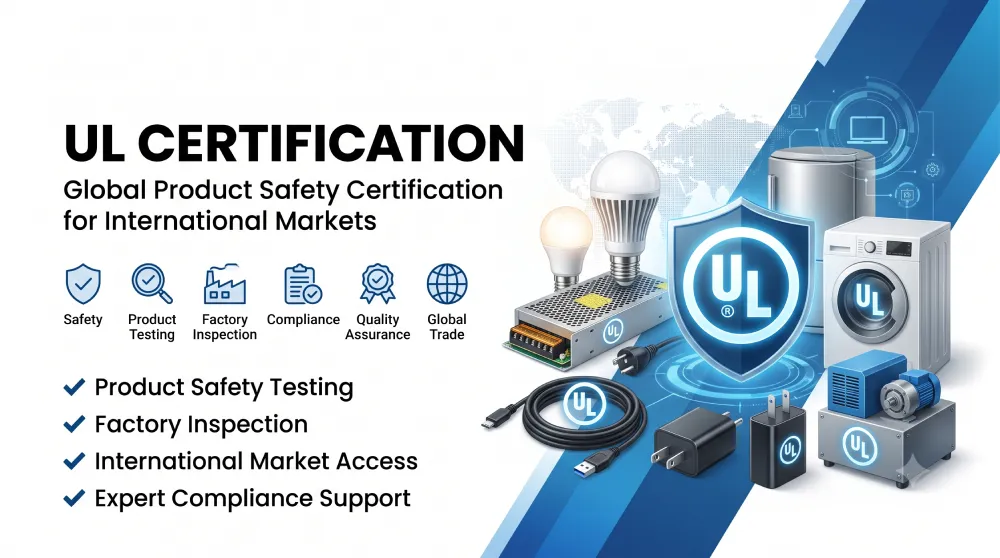
As global markets continue to demand safer and more reliable products, UL Certification has become one of the most recognized product safety certifications worldwide. Manufacturers seeking to build customer confidence and expand into international markets often choose UL Certification to demonstrate that their products meet rigorous safety and performance standards.
UL stands for Underwriters Laboratories, an independent, globally recognized safety science organization established in 1894. For more than a century, UL has been helping manufacturers evaluate, test, inspect, and certify products for compliance with internationally accepted safety requirements.
The UL Mark indicates that a product has been tested by UL and found to comply with applicable safety standards. It provides assurance to consumers, retailers, distributors, insurers, and regulatory authorities that the product has undergone comprehensive safety evaluation.
Today, billions of products bearing the UL Mark are sold worldwide across industries such as electrical equipment, electronics, lighting, industrial machinery, medical devices, consumer appliances, information technology equipment, and renewable energy products.
At Bharati Global Compliances, we provide complete assistance for UL Certification, including product evaluation, documentation, testing coordination, factory inspection support, and end-to-end compliance guidance to help manufacturers successfully obtain UL approval.
What is UL Certification?
UL Certification is an independent third-party product safety certification issued by Underwriters Laboratories (UL) after verifying that a product complies with applicable safety standards.
The certification confirms that the product has successfully passed laboratory testing, technical evaluation, and manufacturing assessments in accordance with UL’s safety requirements.
Unlike mandatory government certifications, UL Certification is primarily a voluntary certification in many countries. However, it is highly valued by manufacturers, retailers, importers, insurance companies, and consumers because it demonstrates a strong commitment to product safety and quality.
Once certified, manufacturers are authorized to display the UL Mark on their products, packaging, and related documentation, indicating compliance with recognized safety standards.
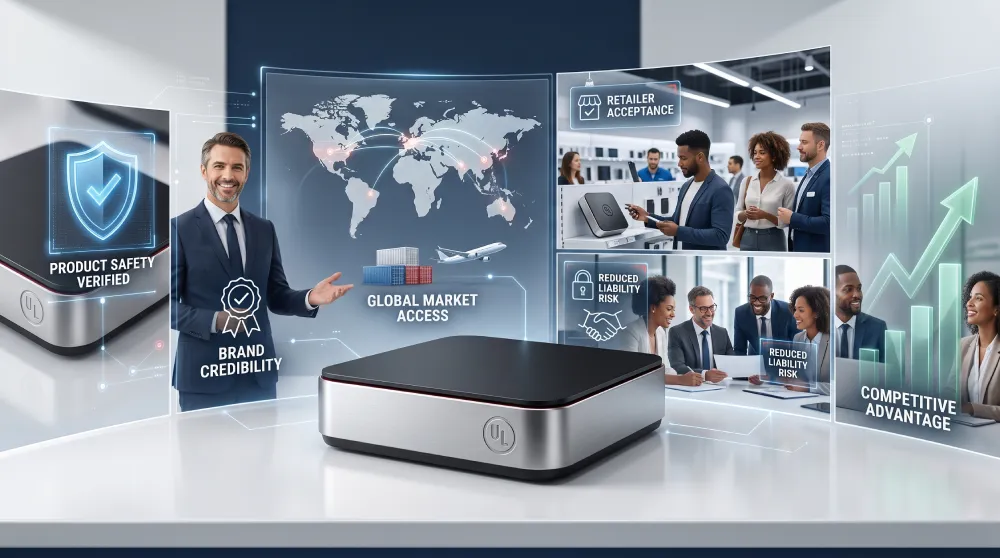
Why is UL Certification Important?
Obtaining UL Certification offers several business and commercial advantages, including:
- Demonstrates compliance with internationally recognized safety standards
- Enhances customer confidence and brand reputation
- Improves product acceptance in global markets
- Supports easier entry into North American and international markets
- Reduces product liability risks
- Helps meet retailer and buyer requirements
- Confirms product reliability and safety
- Strengthens competitive advantage
- Facilitates smoother regulatory approvals where applicable
- Builds trust among distributors, importers, and end users
Products Eligible for UL Certification
UL Certification is available for a wide range of products across multiple industries.
Some commonly certified product categories include:
- Electrical Equipment
- Consumer Electronics
- Information Technology Equipment
- Home Appliances
- LED Lighting Products
- Industrial Machinery
- Power Supplies
- Medical Devices
- Laboratory Equipment
- Fire Protection Equipment
- Batteries and Energy Storage Systems
- Renewable Energy Products
- HVAC Equipment
- Electrical Cables and Connectors
- Automotive Components
- Smart Home Devices
- Telecom Equipment
- Commercial Equipment
- Industrial Control Panels
These products undergo testing against applicable UL safety standards before certification is granted.
Documents Required for UL Certification
Manufacturers applying for UL Certification must submit technical and business documents that enable UL engineers to evaluate the product’s safety, construction, and compliance with applicable standards.
The documents required may vary depending on the product category. However, the following documents are commonly required:
- Product Description and Technical Specifications
- Product Datasheet
- Product Design Drawings
- Bill of Materials (BOM)
- Circuit Diagram (for electrical and electronic products)
- User Manual
- Product Labels and Markings
- Manufacturing Process Details
- Risk Assessment Report (if applicable)
- Existing Test Reports (if available)
- Quality Management Documents
- Company Registration Certificate
- Factory Address Details
- Authorization Letter (if applicable)
Providing complete and accurate documentation helps reduce certification delays and ensures a smoother evaluation process.
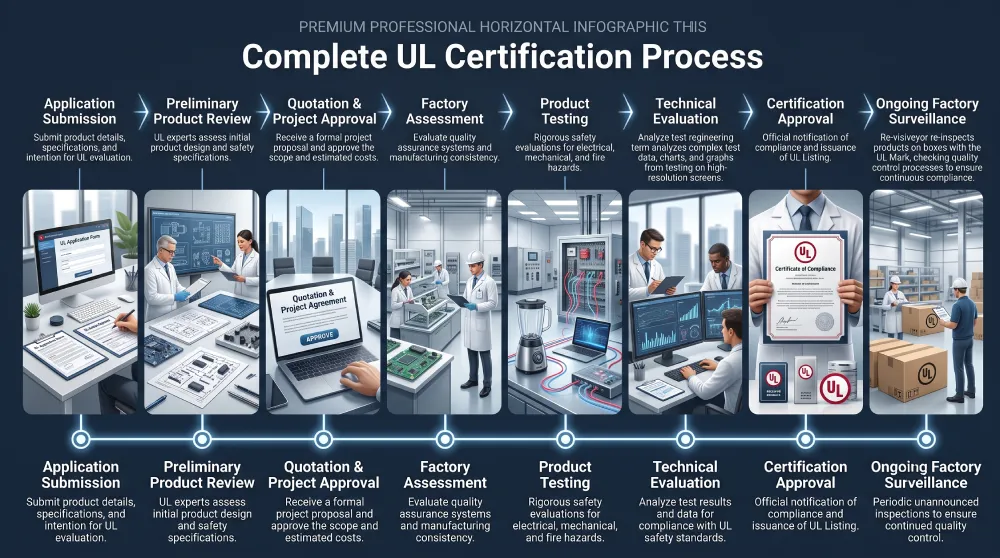
UL Certification Process
UL Certification follows a structured evaluation process to verify that a product meets applicable safety requirements before it is authorized to carry the UL Mark.
Step 1: Application Submission
The manufacturer submits an application along with product details, technical specifications, and supporting documents for evaluation.
Step 2: Preliminary Product Review
UL experts review the product design, construction, intended use, and applicable safety standards to determine the certification requirements.
Step 3: Quotation and Project Approval
Based on the product evaluation, UL provides the testing scope, estimated timeline, and certification costs for approval.
Step 4: Factory Assessment
Where required, UL conducts an inspection of the manufacturing facility to verify production capability and quality control systems.
Step 5: Product Testing
Product samples are tested in accordance with applicable UL safety standards to evaluate electrical safety, fire resistance, mechanical performance, environmental performance, and overall product reliability.
Step 6: Technical Evaluation
UL engineers assess the laboratory test results, technical documentation, and product construction to verify compliance with applicable standards.
Step 7: Certification Approval
If the product successfully meets all applicable safety requirements, UL grants certification and authorizes the manufacturer to use the UL Mark.
Step 8: Ongoing Factory Surveillance
After certification, UL may conduct periodic factory inspections to ensure that certified products continue to comply with approved specifications and safety requirements.
Timeline for UL Certification
The certification timeline depends on the complexity of the product, applicable safety standards, testing requirements, and the completeness of documentation.
A typical timeline is:
| Process | Estimated Timeline |
|---|---|
| Application Review | 3–5 Working Days |
| Documentation Review | 5–10 Working Days |
| Product Testing | 3–6 Weeks |
| Technical Evaluation | 1–2 Weeks |
| Factory Inspection (If Required) | 1–2 Weeks |
| Final UL Certification | Approximately 60 Days |
The actual timeline may vary depending on the product category and testing complexity.
Cost of UL Certification
The cost of UL Certification varies based on several technical and commercial factors, including:
- Product Category
- Product Complexity
- Applicable UL Standards
- Laboratory Testing Charges
- Factory Inspection Requirements
- Number of Product Variants
- Engineering Evaluation Fees
- Follow-up Inspection Charges
- Documentation Requirements
- Consultancy Fees
Since every product has unique certification requirements, the overall cost is determined after a detailed product assessment.
Why Choose Bharati Global Compliances for UL Certification?
Choosing the right compliance partner can significantly reduce the time, effort, and complexity involved in obtaining UL Certification. Bharati Global Compliances offers end-to-end consultancy services to help manufacturers, exporters, and importers achieve global product safety compliance efficiently.
Our experts assist with product evaluation, documentation, applicable UL standards, testing coordination, technical file preparation, communication with testing laboratories, and complete certification support. We work closely with businesses across multiple industries to ensure a smooth certification process with minimal delays.
Why Businesses Choose Us
- Experienced team of product compliance consultants
- Complete assistance from application to certification
- Support for manufacturers, importers, and exporters
- Documentation and technical file preparation
- Coordination with recognized testing laboratories
- Fast and transparent certification process
- Affordable consultancy services
- PAN India support with dedicated compliance experts
- Assistance for international market access
- Timely project execution with continuous updates
Whether you are launching a new product or exporting existing products to international markets, Bharati Global Compliances helps you complete the UL Certification process professionally and efficiently.
Conclusion
UL Certification is one of the most recognized product safety certifications in the world. It demonstrates that a product has been independently evaluated and complies with internationally accepted safety requirements. Although UL Certification is voluntary for many products, it significantly improves customer confidence, enhances brand credibility, reduces product liability risks, and creates better opportunities in global markets.
Manufacturers planning to export products or strengthen their product quality should consider obtaining UL Certification as part of their long-term compliance strategy.
Frequently Asked Questions (FAQs)
What is UL Certification?
UL Certification is an independent product safety certification issued after testing products against recognized safety standards
Is UL Certification mandatory?
In many cases, UL Certification is voluntary. However, many buyers, retailers, and industries require UL-certified products before procurement.
Who issues UL Certification?
UL Solutions (formerly Underwriters Laboratories) issues UL Certification after successful product evaluation and testing.
Which products require UL Certification?
Electrical products, electronic equipment, industrial machinery, lighting products, cables, batteries, appliances, medical devices, and many other products can obtain UL Certification.
How long does UL Certification take?
The certification process generally takes around 45 to 60 working days, depending on product complexity and testing requirements.
What documents are required for UL Certification?
Typically required documents include:
- Company registration details
- Product specifications
- Technical drawings
- Bill of Materials (BOM)
- User manual
- Product photographs
- Test reports (if available)
- Quality management documents
Can Indian manufacturers apply for UL Certification?
Yes. Indian manufacturers, exporters, OEMs, and private label brands can apply for UL Certification to access international markets.
Does UL Certification improve export opportunities?
Yes. UL Certification significantly enhances product credibility and is widely accepted in North America and several international markets.
What is the validity of UL Certification?
UL Certification generally remains valid as long as the certified product continues to comply with applicable standards and periodic factory inspections are successfully completed
How can Bharati Global Compliances help?
Bharati Global Compliances provides complete support for UL Certification, including documentation, testing coordination, technical guidance, compliance review, and end-to-end certification assistance.