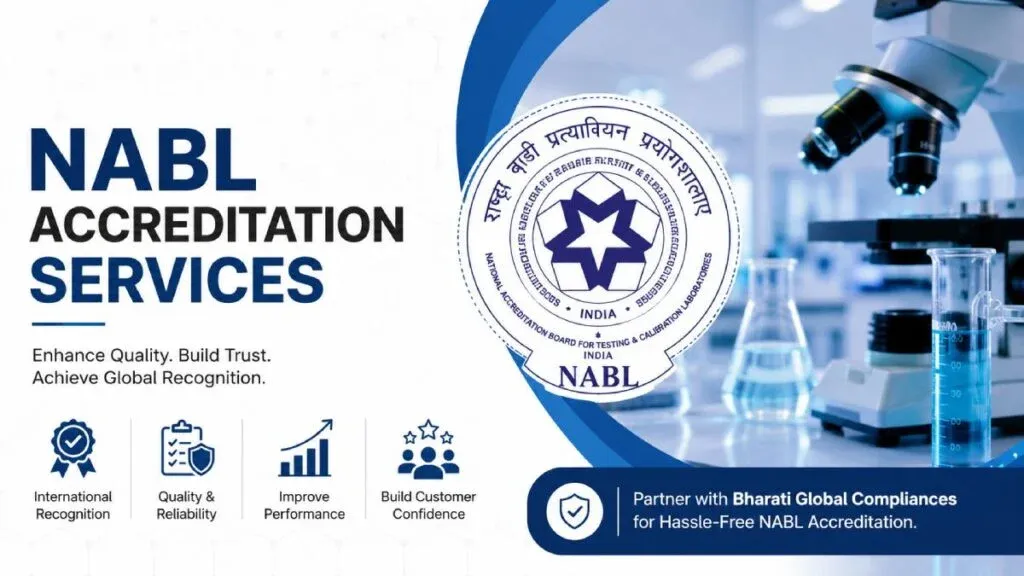
Accurate testing and calibration play a vital role in ensuring product quality, regulatory compliance, and customer confidence. Whether you operate a testing laboratory, calibration laboratory, medical laboratory, or proficiency testing provider, obtaining NABL Accreditation demonstrates your commitment to technical competence, quality management, and internationally accepted laboratory practices.
The National Accreditation Board for Testing and Calibration Laboratories (NABL) is India’s premier accreditation body that assesses laboratories against internationally recognized standards such as ISO/IEC 17025, ISO 15189, ISO/IEC 17043, and ISO 17034. NABL accreditation enhances the credibility of laboratory results and facilitates national and international acceptance of test reports and calibration certificates.
At Bharati Global Compliances, we provide complete NABL accreditation consultancy, assisting laboratories throughout the accreditation journey—from gap analysis and documentation to implementation, assessment support, and post-accreditation compliance.
What is NABL Accreditation?
NABL (National Accreditation Board for Testing and Calibration Laboratories) is an autonomous accreditation body functioning under the Quality Council of India (QCI). It grants accreditation to laboratories that demonstrate technical competence, impartiality, and compliance with internationally accepted laboratory management standards.
NABL accreditation confirms that a laboratory has the necessary infrastructure, qualified personnel, validated methods, quality systems, and technical capabilities to produce accurate and reliable test or calibration results.
Accredited laboratories gain greater recognition among regulatory authorities, customers, manufacturers, exporters, and international organizations.
What is NABL Laboratory Accreditation?
NABL Laboratory Accreditation is a formal recognition that a laboratory operates in accordance with applicable international standards and follows an effective quality management system.
The accreditation process evaluates several critical aspects of laboratory operations, including:
- Technical Competence
- Laboratory Quality Management System
- Equipment Calibration & Maintenance
- Testing & Calibration Methods
- Staff Qualification & Competency
- Measurement Traceability
- Quality Assurance Procedures
- Internal Audits
- Risk Management
- Document Control
Successful accreditation demonstrates that the laboratory consistently delivers technically valid and reliable results.
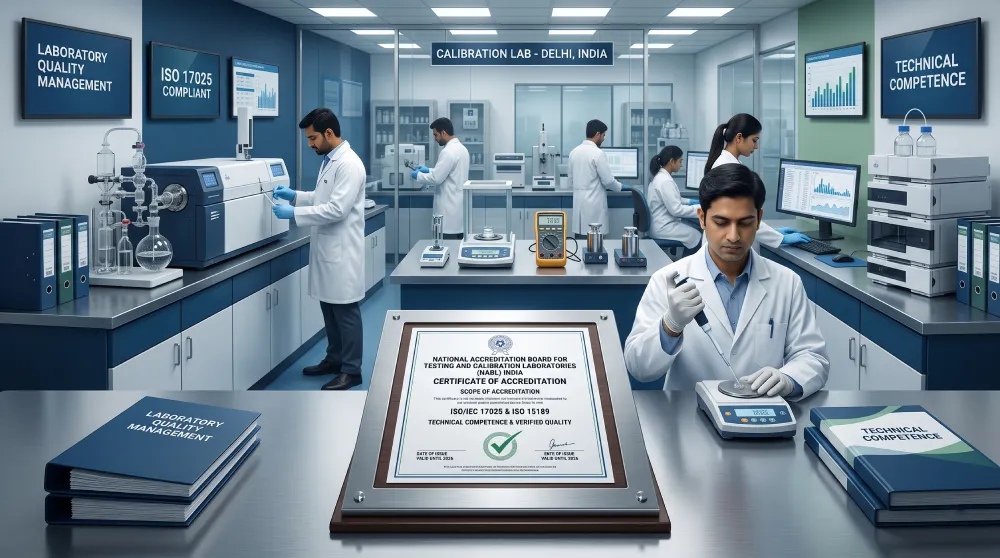
National Accreditation Board for Testing and Calibration Laboratories (NABL)
NABL is responsible for accrediting laboratories operating in different scientific and technical disciplines across India. It promotes confidence in laboratory services by ensuring compliance with internationally recognized standards.
NABL offers accreditation for:
- Testing Laboratories
- Calibration Laboratories
- Medical Laboratories
- Proficiency Testing Providers
- Reference Material Producers
The accreditation framework helps laboratories improve operational efficiency while supporting domestic and international acceptance of laboratory reports.
What is the Laboratory Recognition Scheme (LRS)?
The Laboratory Recognition Scheme (LRS) is administered by the Bureau of Indian Standards (BIS) to recognize laboratories that are competent to conduct testing for products covered under BIS Conformity Assessment Schemes.
While NABL accreditation establishes a laboratory’s technical competence, BIS Laboratory Recognition enables recognized laboratories to perform testing for specific Indian Standards under applicable BIS schemes, subject to BIS requirements.
Laboratories seeking BIS recognition are generally expected to meet the prescribed eligibility criteria, including applicable accreditation requirements.
NABL Accreditation vs BIS Laboratory Recognition
Although both systems focus on laboratory quality and technical competence, they serve different regulatory purposes.
| NABL Accreditation | BIS Laboratory Recognition |
|---|---|
| Granted by NABL | Granted by Bureau of Indian Standards (BIS) |
| Demonstrates technical competence | Authorizes testing under applicable BIS schemes |
| Based on international laboratory standards | Based on BIS recognition requirements |
| Applicable to multiple laboratory disciplines | Applicable to laboratories testing products under BIS conformity assessment |
| Supports national and international acceptance of test results | Supports BIS certification and product conformity assessment |
Understanding the distinction between these two systems helps laboratories select the appropriate compliance pathway.
Objectives of NABL Accreditation
NABL accreditation aims to strengthen laboratory quality, improve technical reliability, and enhance confidence in testing and calibration services.
The primary objectives include:
- Ensuring technically competent laboratory operations
- Improving accuracy and reliability of test results
- Promoting internationally accepted laboratory practices
- Strengthening quality management systems
- Supporting regulatory compliance
- Facilitating acceptance of laboratory reports
- Enhancing customer confidence
- Encouraging continual improvement
- Improving operational efficiency
- Supporting international trade
Benefits of NABL Accreditation
Obtaining NABL accreditation offers significant operational and commercial advantages.
Technical Benefits
- Demonstrates Laboratory Competence
- Reliable Test & Calibration Results
- Improved Measurement Accuracy
- Enhanced Quality Management
- Better Process Control
- Standardized Testing Procedures
- Improved Equipment Management
Business Benefits
- Increased Customer Confidence
- Improved Brand Reputation
- Greater Market Credibility
- Better Regulatory Acceptance
- Competitive Advantage
- Enhanced Business Opportunities
- Support for Government Tenders
- International Recognition
- Improved Client Satisfaction
Who Should Apply for NABL Accreditation?
NABL accreditation is suitable for laboratories across various industries and sectors.
Organizations that commonly apply include:
- Testing Laboratories
- Calibration Laboratories
- Medical Laboratories
- Food Testing Laboratories
- Pharmaceutical Laboratories
- Environmental Laboratories
- Chemical Laboratories
- Mechanical Testing Laboratories
- Electrical & Electronics Laboratories
- Microbiology Laboratories
- Research & Development Laboratories
- Educational Institution Laboratories
- Government Laboratories
- Third-Party Testing Laboratories
Why Choose Bharati Global Compliances?
Achieving NABL accreditation requires careful planning, quality system implementation, technical documentation, and successful assessment. Bharati Global Compliances offers comprehensive consultancy services to simplify every stage of the accreditation process.
Our NABL Consultancy Services
We provide complete support for:
- NABL Eligibility Assessment
- Gap Analysis
- Documentation Preparation
- Quality Manual Development
- SOP Preparation
- ISO/IEC 17025 Implementation
- Internal Audit Support
- Management Review Assistance
- Pre-Assessment Preparation
- Assessment Coordination
- Non-Conformity Closure Support
- Post-Accreditation Compliance
Why Laboratories Trust Bharati Global Compliances
Our team combines regulatory expertise with practical laboratory experience to deliver reliable accreditation solutions.
Our Key Advantages
- Experienced NABL Consultants
- End-to-End Accreditation Support
- Laboratory Quality Management Expertise
- Customized Documentation
- Dedicated Project Manager
- PAN India Consultancy Services
- Transparent Process
- Timely Project Execution
- Ongoing Compliance Guidance
- Long-Term Technical Support
Whether you are establishing a new laboratory or upgrading an existing facility, Bharati Global Compliances helps you achieve NABL accreditation efficiently while maintaining compliance with applicable international standards.
Who Needs NABL Accreditation?
NABL Accreditation is designed for laboratories that perform testing, calibration, medical diagnostics, proficiency testing, or reference material production. It demonstrates that a laboratory operates with technical competence, impartiality, and a robust quality management system in accordance with internationally recognized standards.
Organizations seeking reliable laboratory operations, regulatory acceptance, and enhanced customer confidence can benefit significantly from NABL Accreditation.
At Bharati Global Compliances, we assist laboratories across India in achieving NABL Accreditation through complete consultancy, documentation, implementation, assessment support, and ongoing compliance services.
Industries That Require NABL Accreditation
NABL Accreditation is applicable across a wide range of industries and laboratory sectors, including:
- Manufacturing Industries
- Pharmaceuticals
- Medical & Healthcare
- Food & Beverage
- Chemical Industries
- Electrical & Electronics
- Automotive
- Construction Materials
- Environmental Testing
- Textiles
- Agriculture
- Petrochemicals
- Mining & Minerals
- Aerospace & Defence
- Consumer Products
- Research Institutions
- Government Laboratories
- Educational Institutions
Accreditation enhances the credibility of laboratory results and supports compliance with regulatory and customer requirements.
Types of Laboratories Eligible for NABL Accreditation
NABL provides accreditation to different categories of laboratories based on their scope of work and applicable international standards.
Testing Laboratories
Testing laboratories perform analysis and evaluation of products, materials, and samples to determine compliance with specified standards.
Examples include:
- Chemical Testing Laboratories
- Mechanical Testing Laboratories
- Electrical Testing Laboratories
- Electronics Testing Laboratories
- Food Testing Laboratories
- Environmental Testing Laboratories
- Microbiology Laboratories
- Textile Testing Laboratories
- Building Material Testing Laboratories
- Water Testing Laboratories
Calibration Laboratories
Calibration laboratories verify the accuracy and performance of measuring instruments and equipment.
Common calibration laboratories include:
- Mass Calibration
- Temperature Calibration
- Pressure Calibration
- Electrical Calibration
- Dimensional Calibration
- Flow Calibration
- Volume Calibration
- Force Calibration
- Torque Calibration
- Time & Frequency Calibration
Medical Laboratories
Medical laboratories performing diagnostic testing can obtain NABL Accreditation under the applicable international standards to demonstrate competence and reliability.
Medical laboratory services include:
- Clinical Pathology
- Hematology
- Biochemistry
- Microbiology
- Histopathology
- Molecular Biology
- Immunology
- Cytology
Proficiency Testing Providers
Organizations conducting proficiency testing programs for laboratories can obtain accreditation to demonstrate competence in planning, organizing, and evaluating inter-laboratory comparisons.
Reference Material Producers
Organizations producing certified reference materials used for laboratory testing and calibration can also seek NABL Accreditation under the applicable standards.
Scope of NABL Accreditation
The scope of accreditation defines the specific testing, calibration, or measurement activities that a laboratory is authorized to perform under NABL Accreditation.
The approved scope typically includes:
- Test Parameters
- Measurement Ranges
- Calibration Capabilities
- Testing Methods
- Applicable Standards
- Equipment Used
- Measurement Uncertainty
- Laboratory Disciplines
A clearly defined scope ensures transparency and helps clients understand the laboratory’s accredited capabilities.
Eligibility Criteria for NABL Accreditation
To become eligible for NABL Accreditation, laboratories should establish an effective quality management system and demonstrate technical competence.
General eligibility requirements include:
- Legally Established Laboratory
- Qualified Technical Personnel
- Competent Laboratory Management
- Suitable Infrastructure
- Validated Test Methods
- Calibrated Equipment
- Environmental Controls
- Documented Quality Management System
- Internal Audit Process
- Management Review Mechanism
Meeting these requirements improves the laboratory’s readiness for assessment and accreditation.
Applicable Standards for NABL Accreditation
NABL Accreditation is granted against internationally recognized standards based on the type of laboratory and services offeredISO/IEC 17025 – Testing & Calibration Laboratories
ISO/IEC 17025 is the internationally accepted standard for testing and calibration laboratories. It specifies requirements for competence, impartiality, and consistent laboratory operations.
Key requirements include:
- Quality Management System
- Technical Competence
- Equipment Calibration
- Method Validation
- Measurement Traceability
- Risk-Based Thinking
- Internal Audits
- Corrective Actions
This standard is widely used by laboratories serving manufacturing, engineering, research, and industrial sectors.
ISO 15189 – Medical Laboratories
ISO 15189 specifies quality and competence requirements for medical laboratories.
It focuses on:
- Patient Safety
- Diagnostic Accuracy
- Laboratory Quality Management
- Staff Competency
- Equipment Validation
- Quality Assurance
- Clinical Risk Management
ISO/IEC 17043 – Proficiency Testing Providers
This standard establishes the requirements for organizations conducting proficiency testing programs.
It ensures:
- Fair Performance Evaluation
- Reliable Inter-Laboratory Comparison
- Technical Competence
- Statistical Validity
- Consistent Program Management
ISO 17034 – Reference Material Producers
ISO 17034 specifies competence requirements for organizations producing certified reference materials used by laboratories worldwide.
The standard focuses on:
- Material Characterization
- Homogeneity Assessment
- Stability Studies
- Production Controls
- Quality Assurance
- Documentation
Documents Required for NABL Accreditation
Proper documentation is one of the most critical aspects of the accreditation process.
Commonly required documents include:
Business Documents
- Certificate of Incorporation / Registration
- GST Registration
- PAN Card
- Address Proof
- Organization Chart
- Laboratory Layout
Quality Management Documents
- Quality Manual
- Quality Policy
- Standard Operating Procedures (SOPs)
- Work Instructions
- Document Control Procedure
- Record Control Procedure
Technical Documents
- Scope of Testing / Calibration
- Equipment List
- Calibration Certificates
- Method Validation Reports
- Measurement Uncertainty Records
- Staff Qualification Records
- Training Records
- Internal Audit Reports
- Management Review Minutes
- Proficiency Testing Records
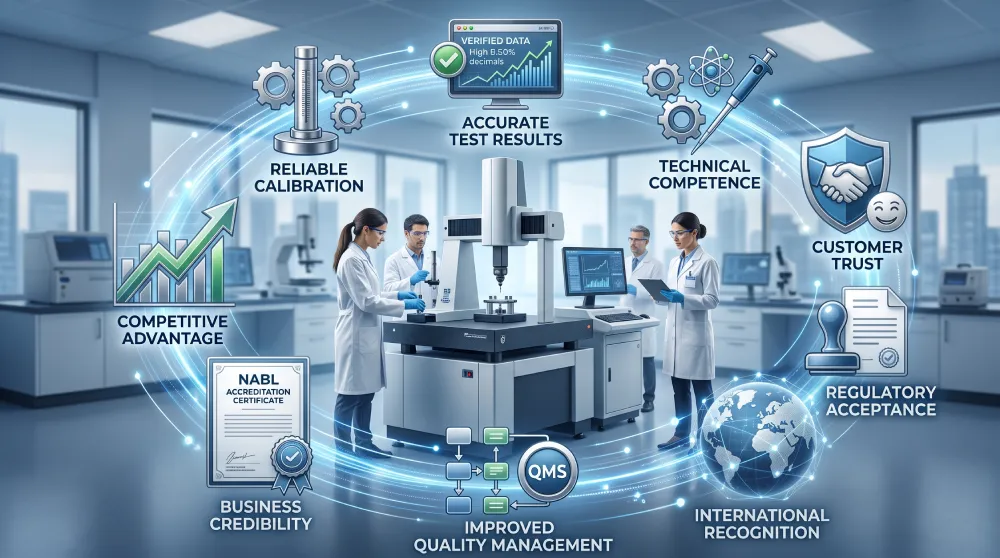
Benefits of NABL Accreditation
Achieving NABL Accreditation provides both technical and commercial advantages.
Technical Benefits
- Improved Accuracy of Test Results
- Enhanced Measurement Reliability
- Standardized Laboratory Processes
- Better Equipment Management
- Increased Technical Competence
- Strong Quality Assurance System
Business Benefits
- Greater Customer Trust
- Improved Market Reputation
- Better Acceptance by Regulatory Authorities
- Enhanced Business Opportunities
- Competitive Advantage
- International Recognition
- Increased Client Satisfaction
Why Choose Bharati Global Compliances?
Obtaining NABL Accreditation requires technical expertise, meticulous documentation, and effective quality system implementation. Bharati Global Compliances offers end-to-end consultancy to help laboratories achieve accreditation efficiently.
Our NABL Accreditation Services
We provide:
- NABL Readiness Assessment
- Gap Analysis
- ISO Standard Implementation
- Quality Manual Preparation
- SOP Development
- Technical Documentation Support
- Internal Audit Assistance
- Management Review Guidance
- Pre-Assessment Preparation
- Assessment Coordination
- Non-Conformity Closure Support
- Post-Accreditation Compliance Services
Our experienced consultants work closely with laboratories of all sizes to simplify the accreditation process, minimize delays, and ensure compliance with NABL requirements.
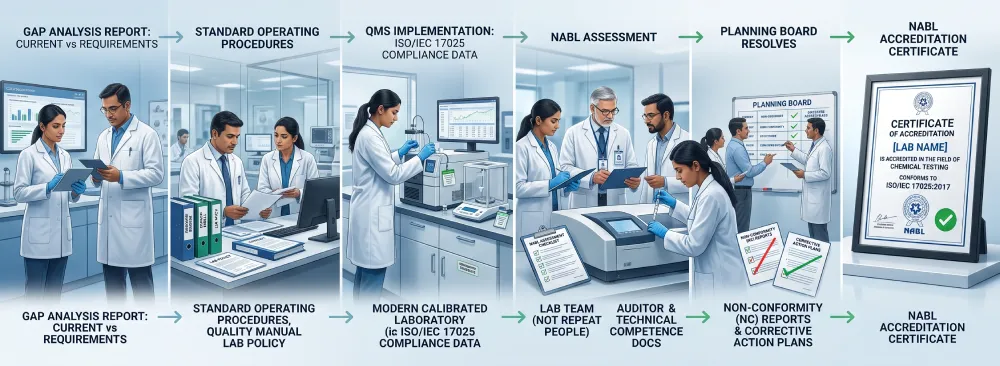
Step-by-Step NABL Accreditation Process
Obtaining NABL Accreditation involves implementing a quality management system, establishing technical competence, preparing documentation, and successfully completing the assessment conducted by the National Accreditation Board for Testing and Calibration Laboratories (NABL).
At Bharati Global Compliances, we provide complete consultancy support throughout the accreditation process—from initial gap assessment to successful accreditation and post-accreditation compliance.
Step 1: Initial Consultation & Gap Analysis
The accreditation journey begins with a detailed evaluation of the laboratory’s existing infrastructure, quality management system, technical capabilities, and compliance with applicable NABL standards.
Our experts assess:
- Existing Laboratory Management System
- Technical Competence
- Equipment Status
- Testing & Calibration Scope
- Documentation Readiness
- Personnel Competency
- Quality System Compliance
- Regulatory Gaps
A comprehensive gap analysis helps identify areas requiring improvement before applying for accreditation.
Step 2: Scope Identification
The next step is to define the laboratory’s Scope of Accreditation, which specifies the testing, calibration, or measurement activities for which accreditation is sought.
The scope generally includes:
- Testing Parameters
- Calibration Parameters
- Product Categories
- Testing Methods
- Applicable Standards
- Measurement Range
- Equipment Used
- Measurement Uncertainty
Selecting an appropriate scope ensures a focused and efficient accreditation process.
Step 3: Documentation Preparation
Documentation is one of the most important stages of NABL Accreditation. A well-documented quality management system demonstrates the laboratory’s commitment to consistency, competence, and continuous improvement.
Documents typically include:
Quality Management Documents
- Quality Manual
- Quality Policy
- Quality Objectives
- Standard Operating Procedures (SOPs)
- Work Instructions
- Document Control Procedure
- Record Control Procedure
- Risk Assessment Records
Technical Documents
- Test Methods
- Calibration Procedures
- Equipment List
- Equipment Calibration Certificates
- Method Validation Reports
- Measurement Uncertainty Calculations
- Environmental Monitoring Records
- Internal Audit Reports
- Management Review Minutes
At Bharati Global Compliances, we prepare customized documentation aligned with NABL requirements and your laboratory’s operations.
Step 4: Quality Management System (QMS) Implementation
After documentation is prepared, the Quality Management System is implemented across the laboratory.
Implementation includes:
- SOP Implementation
- Staff Training
- Equipment Verification
- Internal Process Controls
- Record Maintenance
- Quality Monitoring
- Corrective & Preventive Actions
- Risk Management Practices
Effective implementation ensures that the documented procedures are consistently followed in daily laboratory operations.
Step 5: Internal Audit
Before submitting the application, the laboratory should conduct an Internal Audit to evaluate the effectiveness of the implemented management system.
The audit verifies:
- Compliance with NABL Requirements
- Process Effectiveness
- Technical Competence
- Documentation Accuracy
- Equipment Calibration Status
- Record Maintenance
- Staff Competency
- Corrective Actions
Internal audits help identify non-conformities before the official NABL assessment.
Step 6: Management Review Meeting
A Management Review is conducted to evaluate the overall performance of the laboratory and ensure continual improvement.
Topics generally include:
- Internal Audit Findings
- Customer Feedback
- Non-Conformities
- Corrective Actions
- Risk Assessment
- Equipment Performance
- Resource Requirements
- Improvement Opportunities
The review demonstrates management’s commitment to maintaining an effective quality management system.
Step 7: Online Application Submission
Once the laboratory is fully prepared, the accreditation application is submitted through the NABL online portal.
The application generally includes:
- Laboratory Information
- Scope of Accreditation
- Applicable Standard
- Technical Personnel Details
- Quality Documents
- Equipment Information
- Supporting Records
- Applicable Fees
A complete and accurate application helps reduce processing delays.
Step 8: Document Review by NABL
After receiving the application, NABL reviews the submitted documentation to verify compliance with the applicable accreditation standard.
During this stage, NABL may request:
- Additional Documents
- Technical Clarifications
- Scope Modifications
- Corrective Information
- Supporting Evidence
Our consultants assist in responding promptly to all observations and queries.
Step 9: Pre-Assessment (If Applicable)
In certain cases, NABL may conduct a Pre-Assessment to evaluate the laboratory’s readiness before the final assessment.
The objective is to:
- Identify Major Gaps
- Review Technical Competence
- Assess Documentation
- Verify Quality System Implementation
- Recommend Improvements
Resolving observations during this stage increases the likelihood of a successful final assessment.
Step 10: Final NABL Assessment
The final assessment is conducted by a team of NABL-appointed assessors who evaluate the laboratory’s compliance with the applicable standard.
The assessment generally covers:
- Laboratory Infrastructure
- Technical Competence
- Testing & Calibration Activities
- Equipment Performance
- Personnel Competency
- Record Verification
- Quality Management System
- Method Validation
- Measurement Traceability
- Impartiality & Confidentiality
The assessors may witness actual testing or calibration activities to verify technical competence.
Step 11: Non-Conformity (NC) Closure
If any Non-Conformities (NCs) are identified during the assessment, the laboratory must implement corrective actions and submit evidence within the prescribed timeframe.
Common NCs include:
- Incomplete Documentation
- Equipment Calibration Issues
- Inadequate Records
- SOP Deviations
- Training Gaps
- Method Validation Deficiencies
Bharati Global Compliances provides complete support in preparing corrective action plans and closing NCs effectively.
Step 12: Grant of NABL Accreditation
After satisfactory review of the assessment report and closure of all non-conformities, NABL grants accreditation for the approved scope.
Upon accreditation, the laboratory receives:
- NABL Accreditation Certificate
- Approved Scope of Accreditation
- NABL Accreditation Number
- Authorization to use the NABL Accreditation Symbol in accordance with applicable NABL guidelines
Timeline for NABL Accreditation
The overall accreditation timeline depends on the laboratory’s preparedness, documentation quality, scope of accreditation, and assessment schedule.
| Activity | Estimated Timeline |
|---|---|
| Gap Analysis | 3–7 Working Days |
| Documentation Preparation | 2–4 Weeks |
| QMS Implementation | 2–6 Weeks |
| Internal Audit & Management Review | 1 Week |
| Application Submission | 1–2 Days |
| NABL Document Review | Subject to NABL Processing |
| Assessment | As Scheduled by NABL |
| NC Closure | Depends on Observations |
| Accreditation Grant | Subject to NABL Approval |
Note: Timelines are indicative and may vary based on the laboratory’s readiness, accreditation scope, and NABL processing schedule.
Cost Factors for NABL Accreditation
The total cost of NABL Accreditation depends on several technical and administrative factors, including:
- Type of Laboratory
- Scope of Accreditation
- Number of Testing Parameters
- Applicable Accreditation Standard
- Number of Technical Experts
- Laboratory Infrastructure
- Equipment Calibration Requirements
- Consultancy Services
- Assessment Fees
- Annual Surveillance & Renewal Costs
Why Choose Bharati Global Compliances?
Achieving NABL Accreditation requires expertise, meticulous planning, and continuous compliance. Bharati Global Compliances provides complete support to laboratories seeking accreditation across India.
Our NABL Consultancy Services
- NABL Readiness Assessment
- Gap Analysis
- Documentation Development
- ISO/IEC 17025 Implementation
- ISO 15189 Implementation
- Internal Audit Support
- Staff Training
- Application Filing Assistance
- Assessment Coordination
- NC Closure Support
- Post-Accreditation Compliance
- Surveillance Audit Assistance
With our experienced consultants, your laboratory can achieve NABL Accreditation efficiently while maintaining the highest standards of technical competence and quality managementBIS Laboratory Recognition Scheme (LRS)
The BIS Laboratory Recognition Scheme (LRS) is administered by the Bureau of Indian Standards (BIS) to recognize laboratories that are competent to test products covered under various BIS Conformity Assessment Schemes. Recognition under LRS enables laboratories to perform testing in accordance with applicable Indian Standards and issue reports accepted for BIS certification processes.
While NABL Accreditation demonstrates technical competence, BIS Laboratory Recognition authorizes eligible laboratories to conduct testing for products regulated under BIS certification schemes.
At Bharati Global Compliances, we provide complete consultancy for NABL Accreditation as well as BIS Laboratory Recognition, helping laboratories achieve compliance efficiently.
Purpose of the BIS Laboratory Recognition Scheme
The Laboratory Recognition Scheme has been introduced to strengthen India’s product quality infrastructure by expanding the availability of competent testing laboratories.
The key objectives of the scheme include:
- Supporting BIS Conformity Assessment Schemes
- Ensuring Reliable Product Testing
- Promoting Uniform Testing Practices
- Enhancing Consumer Safety
- Improving Product Quality
- Strengthening Regulatory Compliance
- Expanding Accredited Testing Infrastructure
- Facilitating Faster Certification Processes
Recognized laboratories play a crucial role in maintaining confidence in products certified under BIS standards.
Eligibility for BIS Laboratory Recognition
Laboratories seeking recognition under the BIS LRS should generally satisfy the prescribed eligibility criteria.
Typical requirements include:
- Valid NABL Accreditation under the applicable standard
- Compliance with ISO/IEC 17025 (where applicable)
- Qualified Technical Personnel
- Appropriate Laboratory Infrastructure
- Calibrated Testing Equipment
- Documented Quality Management System
- Adequate Testing Facilities
- Internal Audit and Management Review Records
- Availability of Relevant Indian Standards
- Technical Competence for the Requested Scope
Meeting these requirements helps laboratories demonstrate their capability to perform testing in accordance with BIS requirements.
Recognition of Foreign Laboratories
BIS also provides a framework for recognizing eligible foreign laboratories for specific testing activities, subject to applicable regulatory requirements.
Foreign laboratories are generally expected to:
- Maintain valid accreditation from a recognized accreditation body
- Demonstrate technical competence
- Comply with BIS requirements
- Maintain suitable testing infrastructure
- Provide qualified technical personnel
- Fulfill additional requirements prescribed by BIS
Foreign laboratories seeking recognition should carefully review the latest BIS guidelines before applying.
Documents Required for BIS Laboratory Recognition
Laboratories applying for recognition are generally required to submit comprehensive legal, technical, and quality management documents.
Legal Documents
- Certificate of Incorporation / Registration
- GST Registration (if applicable)
- PAN Card
- Address Proof
- Organization Structure
- Authorization Letter
Accreditation Documents
- Valid NABL Accreditation Certificate
- Approved Scope of Accreditation
- Accreditation Details
- Quality Management System Records
Technical Documents
- Laboratory Layout Plan
- Equipment List
- Calibration Certificates
- Test Methods
- Standard Operating Procedures (SOPs)
- Technical Personnel Details
- Internal Audit Reports
- Management Review Records
- Quality Manual
- List of Applicable Indian Standards
Proper documentation helps ensure a smooth review and assessment process.
Surveillance & Renewal of NABL Accreditation
NABL Accreditation is not a one-time process. Accredited laboratories must continue to comply with applicable standards and undergo periodic surveillance and reassessment to maintain their accreditation.
During surveillance, the following aspects are typically reviewed:
- Continued Compliance with Applicable Standards
- Effectiveness of the Quality Management System
- Internal Audit Reports
- Management Review Records
- Staff Competency
- Equipment Calibration Status
- Method Validation
- Proficiency Testing Participation
- Corrective Actions
- Record Maintenance
Maintaining continual compliance is essential for retaining accreditation.
Maintaining NABL Accreditation
Accredited laboratories should establish a culture of continual improvement and regularly review their quality systems.
Best practices include:
- Conduct Internal Audits at Planned Intervals
- Perform Regular Management Reviews
- Maintain Equipment Calibration
- Train Technical Personnel
- Participate in Proficiency Testing
- Review Standard Operating Procedures
- Maintain Complete Laboratory Records
- Implement Corrective & Preventive Actions
- Monitor Customer Feedback
- Update Documentation as Required
Consistent compliance minimizes the risk of non-conformities during surveillance assessments.
Common Challenges in NABL Accreditation
Many laboratories face technical and documentation-related challenges during the accreditation process.
Common issues include:
- Incomplete Documentation
- Poorly Implemented Quality Management Systems
- Equipment Calibration Delays
- Inadequate Method Validation
- Lack of Staff Training
- Measurement Uncertainty Errors
- Internal Audit Deficiencies
- Improper Record Maintenance
- Non-Conformities During Assessment
- Delayed Corrective Action Closure
With proper planning and expert guidance, these challenges can be addressed effectively.
How Bharati Global Compliances Helps
Obtaining and maintaining NABL Accreditation requires technical expertise, quality system implementation, and continuous regulatory compliance. Bharati Global Compliances provides end-to-end consultancy services tailored to laboratories of all sizes.
Our NABL Consultancy Services
We provide complete assistance with:
- NABL Readiness Assessment
- Gap Analysis
- Quality Management System Implementation
- ISO/IEC 17025 Documentation
- ISO 15189 Documentation
- SOP Preparation
- Internal Audit Support
- Management Review Assistance
- Application Filing
- Assessment Coordination
- Non-Conformity Closure
- Surveillance Audit Support
- Renewal Assistance
- BIS Laboratory Recognition Consultancy
Why Choose Bharati Global Compliances?
Choosing the right consultancy partner can significantly improve the success of your accreditation journey.
Why Clients Trust Us
- Experienced NABL Consultants
- End-to-End Accreditation Support
- Industry-Specific Expertise
- Customized Documentation
- Transparent Consultancy Process
- Dedicated Project Manager
- PAN India Services
- Timely Project Execution
- Ongoing Technical Guidance
- Long-Term Compliance Support
We work closely with testing laboratories, calibration laboratories, medical laboratories, research institutions, and industrial laboratories to simplify the accreditation process and ensure long-term compliance.
Frequently Asked Questions (FAQs)
What is NABL Accreditation?
NABL Accreditation is a formal recognition granted by the National Accreditation Board for Testing and Calibration Laboratories (NABL) to laboratories that demonstrate technical competence and comply with internationally accepted standards such as ISO/IEC 17025, ISO 15189, ISO/IEC 17043, and ISO 17034.
Why is NABL Accreditation important?
NABL Accreditation enhances the credibility of laboratory results, improves customer confidence, ensures compliance with regulatory requirements, and supports national and international acceptance of test reports.
Who can apply for NABL Accreditation?
The following organizations can apply:
- Testing Laboratories
- Calibration Laboratories
- Medical Laboratories
- Food Testing Laboratories
- Environmental Laboratories
- Pharmaceutical Laboratories
- Government Laboratories
- Research Institutions
- Educational Laboratories
- Proficiency Testing Providers
- Reference Material Producers
What standards are applicable for NABL Accreditation?
Depending on the laboratory type, the applicable standards include:
- ISO/IEC 17025
- ISO 15189
- ISO/IEC 17043
- ISO 17034
Is ISO 17025 mandatory for NABL Accreditation?
For testing and calibration laboratories, compliance with ISO/IEC 17025 is generally required as part of the NABL accreditation process.
What documents are required for NABL Accreditation?
Common documents include:
- Quality Manual
- Quality Policy
- Standard Operating Procedures (SOPs)
- Organization Chart
- Equipment List
- Calibration Certificates
- Staff Qualification Records
- Internal Audit Reports
- Management Review Records
- Method Validation Reports
How long does the NABL Accreditation process take?
The timeline varies depending on the laboratory’s preparedness, documentation quality, and NABL assessment schedule. A well-prepared laboratory can complete the process more efficiently.
What is the validity of NABL Accreditation?
NABL Accreditation is subject to ongoing compliance, periodic surveillance, and reassessment as per NABL’s applicable policies and procedures.
What is the cost of NABL Accreditation?
The overall cost depends on several factors, including:
- Type of Laboratory
- Scope of Accreditation
- Number of Testing Parameters
- Applicable Standard
- Laboratory Infrastructure
- Consultancy Requirements
- NABL Assessment Fees
Can foreign laboratories apply for recognition?
Yes. Eligible foreign laboratories may apply for BIS Laboratory Recognition or other applicable recognition programs, subject to meeting the prescribed eligibility criteria and regulatory requirements.
What is the difference between NABL Accreditation and BIS Laboratory Recognition?
NABL Accreditation demonstrates the technical competence of a laboratory, whereas BIS Laboratory Recognition authorizes eligible laboratories to conduct testing for products covered under BIS Conformity Assessment Schemes.
Is NABL Accreditation mandatory?
NABL Accreditation is not mandatory for every laboratory. However, many government departments, regulatory authorities, customers, and certification bodies prefer or require accredited laboratory services.
What are the benefits of NABL Accreditation?
A Quality Manual outlines the laboratory’s quality management system, policies, procedures, and operational framework to ensure compliance with applicable accreditation standards.
Why Choose Bharati Global Compliances?
Partnering with the right consultancy can significantly improve your chances of achieving NABL Accreditation smoothly and efficiently.
Our Expertise Includes:
- Complete NABL Accreditation Consultancy
- ISO/IEC 17025 Implementation
- ISO 15189 Consultancy
- Quality Manual & SOP Preparation
- Internal Audit & Management Review
- Pre-Assessment Readiness
- NABL Application Assistance
- Non-Conformity (NC) Closure Support
- Surveillance & Renewal Assistance
- BIS Laboratory Recognition Consultancy
- PAN India Support
Our experienced consultants work closely with laboratories to ensure compliance with NABL requirements while minimizing delays and improving operational efficiency.
Get NABL Accreditation with Expert Guidance
Whether you are establishing a new laboratory or upgrading an existing facility, Bharati Global Compliances is your trusted partner for end-to-end NABL Accreditation consultancy.
Our Services Include:
- Free Initial Consultation
- Gap Analysis & Readiness Assessment
- Documentation & SOP Development
- Quality Management System Implementation
- Application Filing Assistance
- Assessment Coordination
- Post-Accreditation Compliance Support
📞 Talk to Our NABL Experts Today
📩 Request a Free Consultation
🌐 PAN India NABL Accreditation Services