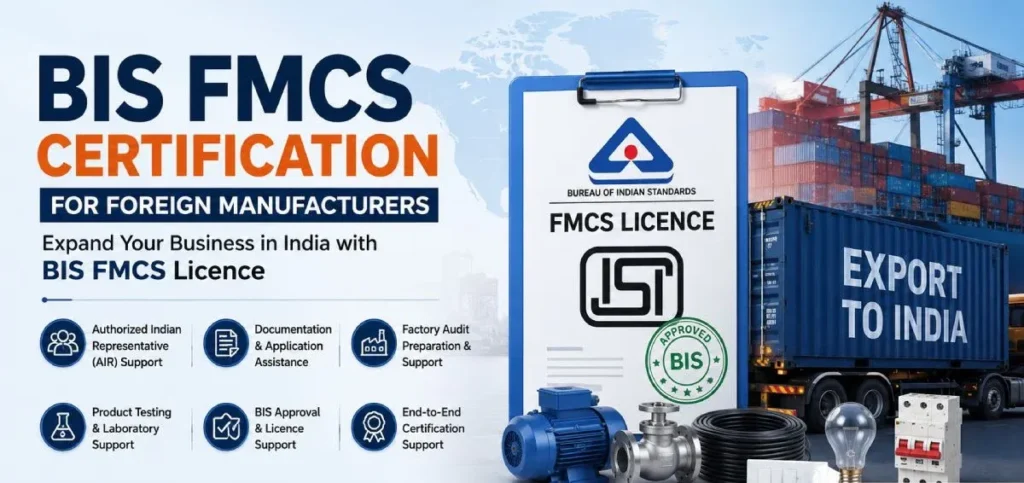
Need BIS FMCS Certification for exporting products to India? Bharati Global Compliances provides complete assistance for BIS FMCS Registration, Authorized Indian Representative (AIR), documentation, factory audit preparation, product testing coordination, and BIS licence approval. Our experts help foreign manufacturers comply with Indian regulations and obtain the BIS ISI Mark smoothly and efficiently.
BIS FMCS Certification Consultant in India
Expanding your business into the Indian market is a significant opportunity, but it also requires strict compliance with Indian product safety and quality regulations. If your product falls under the mandatory certification scheme notified by the Bureau of Indian Standards (BIS), obtaining a BIS FMCS (Foreign Manufacturers Certification Scheme) Licence is a legal requirement before your products can be imported, distributed, or sold in India.
At Bharati Global Compliances, we specialize in helping overseas manufacturers navigate the complete BIS FMCS certification process with confidence. From preparing technical documentation and appointing an Authorized Indian Representative (AIR) to coordinating product testing and supporting factory inspections, our experienced consultants provide end-to-end assistance throughout the certification journey.
Whether your manufacturing facility is located in China, Taiwan, Vietnam, Japan, South Korea, Germany, Italy, Turkey, the United States, the United Kingdom, or any other country, our team ensures that your application complies with the latest BIS requirements, reducing delays and simplifying the approval process.
Our BIS FMCS Services Include:
- Complete BIS FMCS Registration Assistance
- BIS Licence Application Preparation
- Authorized Indian Representative (AIR) Services
- Product Standard Identification
- Technical Documentation Support
- Factory Audit Preparation
- Coordination with BIS Officials
- Product Testing Assistance
- Renewal & Surveillance Compliance
- Ongoing Regulatory Support
Introduction to BIS FMCS Certification
India has emerged as one of the world’s fastest-growing manufacturing and consumer markets. With increasing industrialization, infrastructure development, and rising consumer demand, the country has become a preferred destination for global manufacturers looking to expand their business operations. Every year, thousands of foreign companies export products to India across industries such as electrical equipment, construction materials, chemicals, consumer goods, industrial machinery, automotive components, household appliances, and many others.
However, entering the Indian market involves much more than simply shipping products across borders. The Government of India has established a comprehensive regulatory framework to ensure that products sold in the country meet prescribed standards of quality, safety, reliability, and performance. These regulations protect consumers, encourage fair competition, and maintain consistent manufacturing practices.
One of the most important regulatory authorities responsible for maintaining product quality standards in India is the Bureau of Indian Standards (BIS). BIS develops Indian Standards (IS), conducts conformity assessments, grants licences, and authorizes manufacturers to use the Standard Mark (ISI Mark) on products that comply with applicable Indian Standards.
For manufacturers located outside India, BIS operates a dedicated certification programme known as the Foreign Manufacturers Certification Scheme (FMCS). This scheme enables eligible foreign manufacturing units to obtain a BIS Licence and legally use the ISI Mark on products intended for the Indian market.
Without obtaining the required BIS FMCS Licence, manufacturers of notified products may face significant challenges, including customs clearance issues, restrictions on imports, regulatory penalties, shipment delays, and denial of market access. Therefore, understanding the FMCS certification process is essential for any overseas business planning long-term operations in India.
The FMCS certification process is considerably more comprehensive than many businesses initially expect. It involves multiple stages, including product standard identification, documentation review, factory inspection by BIS officials, laboratory testing, technical evaluation, licence approval, and continuous compliance after certification. Since every application is scrutinized carefully, incomplete documentation or non-compliance with BIS requirements may result in delays or rejection.
This is where professional consultancy plays a vital role.
At Bharati Global Compliances, we assist foreign manufacturers in managing every stage of the BIS FMCS certification process. Our objective is not only to help businesses obtain the licence but also to ensure that they remain compliant with Indian regulations throughout the validity period of the certification.
What is BIS FMCS Certification?
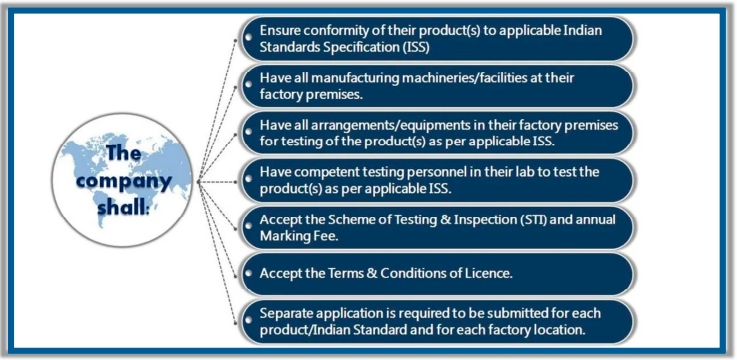
BIS FMCS (Foreign Manufacturers Certification Scheme) is a certification scheme administered by the Bureau of Indian Standards (BIS) specifically for manufacturing units located outside India. The scheme allows eligible foreign manufacturers to obtain a BIS Licence and use the ISI Standard Mark on products that conform to the applicable Indian Standards.
The FMCS scheme operates under the provisions of the BIS Act, 2016 and the Bureau of Indian Standards (Conformity Assessment) Regulations, 2018. It is administered by the Foreign Manufacturers Certification Department (FMCD) of BIS, which is responsible for processing applications, conducting factory inspections, evaluating compliance, and granting licences to overseas manufacturers.
Unlike domestic manufacturers, foreign applicants must undergo an international factory audit conducted by BIS officials before a licence can be granted. During this inspection, BIS verifies manufacturing infrastructure, quality management systems, testing facilities, production processes, and product conformity with relevant Indian Standards.
Only after successful completion of all evaluation stages does BIS issue the FMCS Licence, allowing the manufacturer to apply the ISI Mark to certified products.
It is important to understand that FMCS certification is granted to the manufacturing unit, not merely to the company or brand. Consequently, if the same company operates multiple factories in different countries or locations, each manufacturing facility generally requires a separate BIS licence.
Furthermore, each product covered under a different Indian Standard may require a separate application, depending on BIS regulations.
Objectives of the Foreign Manufacturers Certification Scheme (FMCS)
The BIS FMCS Scheme has been introduced with several important objectives that contribute to maintaining quality standards within the Indian market.
Protect Consumer Safety
The primary objective of FMCS is to ensure that products imported into India are safe for consumers and meet prescribed quality requirements.
Maintain Uniform Product Standards
Products manufactured in different countries should comply with the same Indian Standards before entering the market. This creates consistency in quality and performance.
Promote Fair Trade
The certification scheme creates a level playing field by ensuring that imported products follow the same regulatory requirements as products manufactured within India.
Prevent Substandard Imports
The FMCS system helps prevent the import and sale of unsafe, low-quality, or non-compliant products that may pose risks to consumers or industries.
Strengthen Consumer Confidence
The presence of the ISI Mark indicates that the product has undergone a rigorous conformity assessment process and complies with Indian Standards, thereby enhancing customer trust.
Encourage Quality Manufacturing
The scheme motivates manufacturers worldwide to adopt better quality management practices, establish robust testing facilities, and continuously improve production processes.
Why is BIS FMCS Certification Mandatory?
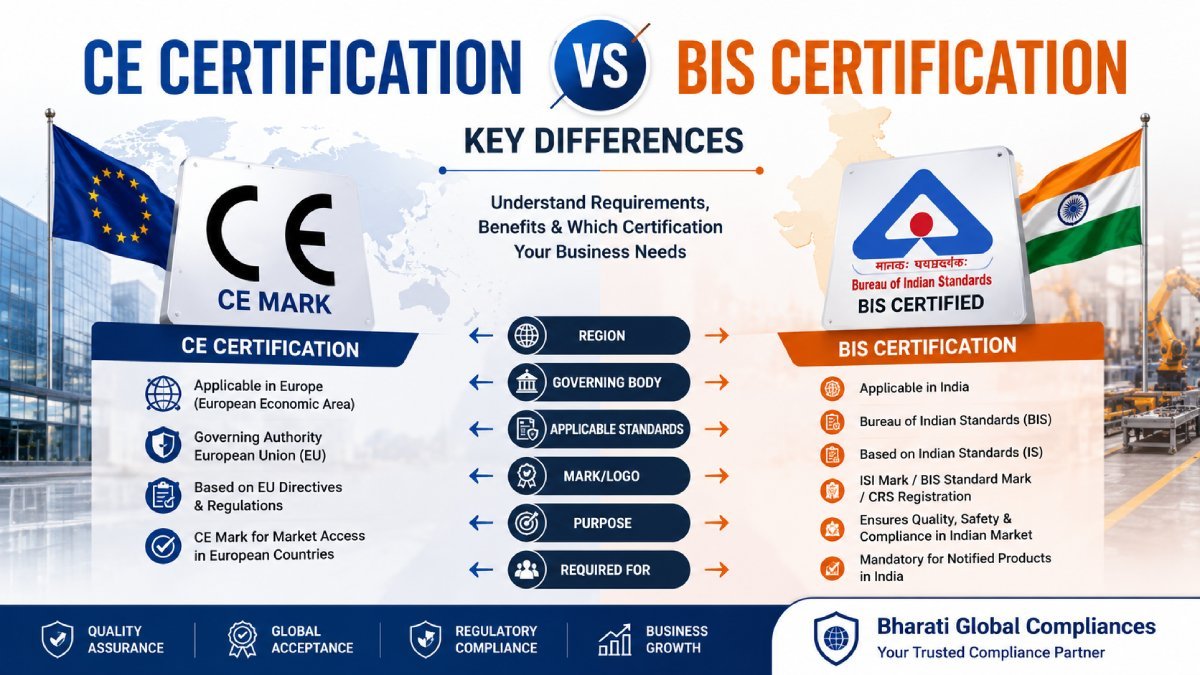
Many foreign manufacturers assume that obtaining international certifications such as ISO, CE Marking, UL, or other approvals is sufficient for selling products in India. However, these certifications do not replace BIS certification where it is legally required.
The Government of India has issued various Quality Control Orders (QCOs) making BIS certification mandatory for specified products. If a product falls under a mandatory QCO, importing or selling it in India without the required BIS Licence is prohibited.
Obtaining BIS FMCS certification is essential because it:
- Ensures compliance with Indian laws and regulations.
- Facilitates smooth customs clearance.
- Demonstrates conformity with applicable Indian Standards.
- Authorizes the legal use of the ISI Mark.
- Builds confidence among distributors, importers, and consumers.
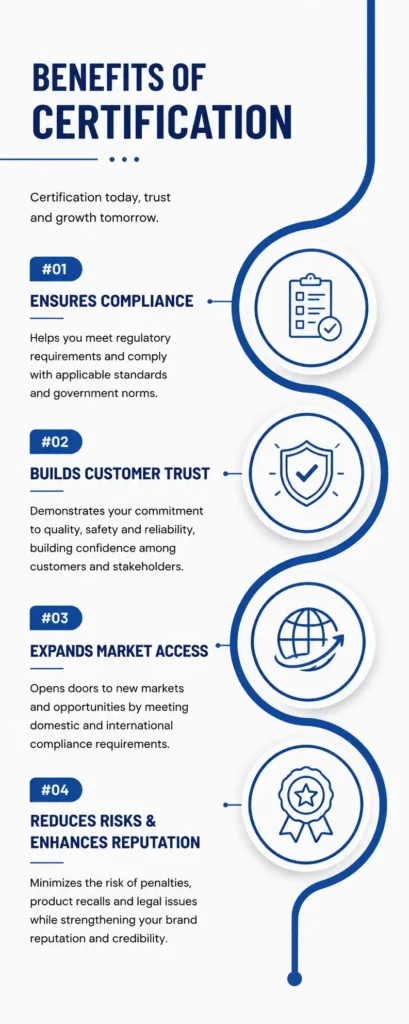
- Reduces regulatory risks and potential legal actions.
- Supports long-term market access and business growth in India.
Failure to comply may lead to shipment detention, rejection at ports, penalties, product recalls, or restrictions on sales within the Indian market.
For this reason, foreign manufacturers should initiate the BIS FMCS certification process well before planning commercial exports to India.
Products Covered, Eligibility, Documents & Authorized Indian Representative (AIR)
Products Covered Under BIS FMCS Certification
The Bureau of Indian Standards (BIS) has notified hundreds of products under the mandatory ISI Certification Scheme. If a foreign manufacturer intends to export any of these notified products to India, obtaining a BIS FMCS Licence is mandatory before the products can be imported, marketed, or sold in the country.
The list of products covered under FMCS continues to expand as the Government of India introduces new Quality Control Orders (QCOs) across various industries. Therefore, manufacturers should always verify whether their product falls under the latest mandatory certification requirements before planning exports.
At Bharati Global Compliances, our experts help businesses identify the applicable Indian Standard (IS Standard), verify certification requirements, and prepare the complete FMCS application accordingly.
Major Product Categories Covered Under BIS FMCS
Electrical Products
Electrical products constitute one of the largest categories requiring BIS certification due to their direct impact on consumer safety and electrical performance.
Examples include:
- Switches
- Circuit Breakers
- Electric Motors
- Transformers
- Cables and Wires
- Electrical Insulators
- Electrical Accessories
- Distribution Equipment
- Capacitors
- Relays
Each product must comply with its respective Indian Standard before obtaining a BIS Licence.
Electronic Equipment
Various electronic products are regulated under mandatory certification requirements to ensure electrical safety, energy efficiency, and product reliability.
Depending on the applicable regulation, electronic products may require BIS FMCS or BIS CRS certification.
Steel & Metal Products
India has made BIS certification mandatory for numerous steel and metal products to maintain structural integrity and industrial safety.
Examples include:
- Steel Bars
- Steel Pipes
- Stainless Steel Products
- Structural Steel
- Wire Rods
- Alloy Steel Products
- Steel Plates
- Fasteners
Cement & Construction Materials
Construction materials used in infrastructure projects are required to comply with Indian Standards.
Examples include:
- Ordinary Portland Cement
- Portland Pozzolana Cement
- Cement Clinker
- Concrete Products
- Building Materials
- Construction Chemicals
Chemical Products
Several industrial and specialty chemicals require BIS certification before they can be imported into India.
These products generally undergo extensive laboratory testing to verify their chemical composition and compliance with Indian Standards.
Household Products
Many household products require BIS approval to ensure consumer safety and product quality.
Examples include:
- Pressure Cookers
- LPG Cylinders
- Kitchen Equipment
- Domestic Appliances
- Cookware
- Storage Containers
Industrial Products
Industrial manufacturing products requiring BIS certification include:
- Valves
- Industrial Components
- Machinery Parts
- Industrial Equipment
- Pipes and Fittings
- Hydraulic Components
Automotive Components
Several automotive parts fall under mandatory BIS certification requirements to ensure road safety and product durability.
How to Check Whether Your Product Requires BIS FMCS?
One of the most common questions asked by overseas manufacturers is:
“Does my product require BIS FMCS Certification?”
The answer depends on several factors, including:
- Product category
- Applicable Indian Standard (IS)
- Quality Control Order (QCO)
- Manufacturing process
- End use of the product
- Ministry issuing the notification
Sometimes two similar-looking products may have entirely different certification requirements.
For example:
- One product may require BIS FMCS.
- Another may require BIS CRS Registration.
- A third product may not require BIS certification at all.
Therefore, it is advisable to conduct a product eligibility assessment before initiating exports.
Bharati Global Compliances provides product eligibility verification to help manufacturers determine the exact certification applicable to their products.
Eligibility Criteria for BIS FMCS Certification
Before applying for BIS FMCS Certification, manufacturers must ensure that they satisfy the eligibility requirements prescribed by the Bureau of Indian Standards.
Failure to meet these conditions may delay the application or result in rejection.
Manufacturing Unit Must Be Located Outside India
The FMCS Scheme is exclusively designed for overseas manufacturing units.
Companies having manufacturing facilities within India must apply under the Domestic ISI Certification Scheme instead of FMCS.
Manufacturing Facility Must Be Fully Operational
The factory should be commercially operational with complete manufacturing infrastructure.
BIS generally does not grant licences to manufacturing units that are still under construction or not fully functional.
Availability of Manufacturing Machinery
The factory should possess adequate manufacturing machinery for producing the certified product.
The production process must be stable, controlled, and capable of consistently manufacturing products conforming to Indian Standards.
In-house Testing Facilities
The manufacturing unit should maintain adequate laboratory facilities capable of conducting routine quality tests specified under the relevant Indian Standard.
The testing laboratory should include:
- Required testing equipment
- Calibrated instruments
- Qualified testing personnel
- Proper test records
Quality Management System
Although ISO certification may not always be mandatory, BIS expects manufacturers to maintain an effective quality management system that ensures consistent production quality.
Compliance with Applicable Indian Standards
Every product must comply with the relevant Indian Standard before certification can be granted.
Compliance is verified through:
- Factory inspection
- Sample testing
- Technical document review
- Manufacturing assessment
Acceptance of BIS Terms and Conditions
Applicants must formally agree to comply with:
- Scheme of Inspection and Testing (SIT)
- BIS Licence Conditions
- Annual Marking Fee
- Product Surveillance Requirements
- Quality Control Obligations
Documents Required for BIS FMCS Certification
Documentation is one of the most critical stages of the FMCS certification process. BIS evaluates every application based on the accuracy, completeness, and authenticity of the submitted documents.
Preparing the documentation carefully can significantly reduce processing delays and improve the chances of timely approval.
Company Registration Documents
The applicant must provide documents establishing the legal identity of the manufacturing organization.
These generally include:
- Certificate of Incorporation
- Business Registration Certificate
- Factory Licence
- Manufacturing Authorization
- Company Profile
Manufacturing Documents
These documents help BIS understand the production process.
Typically required documents include:
- Manufacturing Process Flow Chart
- Production Layout
- Manufacturing Capacity Details
- Machinery List
- Production Line Information
Quality Control Documents
Manufacturers should demonstrate that effective quality control procedures are implemented throughout production.
Typical documents include:
- Quality Manual
- Inspection Procedures
- Calibration Certificates
- Internal Testing Procedures
- Test Records
Laboratory Documents
The factory laboratory plays a crucial role during BIS inspection.
Manufacturers should prepare:
- Laboratory Equipment List
- Calibration Reports
- Laboratory Layout
- Equipment Photographs
- Testing Procedures
Product Documents
The applicant should submit technical information regarding the product.
Examples include:
- Product Drawings
- Product Specifications
- Technical Datasheets
- Product Catalogue
- Bill of Materials (if applicable)
Test Reports
BIS may require product test reports from recognized laboratories depending on the applicable Indian Standard and certification stage.
Authorized Indian Representative Documents
Where required, documents relating to the Authorized Indian Representative (AIR) should also be submitted.
These generally include:
- AIR Nomination Letter
- Acceptance Letter
- Identity Proof
- Address Proof
- Authorization Documents
Authorized Indian Representative (AIR)
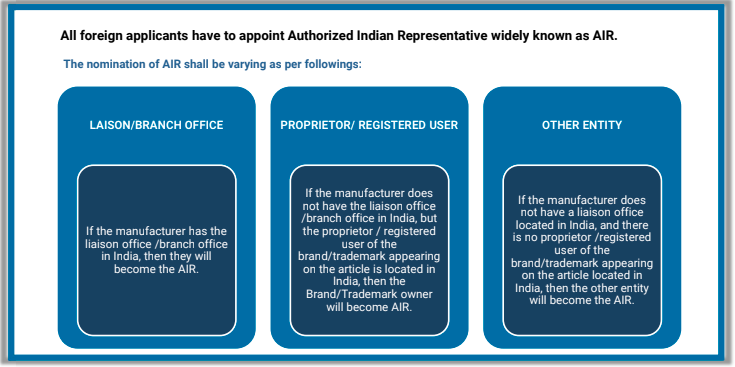
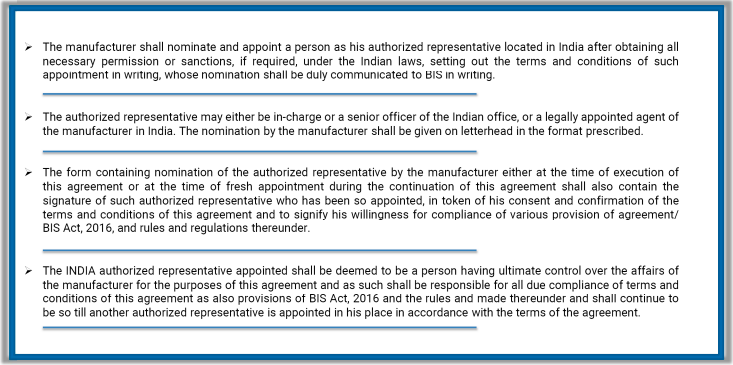
One of the most important requirements under the BIS FMCS Scheme is the appointment of an Authorized Indian Representative (AIR).
Foreign manufacturers without an established legal entity in India are generally required to nominate an AIR to represent them before the Bureau of Indian Standards.
The AIR acts as the official communication link between BIS and the overseas manufacturer throughout the certification lifecycle.
Why is AIR Mandatory?
Since BIS authorities cannot coordinate every operational matter directly with manufacturers located overseas, the AIR ensures that regulatory communication remains smooth and efficient.
The AIR assists in:
- Communication with BIS
- Submission of documents
- Responding to technical queries
- Coordinating inspections
- Managing licence-related correspondence
- Supporting renewal applications
- Addressing surveillance activities
The appointment of a competent AIR often helps avoid unnecessary delays and facilitates quicker resolution of compliance issues.
Who Can Become an Authorized Indian Representative?
The eligibility of an AIR depends on the manufacturer’s presence in India.
Generally, the following entities may serve as an AIR:
- Indian Branch Office of the Foreign Manufacturer
- Indian Subsidiary Company
- Liaison Office
- Authorized Importer
- Authorized Distributor
- Independent Representative (subject to BIS requirements)
The selected AIR must be capable of fulfilling all responsibilities specified under the BIS Act, Rules, and applicable Regulations.
Responsibilities of the Authorized Indian Representative
The AIR plays a significant role throughout the validity period of the BIS Licence.
Key responsibilities include:
- Representing the foreign manufacturer before BIS.
- Coordinating submission of applications and supporting documents.
- Responding to queries raised by BIS authorities.
- Assisting during factory inspections and audits.
- Maintaining communication regarding licence conditions.
- Supporting surveillance inspections and renewals.
- Ensuring compliance with applicable BIS regulations.
- Facilitating corrective actions whenever required.
Selecting an experienced AIR with a strong understanding of BIS procedures can substantially improve the efficiency of the certification process.
How Bharati Global Compliances Supports Foreign Manufacturers
Obtaining a BIS FMCS Licence requires technical expertise, regulatory understanding, and careful coordination between the manufacturer, testing laboratories, the Authorized Indian Representative, and BIS authorities.
Bharati Global Compliances provides comprehensive support by helping clients:
- Identify the correct Indian Standard for their products.
- Assess FMCS eligibility before application.
- Prepare and review documentation.
- Coordinate with testing laboratories.
- Arrange and support the appointment of an Authorized Indian Representative (AIR).
- Prepare the manufacturing unit for BIS factory inspections.
- Assist with application submission and query resolution.
- Guide clients through licence approval, renewal, and post-certification compliance.
By offering end-to-end consultancy, we help overseas manufacturers streamline the certification process and confidently enter the Indian market.
Complete BIS FMCS Registration Process for Foreign Manufacturers
Obtaining a BIS FMCS Licence is not simply about submitting an application. It is a comprehensive conformity assessment process through which the Bureau of Indian Standards (BIS) verifies whether a foreign manufacturing unit is capable of consistently producing products that comply with the applicable Indian Standard (IS).
Unlike many certification schemes where only documents are reviewed, the BIS FMCS process involves technical scrutiny, factory inspection, laboratory evaluation, product testing, and quality system assessment before a licence is granted.
For foreign manufacturers entering the Indian market for the first time, understanding each stage of the certification process can significantly reduce delays and improve the likelihood of obtaining approval without unnecessary complications.
At Bharati Global Compliances, we assist overseas manufacturers throughout every stage of the BIS FMCS registration process—from identifying the applicable Indian Standard to obtaining the final licence and maintaining compliance after certification.
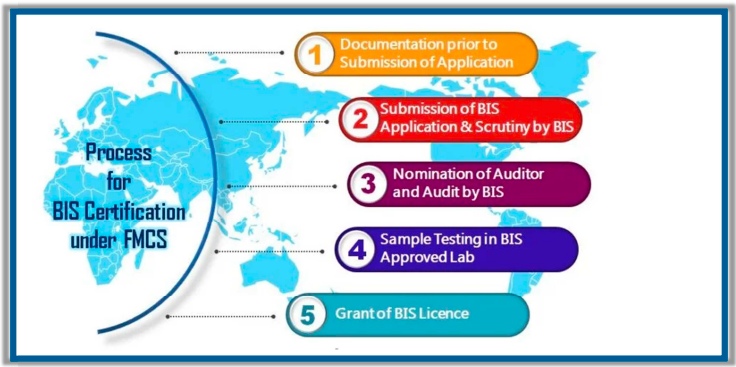
Step-by-Step BIS FMCS Certification Process
Although the exact requirements may vary depending on the product category and applicable Indian Standard, the certification process generally consists of the following stages:
- Product Eligibility Assessment
- Identification of Applicable Indian Standard
- Appointment of Authorized Indian Representative (AIR)
- Preparation of Documentation
- Online Application Submission
- Scrutiny of Documents by BIS
- Factory Inspection by BIS Officials
- Product Sample Collection
- Laboratory Testing
- Technical Evaluation
- Grant of BIS Licence
- Permission to Use the ISI Mark
- Ongoing Surveillance & Compliance
Each stage plays an important role in determining whether the manufacturer satisfies BIS requirements.
Step 1: Product Eligibility Assessment
Before preparing any documentation, the manufacturer should determine whether the product falls under the mandatory BIS certification scheme.
This involves identifying:
- Applicable Quality Control Order (QCO)
- Relevant Indian Standard (IS)
- Certification Scheme
- Product Category
- Scope of Certification
Many overseas manufacturers mistakenly assume that all products require FMCS certification. However, depending on the product, the applicable certification may instead fall under:
- BIS CRS Registration
- Hallmarking
- Voluntary Certification
- No BIS Requirement
A professional eligibility assessment helps avoid unnecessary applications and ensures that the correct certification route is selected from the outset.
Step 2: Identification of the Applicable Indian Standard (IS)
Every product certified under FMCS must comply with a specific Indian Standard (IS Code) published by the Bureau of Indian Standards.
The applicable standard defines:
- Product specifications
- Performance requirements
- Safety criteria
- Testing methods
- Sampling procedures
- Marking requirements
- Quality control measures
Selecting the wrong Indian Standard can lead to application rejection or significant processing delays. Therefore, manufacturers should carefully verify the correct standard before initiating the certification process.
Step 3: Appointment of an Authorized Indian Representative (AIR)
Foreign manufacturers that do not have a registered office or legal entity in India are generally required to appoint an Authorized Indian Representative (AIR).
The AIR serves as the official liaison between the foreign manufacturer and BIS throughout the certification lifecycle.
The responsibilities of the AIR include:
- Coordinating with BIS authorities
- Managing application-related communications
- Submitting documents and clarifications
- Assisting during inspections
- Supporting licence renewals
- Responding to compliance-related queries
Appointing an experienced AIR can significantly improve coordination and help resolve regulatory issues more efficiently.
Step 4: Preparation of Documentation
Documentation is one of the most critical aspects of the FMCS certification process.
Before submitting the application, the manufacturer must compile comprehensive information related to:
Company Documents
- Business Registration Certificate
- Manufacturing Licence
- Factory Registration
- Organization Details
Product Documents
- Product Specifications
- Technical Drawings
- Product Catalogue
- Material Specifications
Manufacturing Documents
- Process Flow Chart
- Manufacturing Layout
- Machinery Details
- Production Capacity
Laboratory Documents
- Testing Equipment List
- Calibration Certificates
- Laboratory Layout
- Internal Testing Procedures
Quality Documents
- Quality Manual
- Inspection Procedures
- Standard Operating Procedures
- Test Records
- Quality Control Reports
Since BIS performs detailed scrutiny of these documents, accuracy and consistency are essential throughout the application.
Step 5: Submission of the BIS FMCS Application
Once all documents have been prepared, the manufacturer submits the application to the Foreign Manufacturers Certification Department (FMCD) of BIS.
The application typically includes:
- Completed application forms
- Technical documentation
- Manufacturing information
- Product details
- Supporting declarations
- Prescribed application fees
The information submitted should accurately represent the manufacturing process and product specifications. Any inconsistencies discovered later during the inspection may result in additional queries or delays.
Step 6: Application Scrutiny by BIS
After receiving the application, BIS conducts a detailed review of all submitted documents.
During this stage, BIS verifies:
- Completeness of documentation
- Product details
- Manufacturing information
- Applicable Indian Standard
- Testing facilities
- Quality management procedures
- AIR nomination (where applicable)
If any information is incomplete or unclear, BIS may issue a technical query requesting additional documents or clarification.
Prompt and accurate responses to these queries are essential to keep the certification process moving forward.
Step 7: Factory Inspection by BIS Officials
One of the most significant stages of the FMCS certification process is the inspection of the overseas manufacturing facility.
Unlike many certification schemes that rely solely on documentation, BIS officials physically visit the manufacturing unit to assess whether the factory is capable of consistently producing products that comply with Indian Standards.
The inspection is scheduled after the application has been found satisfactory.
What Do BIS Officials Inspect?
During the factory visit, BIS officers evaluate several critical aspects of the manufacturing facility, including:
Manufacturing Infrastructure
The inspection team verifies whether the factory possesses the necessary machinery, production equipment, and manufacturing capabilities required for the certified product.
Production Process
BIS examines the complete manufacturing workflow to ensure that production is carried out in a controlled and systematic manner.
Officials may observe:
- Raw material handling
- Manufacturing operations
- Assembly processes
- Packaging procedures
- Final inspection
Quality Control System
The effectiveness of the manufacturer’s quality management system is carefully evaluated.
This includes reviewing:
- Incoming material inspection
- In-process quality checks
- Final product inspection
- Record maintenance
- Corrective action procedures
Laboratory Facilities
One of the most important areas inspected by BIS is the in-house testing laboratory.
Officials verify:
- Availability of testing equipment
- Calibration status
- Laboratory environment
- Test procedures
- Competency of laboratory personnel
The laboratory should be capable of conducting routine quality tests required under the applicable Indian Standard.
Technical Personnel
BIS also evaluates whether qualified technical staff are available to supervise manufacturing and testing activities.
The competency of production engineers, quality managers, and laboratory personnel may be assessed during the inspection.
Step 8: Product Sample Collection
After completing the factory inspection, BIS officials select product samples for independent laboratory testing.
The samples are:
- Randomly selected
- Properly identified
- Officially sealed
- Forwarded to a BIS-recognized laboratory
This process ensures that the tested samples accurately represent the products manufactured at the facility.
Step 9: Laboratory Testing
The collected product samples undergo testing according to the applicable Indian Standard.
Testing verifies whether the product satisfies all mandatory technical requirements, including:
- Safety
- Performance
- Durability
- Material composition
- Mechanical properties
- Electrical characteristics
- Chemical properties (where applicable)
Testing procedures vary depending on the product category and the applicable IS Standard.
Only products that successfully comply with all required parameters proceed to the next stage of certification.
Step 10: Technical Evaluation by BIS
Once the laboratory test reports are received, BIS conducts a comprehensive technical evaluation.
During this stage, BIS reviews:
- Inspection findings
- Laboratory test reports
- Manufacturing capabilities
- Quality control system
- Compliance with Indian Standards
- Technical documentation
If any non-conformities are identified, BIS may request corrective actions before further processing the application.
Manufacturers should address these observations promptly to avoid delays in licence approval.
Step 11: Grant of BIS FMCS Licence
When BIS is satisfied that:
- The factory complies with applicable requirements,
- Product testing is successful,
- Technical documentation is complete,
- Quality systems are adequate,
the Bureau grants the BIS FMCS Licence.
The licence authorizes the manufacturer to produce and export certified products to India in accordance with the approved Indian Standard.
The licence also contains important information such as:
- Licence Number
- Product Details
- Applicable Indian Standard
- Manufacturing Unit
- Scope of Certification
- Licence Validity
Step 12: Permission to Use the ISI Standard Mark
After receiving the BIS Licence, the foreign manufacturer is authorized to use the ISI Standard Mark on certified products.
However, the ISI Mark may only be applied:
- To products covered under the licence.
- At the approved manufacturing facility.
- In accordance with BIS marking guidelines.
- While maintaining continuous compliance with Indian Standards.
Unauthorized use or misuse of the ISI Mark may result in regulatory action, suspension, or cancellation of the licence.
How Bharati Global Compliances Simplifies the FMCS Process
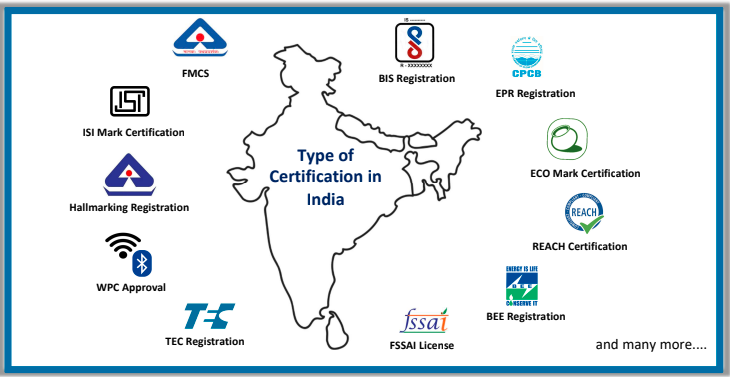
The BIS FMCS certification process involves technical documentation, regulatory coordination, factory readiness, and strict compliance with Indian Standards. Even minor errors in documentation or delays in responding to BIS queries can extend the approval timeline.
Bharati Global Compliances provides end-to-end consultancy by assisting manufacturers with product eligibility assessment, identification of the correct Indian Standard, documentation preparation, AIR support, application filing, factory audit readiness, laboratory coordination, query management, and post-licence compliance. Our structured approach helps overseas manufacturers navigate the certification process efficiently while reducing avoidable delays.
BIS FMCS Licence Validity, Timeline, Cost Factors, Renewal, Surveillance & Compliance
Obtaining a BIS FMCS Licence is only one part of the compliance journey. After the licence is granted, foreign manufacturers are expected to maintain continuous conformity with the applicable Indian Standards throughout the validity period. The Bureau of Indian Standards (BIS) conducts regular surveillance activities to ensure that certified products continue to meet the prescribed quality and safety requirements.
For this reason, manufacturers should view FMCS certification as an ongoing compliance commitment rather than a one-time approval. Proper planning for licence validity, renewal, surveillance inspections, and post-certification obligations helps businesses avoid interruptions in exports and ensures uninterrupted access to the Indian market.
At Bharati Global Compliances, we not only assist clients in obtaining the BIS FMCS Licence but also provide continuous support for renewal, surveillance preparation, documentation updates, and regulatory compliance.
Timeline for BIS FMCS Certification
One of the most common questions foreign manufacturers ask is:
“How long does it take to obtain a BIS FMCS Licence?”
There is no fixed timeline applicable to every application. The processing time depends on multiple technical and administrative factors, including the complexity of the product, completeness of documentation, availability of BIS inspection teams, laboratory testing schedules, and the responsiveness of the manufacturer during the certification process.
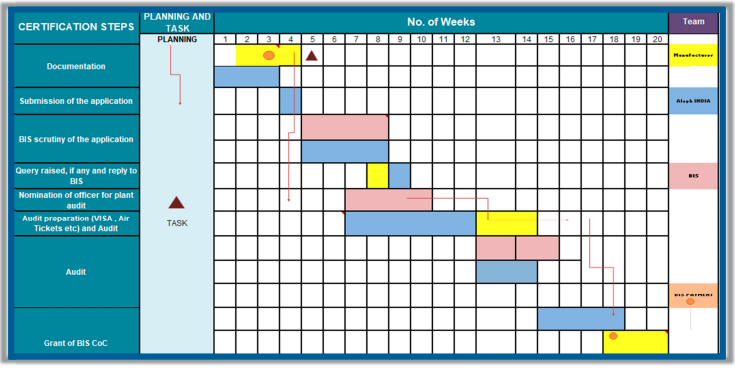
Under normal circumstances, the BIS FMCS certification process generally takes 4 to 6 months from the date a complete application is accepted. However, in certain cases, the timeline may extend if additional information, corrective actions, or supplementary testing is required.
Typical BIS FMCS Certification Timeline
| Stage | Estimated Duration |
|---|---|
| Product Eligibility Assessment | 2–5 Days |
| Documentation Preparation | 2–4 Weeks |
| Application Review by BIS | 2–3 Weeks |
| Technical Query Resolution (if applicable) | 1–3 Weeks |
| Factory Audit Scheduling | 2–6 Weeks |
| Overseas Factory Inspection | 1–3 Days |
| Product Sample Testing | 3–6 Weeks |
| Technical Evaluation | 2–4 Weeks |
| Grant of BIS Licence | 1–2 Weeks |
Estimated Total Duration: 4–6 Months (subject to product category and BIS processing).
Factors That May Increase the Timeline
Although BIS strives to process applications efficiently, certain circumstances may extend the approval period.
These include:
- Incomplete or inaccurate documentation
- Incorrect product classification
- Delay in appointing an Authorized Indian Representative (AIR)
- Pending clarifications requested by BIS
- Factory not fully prepared for inspection
- Delay in laboratory testing
- Non-conformities identified during the audit
- Delay in payment of prescribed BIS fees
- National holidays or travel scheduling for overseas inspections
Planning the certification process well in advance helps manufacturers avoid disruptions in export schedules.
Cost Factors for BIS FMCS Certification
Unlike many regulatory approvals, there is no single fixed fee applicable to every FMCS certification project. The overall cost depends on several variables specific to the manufacturer, product, and certification scope.
Manufacturers should consider the certification process as an investment in regulatory compliance, product credibility, and long-term market access rather than merely an administrative expense.
Factors Influencing the Cost of BIS FMCS Certification
Product Category
Different products require different levels of technical evaluation, testing, and inspection. Complex industrial products generally involve higher certification costs than simpler consumer products.
Number of Products
Each product covered under a different Indian Standard usually requires a separate certification process. As the number of products increases, documentation, testing, and evaluation costs may also increase.
Manufacturing Locations
BIS grants licences to individual manufacturing units. If a company has factories in multiple countries or different locations, separate applications may be required for each manufacturing facility.
Factory Inspection Expenses
Since BIS officials travel overseas to inspect manufacturing facilities, inspection-related expenses vary depending on the country and travel arrangements.
Laboratory Testing Charges
Testing charges depend upon:
- Product type
- Applicable Indian Standard
- Number of tests required
- Laboratory selected
- Sample quantity
Consultancy Services
Many overseas manufacturers choose experienced consultants to simplify documentation, coordinate inspections, manage technical queries, and reduce certification delays.
Professional consultancy often helps avoid costly mistakes that may otherwise result in repeated submissions or prolonged processing.
Validity of BIS FMCS Licence
Once granted, the BIS FMCS Licence remains valid for the period specified by the Bureau of Indian Standards, subject to compliance with all applicable licence conditions.
During the validity period, manufacturers must continue producing products that conform to the approved Indian Standard and maintain the same manufacturing infrastructure, testing facilities, and quality management systems assessed during certification.
The licence holder is also expected to:
- Maintain production records
- Conduct routine quality testing
- Preserve inspection reports
- Follow the approved Scheme of Inspection and Testing (SIT)
- Allow BIS surveillance activities whenever required
Any significant changes in manufacturing processes, factory location, product design, or testing facilities should be communicated to BIS.
Renewal of BIS FMCS Licence
Obtaining the licence is not the final step. Manufacturers intending to continue exporting certified products to India must apply for licence renewal before the existing licence expires.
Failure to renew the licence on time may interrupt business operations and affect product availability in the Indian market.
Renewal Process
The renewal procedure generally involves:
Review of Existing Licence
The manufacturer reviews the current licence and verifies whether all compliance requirements have been maintained throughout the validity period.
Preparation of Renewal Documents
Updated records relating to production, quality control, testing, calibration, and compliance are compiled for submission.
Submission of Renewal Application
The renewal application is filed along with the prescribed documents and applicable fees before the expiry of the existing licence.
Verification by BIS
BIS reviews the manufacturer’s compliance history, surveillance records, production data, and any complaints received during the licence period.
Renewal Approval
If BIS is satisfied that the manufacturer continues to comply with all applicable requirements, the licence is renewed for the prescribed period.
Timely renewal helps manufacturers avoid disruptions in imports, customs clearance, and product sales.
Surveillance Inspection by BIS
Maintaining product quality after obtaining certification is equally important.
Therefore, BIS conducts Surveillance Inspections from time to time to verify that licensed manufacturers continue to comply with Indian Standards.
Surveillance inspections are an integral part of the FMCS certification scheme and help maintain confidence in products carrying the ISI Mark.
Purpose of Surveillance Inspection
The objective of surveillance is to ensure that:
- Manufacturing quality remains consistent.
- Testing facilities continue to function properly.
- Products continue to conform to Indian Standards.
- Quality management systems remain effective.
- Consumers receive safe and reliable products.
What Happens During Surveillance?
During surveillance activities, BIS may:
- Review manufacturing records
- Inspect production processes
- Verify testing equipment
- Check calibration status
- Examine quality control procedures
- Collect market or factory samples
- Review complaint records
- Assess corrective actions
Manufacturers should maintain complete documentation at all times to facilitate smooth surveillance inspections.
Product Sample Testing During Surveillance
BIS may collect product samples either from the manufacturing facility or directly from the Indian market.
These samples are tested in recognized laboratories to confirm ongoing compliance with the applicable Indian Standard.
If the samples meet all specified requirements, the licence continues without interruption.
Complaint Redressal Mechanism
Product quality remains the responsibility of the manufacturer even after certification.
If BIS receives complaints regarding certified products, the Bureau may initiate an investigation to determine whether the product continues to comply with Indian Standards.
Complaints may relate to:
- Product safety
- Performance issues
- Manufacturing defects
- Quality concerns
- Improper use of the ISI Mark
Manufacturers are expected to cooperate fully during such investigations and implement corrective actions wherever necessary.
Suspension or Cancellation of BIS FMCS Licence
The Bureau of Indian Standards has the authority to suspend or cancel an FMCS Licence if the manufacturer fails to comply with the applicable provisions of the BIS Act, Regulations, or licence conditions.
Such actions are generally taken only after due process and evaluation of the non-conformities identified.
Common Reasons for Suspension or Cancellation
A licence may be suspended or cancelled due to:
- Failure to maintain product quality
- Misuse of the ISI Standard Mark
- Submission of misleading or false information
- Major deviations in the manufacturing process
- Inadequate testing facilities
- Failure to comply with surveillance requirements
- Repeated non-conforming test results
- Non-payment of applicable BIS fees
- Failure to implement corrective actions
Suspension or cancellation may impact the manufacturer’s ability to export certified products to India until compliance is restored.
Common Reasons for Delay or Rejection of FMCS Applications
Many certification delays are avoidable and result from preventable errors during application preparation.
Some of the most common reasons include:
- Incorrect identification of the applicable Indian Standard.
- Incomplete application forms.
- Missing supporting documents.
- Inconsistent technical information.
- Inadequate laboratory infrastructure.
- Uncalibrated testing equipment.
- Factory not ready for inspection.
- Delayed responses to BIS technical queries.
- Poor quality management documentation.
- Failure to appoint a compliant Authorized Indian Representative (AIR).
Careful planning and professional guidance can significantly reduce these risks.
Best Practices for Faster BIS FMCS Approval
To improve the efficiency of the certification process, manufacturers should:
- Confirm product eligibility before applying.
- Identify the correct Indian Standard.
- Prepare complete and accurate documentation.
- Ensure testing equipment is calibrated.
- Train production and quality control personnel.
- Conduct an internal compliance review before the BIS audit.
- Respond promptly to BIS queries.
- Maintain transparent communication throughout the process.
- Engage experienced compliance professionals to coordinate the certification journey.
Following these practices can help minimize delays and improve the likelihood of a smooth approval process.
How Bharati Global Compliances Supports You After Certification
Our support does not end with the grant of the BIS FMCS Licence. Bharati Global Compliances continues to assist clients with licence renewals, surveillance inspection readiness, compliance documentation, regulatory updates, technical query handling, and post-certification advisory services. Our goal is to help manufacturers maintain uninterrupted compliance and confidently continue exporting certified products to the Indian market.
Why Choose Bharati Global Compliances, Industries We Serve, & Get Started with BIS FMCS Certification
Obtaining a BIS FMCS Licence is not just about meeting regulatory requirements—it is about establishing long-term trust in one of the world’s fastest-growing markets. A successful certification process requires technical expertise, proper planning, accurate documentation, and continuous compliance with BIS regulations.
Many foreign manufacturers encounter delays because of incomplete documentation, incorrect product classification, inadequate factory preparation, or difficulties in coordinating with Indian authorities. Working with an experienced compliance partner helps eliminate these challenges and ensures a smoother certification journey.
At Bharati Global Compliances, we combine regulatory knowledge, practical experience, and a structured project management approach to help overseas manufacturers obtain BIS FMCS Certification efficiently and confidently.
Why Choose Bharati Global Compliances for BIS FMCS Certification?
Choosing the right compliance partner can significantly impact the success and speed of your certification process. Our consultancy is committed to providing transparent, reliable, and end-to-end support for manufacturers across the globe.
Industry Expertise
Our team possesses extensive knowledge of the Bureau of Indian Standards (BIS), applicable Indian Standards (IS), Quality Control Orders (QCOs), and FMCS procedures. We stay updated with the latest regulatory changes to ensure our clients receive accurate guidance at every stage.
Complete End-to-End Assistance
We manage the entire certification process, allowing manufacturers to focus on production while we handle regulatory compliance.
Our support includes:
- Product eligibility assessment
- Identification of the correct Indian Standard
- Documentation preparation
- Application filing
- AIR assistance
- Factory audit preparation
- Product testing coordination
- BIS query management
- Licence approval support
- Renewal and post-certification compliance
Dedicated Project Management
Every client is assigned a dedicated compliance expert who coordinates the project from the initial consultation to the grant of the BIS Licence.
This ensures timely communication, organized documentation, and continuous project monitoring.
Global Client Support
We assist manufacturers located across:
- China
- Taiwan
- South Korea
- Japan
- Vietnam
- Thailand
- Malaysia
- Germany
- Italy
- France
- United Kingdom
- United States
- Turkey
- UAE
- Singapore
- And many other countries
Regardless of your manufacturing location, our team provides reliable support throughout the certification process.
Transparent Process
We believe in complete transparency.
Our clients receive:
- Regular project updates
- Clear documentation checklists
- Defined certification roadmap
- Prompt responses to queries
- Professional consultation throughout the project
Long-Term Compliance Support
Our relationship with clients continues even after the licence is granted.
We provide assistance for:
- Licence Renewal
- Surveillance Inspection Preparation
- Additional Product Certifications
- Scope Extension
- Regulatory Updates
- Ongoing BIS Compliance
Our BIS FMCS Consultancy Services
At Bharati Global Compliances, we provide comprehensive consultancy services designed specifically for overseas manufacturers.
Product Eligibility Assessment
We evaluate whether your product requires BIS FMCS Certification and identify the applicable Indian Standard.
Indian Standard Identification
Selecting the correct IS Standard is critical. Our experts analyze your product specifications and determine the appropriate standard applicable under BIS regulations.
Documentation Preparation
We assist in preparing and reviewing all technical and regulatory documents required for FMCS certification.
Authorized Indian Representative (AIR) Assistance
Where required, we guide manufacturers through the appointment of an Authorized Indian Representative and ensure compliance with BIS requirements.
Factory Audit Preparation
Before the BIS inspection, we help manufacturers prepare their production facilities, laboratories, quality systems, and documentation to minimize observations during the audit.
Product Testing Coordination
We coordinate product testing with recognized laboratories and assist in interpreting technical requirements under the applicable Indian Standard.
BIS Query Resolution
If BIS raises technical observations or requests additional information, our consultants assist in preparing timely and accurate responses.
Renewal & Compliance Services
We continue supporting clients after certification by assisting with licence renewals, surveillance inspections, and ongoing regulatory compliance.
Industries We Serve
Our BIS FMCS consultancy services support manufacturers from a wide range of industries.
These include:
Electrical Equipment Manufacturers
Switchgear, cables, transformers, electrical accessories, motors, and power distribution equipment.
Construction Material Manufacturers
Cement, steel products, pipes, fittings, construction chemicals, and building materials.
Consumer Product Manufacturers
Household appliances, cookware, pressure cookers, LPG cylinders, and consumer goods.
Industrial Equipment Manufacturers
Industrial machinery, valves, engineering products, hydraulic components, and mechanical equipment.
Chemical Manufacturers
Industrial chemicals, specialty chemicals, fertilizers, and chemical intermediates.
Automotive Component Manufacturers
Automotive parts, safety components, engineering products, and industrial assemblies.
Frequently Asked Questions (FAQs)
What is BIS FMCS Certification?
BIS FMCS (Foreign Manufacturers Certification Scheme) is a certification programme administered by the Bureau of Indian Standards for manufacturers located outside India. It allows eligible foreign manufacturers to obtain a BIS Licence and use the ISI Mark on products that comply with applicable Indian Standards.
Is BIS FMCS mandatory?
Yes. If your product is covered under a mandatory Quality Control Order (QCO), obtaining BIS FMCS Certification is legally required before exporting and selling the product in India.
Who can apply for BIS FMCS Certification?
Any manufacturer located outside India producing products covered under the mandatory BIS certification scheme can apply for FMCS Certification.
What is the validity of a BIS FMCS Licence?
The validity of the licence is determined by BIS and is subject to compliance with all applicable licence conditions. Renewal should be completed before expiry to ensure uninterrupted market access.
Is an Authorized Indian Representative (AIR) mandatory?
In most cases, yes. Foreign manufacturers without a legal entity in India are generally required to appoint an Authorized Indian Representative (AIR).
Can one licence cover multiple factories?
No. BIS issues licences to individual manufacturing units. Separate applications are generally required for each factory.
Can one licence cover multiple products?
Only products covered under the same scope and applicable Indian Standard may be included, subject to BIS regulations. Additional products may require separate applications.
How long does the FMCS certification process take?
The average processing time is approximately 4 to 6 months, depending on documentation, inspection schedules, testing timelines, and BIS evaluation.
Does BIS inspect overseas factories?
Yes. BIS officials conduct on-site inspections of the overseas manufacturing facility before granting the licence.
What happens during the factory inspection?
BIS evaluates the manufacturing process, production infrastructure, testing laboratory, quality management system, technical personnel, and product conformity.
Is product testing mandatory?
Yes. Product samples are generally tested in accordance with the applicable Indian Standard before the licence is granted.
Can BIS reject an application?
Yes. Applications may be rejected if the manufacturer fails to satisfy BIS requirements or does not comply with applicable Indian Standards.
What happens if my product fails testing?
The manufacturer may need to investigate the cause, implement corrective actions, and comply with BIS requirements before proceeding further.
Can the BIS Licence be suspended?
Yes. Failure to maintain product quality, misuse of the ISI Mark, or non-compliance with licence conditions may result in suspension or cancellation.
Why should I hire a BIS FMCS consultant?
A professional consultant helps simplify documentation, coordinate inspections, manage technical queries, and reduce certification delays, making the overall process more efficient.
Ready to Export Your Products to India?
Expanding into the Indian market offers significant business opportunities, but regulatory compliance is essential for long-term success. If your products fall under the mandatory BIS certification scheme, obtaining the BIS FMCS Licence is a critical step before entering the market.
With the right guidance and expert support, the certification process becomes more organized, efficient, and predictable.
Bharati Global Compliances is committed to helping foreign manufacturers navigate every stage of the BIS FMCS certification process—from eligibility assessment and documentation to factory inspections, product testing, licence approval, and post-certification compliance.
Whether you are exporting a single product or managing a diverse product portfolio, our experts provide tailored solutions to help you achieve compliance with confidence.