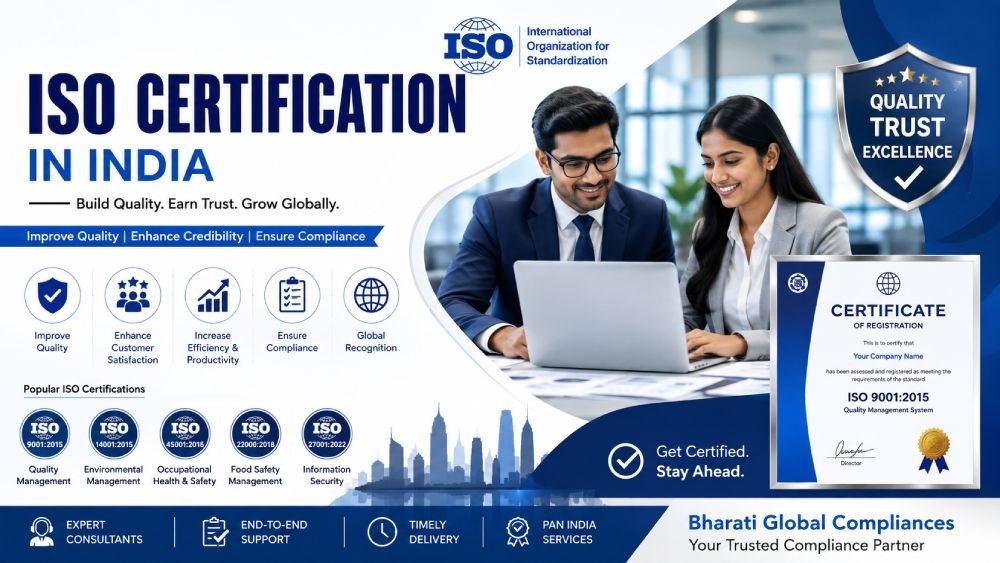
In today’s competitive business environment, maintaining high standards of quality, safety, efficiency, and customer satisfaction is essential for long-term success. ISO Certification helps organizations establish internationally recognized management systems that improve operational performance, build customer confidence, and demonstrate a commitment to continual improvement.
Whether you are a startup, MSME, manufacturer, exporter, service provider, educational institution, healthcare organization, or multinational company, obtaining the appropriate ISO Certification enhances your credibility and strengthens your position in both domestic and international markets.
At Bharati Global Compliances, we provide end-to-end consultancy for ISO Certification in India. Our experienced consultants assist businesses in selecting the right ISO standard, preparing documentation, implementing management systems, coordinating audits, and obtaining certification from accredited certification bodies.
What is ISO Certification?
ISO (International Organization for Standardization) is an independent international organization that develops globally accepted standards for quality management, environmental management, information security, occupational health and safety, food safety, energy management, and many other business processes.
ISO Certification confirms that an organization has implemented a management system that complies with the requirements of a specific ISO standard. It demonstrates that the organization follows internationally recognized best practices to deliver consistent products and services while continually improving its operations.
Rather than using the general term “ISO Certified,” organizations should refer to the specific standard they have achieved, such as ISO 9001:2015 Certification, ISO 14001:2015 Certification, or ISO 45001:2018 Certification.
Why is ISO Certification Important?
ISO Certification is recognized worldwide and helps businesses improve operational efficiency while enhancing their reputation in the marketplace. It provides a structured framework for managing business processes, reducing risks, improving product quality, and meeting customer expectations.
Some of the major advantages of ISO Certification include:
- Improves product and service quality.
- Enhances customer satisfaction and trust.
- Builds international business credibility.
- Strengthens brand reputation.
- Improves operational efficiency.
- Standardizes business processes.
- Reduces operational risks and errors.
- Supports regulatory compliance.
- Improves employee productivity.
- Creates opportunities in domestic and international markets.
- Helps qualify for government and private tenders.
- Encourages continual business improvement.

Who Needs ISO Certification?
ISO Certification is suitable for organizations of all sizes and industries. Businesses seeking improved quality management, regulatory compliance, customer confidence, or international market access can benefit from implementing the appropriate ISO standard.
Organizations that commonly obtain ISO Certification include:
- Manufacturing Companies
- Service Providers
- Exporters and Importers
- Healthcare Organizations
- Hospitals and Clinics
- Educational Institutions
- IT and Software Companies
- Construction Companies
- Food Manufacturers
- Pharmaceutical Companies
- Laboratories
- Engineering Companies
- Logistics and Transportation Businesses
- Government Organizations
- Startups and MSMEs
- E-commerce Businesses
- Hotels and Hospitality Industry
- Financial Service Providers
ISO Certification Services Offered by Bharati Global Compliances
At Bharati Global Compliances, we provide consultancy for a wide range of internationally recognized ISO standards based on your business requirements.
Our ISO consultancy services include:
- ISO 9001 – Quality Management System
- ISO 14001 – Environmental Management System
- ISO 22000 – Food Safety Management System
- ISO 27001 – Information Security Management System
- ISO 45001 – Occupational Health & Safety Management System
- ISO 13485 – Medical Devices Quality Management System
- ISO 50001 – Energy Management System
- ISO 22301 – Business Continuity Management System
- ISO 37001 – Anti-Bribery Management System
- ISO 20000-1 – IT Service Management System
- ISO 41001 – Facility Management System
- ISO 21001 – Educational Organizations Management System
- ISO 31000 – Risk Management Guidance
- Customized ISO Consultancy Services
Why Choose Bharati Global Compliances?
With years of experience in regulatory compliance and certification consultancy, Bharati Global Compliances provides complete support throughout the ISO Certification process. From selecting the appropriate ISO standard to documentation, implementation guidance, audit coordination, and certification assistance, our experts ensure a smooth, transparent, and hassle-free experience for businesses across India.
We are committed to delivering professional consultancy, timely support, and cost-effective certification solutions tailored to your organization’s specific requirements.
Types of ISO Certifications
Different ISO standards are designed to address specific aspects of business operations, such as quality management, environmental protection, information security, occupational health and safety, food safety, and energy efficiency. Choosing the right ISO standard depends on the nature of your business, industry requirements, and organizational objectives.
Below are some of the most widely adopted ISO Certifications in India.
ISO 9001:2015 – Quality Management System (QMS)
ISO 9001 is one of the most recognized quality management standards in the world. It helps organizations establish a systematic approach to delivering consistent products and services while improving customer satisfaction and operational efficiency.
ISO 14001:2015 – Environmental Management System (EMS)
ISO 14001 provides a framework for managing environmental responsibilities effectively. It helps organizations reduce environmental impact, comply with environmental regulations, improve resource efficiency, and promote sustainable business practices.
ISO 45001:2018 – Occupational Health & Safety Management System (OHSMS)
ISO 45001 focuses on improving workplace safety by identifying occupational hazards, reducing workplace risks, preventing accidents, and creating a safe and healthy working environment for employees.
ISO 22000:2018 – Food Safety Management System (FSMS)
ISO 22000 is designed for organizations involved in the food supply chain. It helps businesses implement effective food safety management practices, identify food safety hazards, and ensure compliance with internationally accepted food safety standards.
ISO 27001:2022 – Information Security Management System (ISMS)
ISO 27001 helps organizations protect confidential information through systematic risk management. It strengthens data security, safeguards customer information, minimizes cyber risks, and ensures compliance with information security best practices.
ISO 50001 – Energy Management System
ISO 50001 enables organizations to improve energy performance, reduce energy consumption, lower operational costs, and support environmental sustainability through efficient energy management practices.
ISO 13485 – Medical Devices Quality Management System
ISO 13485 is specifically developed for manufacturers and suppliers of medical devices. It ensures that medical devices consistently meet customer expectations as well as applicable regulatory requirements.
ISO 37001 – Anti-Bribery Management System
ISO 37001 assists organizations in preventing, detecting, and addressing bribery risks by implementing effective anti-bribery policies, procedures, and internal controls.
ISO 22301 – Business Continuity Management System
ISO 22301 helps organizations prepare for unexpected disruptions by establishing effective business continuity plans that ensure critical operations continue during emergencies.
ISO 20000-1 – IT Service Management System
ISO 20000-1 provides a structured framework for delivering high-quality IT services, improving service management processes, and enhancing customer satisfaction.

Documents Required for ISO Certification
The documentation required for ISO Certification may vary depending on the selected ISO standard and the nature of the organization. However, the following documents are commonly required during the certification process:
- PAN Card of the Business
- Certificate of Incorporation or Business Registration
- GST Registration Certificate (if applicable)
- Aadhaar Card of the Authorized Signatory
- Address Proof of the Business
- Organization Chart
- Scope of Business Activities
- List of Products or Services
- Process Flow Chart
- Quality Manual (where applicable)
- Standard Operating Procedures (SOPs)
- Business Policies and Procedures
- Employee Details
- Previous Audit Reports (if available)
- Existing Certifications (if applicable)
Additional documents may be required depending on the applicable ISO standard and the certification body’s requirements.
Who Should Apply for ISO Certification?
ISO Certification is suitable for organizations across various industries that wish to improve quality, operational efficiency, regulatory compliance, and customer confidence.
Businesses that commonly apply for ISO Certification include:
- Manufacturing Companies
- MSMEs and Startups
- IT and Software Companies
- Construction Companies
- Healthcare Organizations
- Hospitals and Laboratories
- Educational Institutions
- Food Processing Units
- Hotels and Hospitality Businesses
- Logistics and Transportation Companies
- Pharmaceutical Companies
- Engineering Firms
- Government Organizations
- Exporters and Importers
- Retail Businesses
- E-commerce Companies
- Financial Institutions
- Service-Based Businesses
Whether you operate a small enterprise or a large multinational organization, ISO Certification demonstrates your commitment to internationally accepted management practices and continuous business improvement.
ISO Certification Process
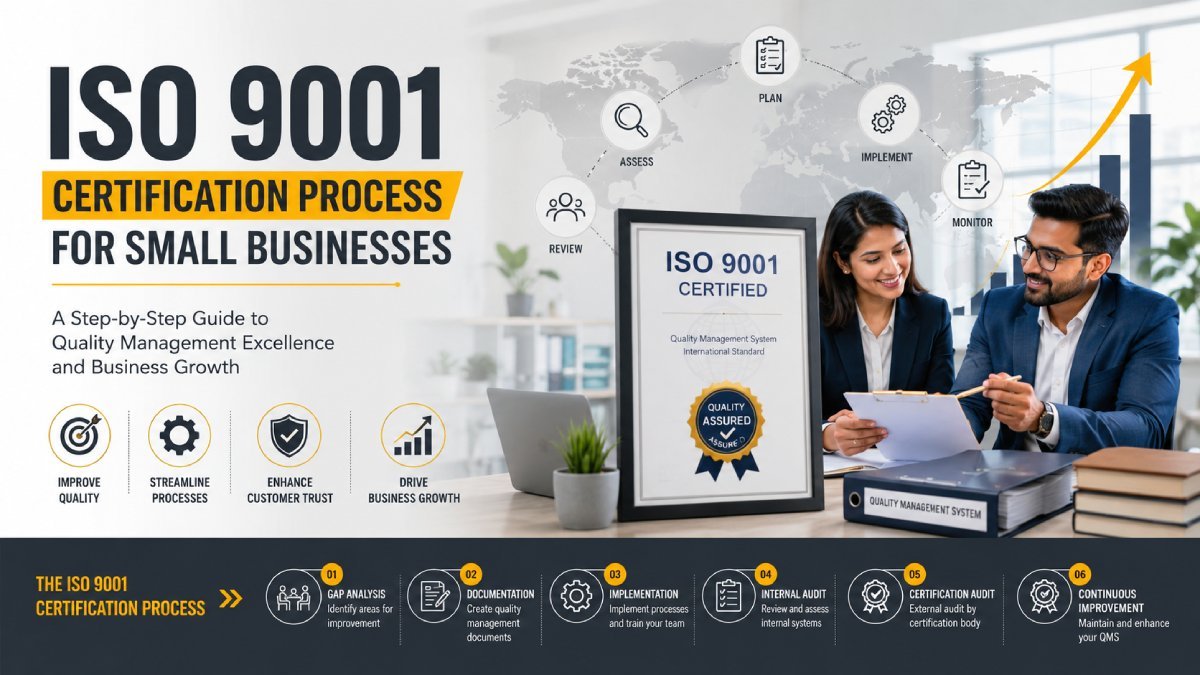
Obtaining ISO Certification involves a systematic process that ensures your organization’s management system complies with the requirements of the selected ISO standard. At Bharati Global Compliances, we provide complete guidance throughout every stage of the certification process, ensuring a smooth and hassle-free experience.
Step 1: Understanding Business Requirements
The first step is to understand your organization’s business activities, objectives, industry requirements, and compliance needs. Based on this assessment, our experts recommend the most suitable ISO standard for your business.
Step 2: Gap Analysis
A detailed gap analysis is conducted to evaluate your existing business processes against the requirements of the selected ISO standard. This helps identify areas that require improvement before certification.
Step 3: Documentation Preparation
Our consultants assist in preparing all mandatory documentation required for ISO implementation, including quality manuals, policies, standard operating procedures (SOPs), process flowcharts, risk assessments, and other management system documents.
Step 4: Implementation of the Management System
The documented management system is implemented across the organization. Employees are trained on the new procedures to ensure consistent implementation and compliance with ISO requirements.
Step 5: Internal Audit
Before the certification audit, an internal audit is conducted to verify that the implemented management system is functioning effectively and complies with the selected ISO standard. Any identified non-conformities are corrected at this stage.
Step 6: Certification Audit
An accredited certification body conducts a two-stage audit to assess the organization’s compliance with the applicable ISO standard. The auditors review documentation, evaluate business processes, and verify implementation across the organization.
Step 7: Issuance of ISO Certificate
After the successful completion of the certification audit and closure of any observations, the certification body issues the ISO Certificate. The organization can then demonstrate compliance with the applicable international standard.
Timeline for ISO Certification
The duration of the ISO Certification process depends on the size of the organization, the complexity of operations, and the selected ISO standard.
The general timeline is as follows:
- Initial Consultation: 1–2 Working Days
- Documentation Preparation: 3–7 Working Days
- Management System Implementation: 1–3 Weeks
- Internal Audit: 2–5 Working Days
- Certification Audit: 1–3 Working Days
- Certificate Issuance: 7–15 Working Days
The overall certification process is generally completed within 2 to 6 weeks, depending on the organization’s readiness and the certification body’s schedule.
Validity of ISO Certification
Most ISO Certifications are valid for three years, subject to successful surveillance audits conducted annually by the certification body. These periodic audits ensure that the organization continues to maintain and improve its management system in accordance with the applicable ISO standard.
At the end of the three-year certification cycle, the organization must undergo a recertification audit to renew its ISO Certification.
Surveillance Audit and Renewal
Maintaining ISO Certification requires continuous compliance with the applicable standard. During the validity period, certification bodies conduct surveillance audits to verify that the management system remains effective and continues to meet ISO requirements.
Organizations should:
- Continue following documented procedures.
- Conduct regular internal audits.
- Address non-conformities promptly.
- Review management system performance periodically.
- Maintain updated documentation.
- Implement continual improvement practices.
Successful completion of surveillance audits ensures uninterrupted validity of the ISO Certificate.

Why Choose Bharati Global Compliances?
At Bharati Global Compliances, we simplify the ISO Certification process by providing complete consultancy, implementation support, documentation assistance, audit coordination, and post-certification guidance.
Our ISO consultancy services include:
- ISO Gap Analysis
- Documentation Preparation
- ISO Implementation Support
- Internal Audit Assistance
- Certification Audit Coordination
- Training & Awareness Programs
- ISO Certificate Consultancy
- Surveillance Audit Support
- Recertification Assistance
- PAN India Services
With our experienced compliance professionals, transparent process, and dedicated client support, businesses across India trust Bharati Global Compliances for reliable and efficient ISO Certification services.
Benefits of ISO Certification
ISO Certification is more than just an internationally recognized certificate—it is a strategic business tool that helps organizations improve efficiency, enhance customer confidence, and gain a competitive advantage in the marketplace. Implementing an ISO management system enables businesses to streamline operations, minimize risks, and achieve sustainable growth.
Improves Business Credibility
ISO Certification demonstrates that your organization follows internationally accepted standards and best practices. It enhances your reputation among customers, suppliers, investors, and regulatory authorities.
Enhances Customer Satisfaction
By implementing standardized processes and quality management systems, organizations can consistently deliver high-quality products and services that meet customer expectations.
Improves Operational Efficiency
ISO standards help businesses establish structured processes, eliminate inefficiencies, reduce waste, and optimize resource utilization, resulting in improved operational performance.
Increases Business Opportunities
Many government organizations, multinational corporations, and large private companies prefer working with ISO-certified businesses. Certification improves your chances of securing contracts, tenders, and international business opportunities.
Strengthens Risk Management
ISO management systems help organizations identify potential risks, implement preventive measures, and establish effective control mechanisms to reduce business disruptions.
Ensures Regulatory Compliance
ISO standards support organizations in complying with applicable legal, statutory, and regulatory requirements, reducing the likelihood of penalties and compliance issues.
Improves Employee Productivity
Clearly defined procedures, responsibilities, and standardized workflows improve employee performance, accountability, and workplace efficiency.
Promotes Continuous Improvement
ISO standards encourage organizations to regularly monitor performance, conduct internal audits, review management systems, and implement continual improvements to achieve long-term business success.
Common Mistakes to Avoid During ISO Certification
Many organizations face unnecessary delays or certification issues due to avoidable mistakes during implementation. Proper planning and expert guidance can help ensure a smooth certification process.
Selecting the Wrong ISO Standard
Businesses should carefully choose the ISO standard that aligns with their industry, operations, and organizational objectives. Selecting the wrong certification may not provide the intended business benefits.
Inadequate Documentation
Incomplete or poorly prepared documentation is one of the most common reasons for audit observations. All required policies, procedures, manuals, and records should be properly maintained before the certification audit.
Poor Implementation
Preparing documents alone is not sufficient. The management system must be effectively implemented throughout the organization, and employees should understand their roles and responsibilities.
Ignoring Internal Audits
Internal audits help identify gaps before the certification audit. Skipping this important step may result in major non-conformities during the external assessment.
Lack of Employee Awareness
Employees play a crucial role in maintaining compliance with ISO standards. Proper training and awareness programs are essential for successful implementation.
Choosing an Unreliable Certification Body
Organizations should select an experienced and reputable certification body to ensure the credibility and global acceptance of their ISO Certificate.
Why Choose Bharati Global Compliances?
At Bharati Global Compliances, we provide complete consultancy services for ISO Certification across various industries. Our experienced professionals guide organizations through every stage of the certification process, ensuring compliance with international standards while minimizing time and effort.
Our ISO Consultancy Services
- ISO 9001 Certification
- ISO 14001 Certification
- ISO 22000 Certification
- ISO 27001 Certification
- ISO 45001 Certification
- ISO 13485 Certification
- ISO 50001 Certification
- ISO 37001 Certification
- ISO Documentation Support
- Internal Audit Assistance
- Certification Audit Coordination
- Surveillance Audit Support
- ISO Renewal Assistance
- Employee Training
- PAN India Consultancy Services
Why Businesses Trust Bharati Global Compliances
Organizations across India choose Bharati Global Compliances because of our commitment to quality, transparency, and client satisfaction.
Our key advantages include:
- Experienced ISO Consultants
- End-to-End Certification Support
- Complete Documentation Assistance
- Fast and Transparent Process
- Affordable Consultancy Services
- Dedicated Client Support
- Industry-Specific Expertise
- Assistance for All Major ISO Standards
- PAN India Service Coverage
- High Client Satisfaction
Whether you are a startup, MSME, manufacturer, exporter, healthcare provider, educational institution, IT company, or multinational organization, Bharati Global Compliances helps you achieve ISO Certification efficiently with expert guidance and complete regulatory support.
Frequently Asked Questions (FAQs)
What is ISO Certification?
ISO Certification is an internationally recognized certification that confirms an organization has implemented a management system in accordance with the requirements of a specific ISO standard. It demonstrates a commitment to quality, efficiency, safety, and continual improvement.
Is ISO Certification mandatory in India?
No. ISO Certification is generally voluntary unless it is specifically required by a customer, government authority, regulatory body, or tender conditions. However, obtaining ISO Certification significantly enhances business credibility and market competitiveness.
Which ISO Certification is best for my business?
The appropriate ISO standard depends on your business activities and industry requirements. Some of the most common certifications include:
- ISO 9001 – Quality Management System
- ISO 14001 – Environmental Management System
- ISO 22000 – Food Safety Management System
- ISO 27001 – Information Security Management System
- ISO 45001 – Occupational Health & Safety Management System
- ISO 13485 – Medical Devices Quality Management System
- ISO 50001 – Energy Management System
Our experts at Bharati Global Compliances help you select the most suitable ISO Certification based on your business objectives.
Who can apply for ISO Certification?
Organizations of all sizes and industries can apply for ISO Certification, including:
- Manufacturing Companies
- Startups and MSMEs
- Service Providers
- Healthcare Organizations
- Educational Institutions
- Food Businesses
- IT Companies
- Construction Firms
- Logistics Companies
- Laboratories
- Hotels and Hospitality Businesses
- Exporters and Importers
- Government Organizations
What documents are required for ISO Certification?
The documentation requirements vary depending on the selected ISO standard. Commonly required documents include:
- Business Registration Certificate
- PAN Card
- GST Registration (if applicable)
- Business Address Proof
- Organization Chart
- Process Flow Diagram
- Quality Manual
- Standard Operating Procedures (SOPs)
- Employee Details
- Business Policies
- Scope of Activities
Additional documentation may be required based on the applicable ISO standard.
How long does it take to obtain ISO Certification?
The certification timeline depends on the size of the organization and the selected ISO standard. In most cases, the complete process is completed within 2 to 6 weeks, including documentation, implementation, audit, and certificate issuance.
What is the validity of an ISO Certificate?
Most ISO Certificates are valid for three years, subject to successful annual surveillance audits conducted by the certification body. After three years, the organization must undergo a recertification audit to renew the certificate.
Can ISO Certification help in Government Tenders?
Yes. Many Government departments, Public Sector Undertakings (PSUs), and large private organizations prefer or require ISO-certified companies while awarding contracts and tenders. ISO Certification improves your eligibility and enhances your competitive advantage.
Can startups and MSMEs obtain ISO Certification?
Yes. ISO Certification is highly beneficial for startups and MSMEs. It improves operational efficiency, builds customer confidence, strengthens brand reputation, and creates better opportunities for business growth and market expansion.
Why choose Bharati Global Compliances for ISO Certification?
Bharati Global Compliances provides complete ISO consultancy services, including standard selection, documentation, implementation support, audit coordination, certification assistance, surveillance audit support, and renewal services. Our experienced consultants ensure a smooth, transparent, and hassle-free certification process for businesses across India.
Get ISO Certification with Bharati Global Compliances
Achieving ISO Certification is a significant step toward improving your organization’s quality standards, operational efficiency, customer satisfaction, and global credibility. Whether you are a startup, MSME, manufacturer, exporter, service provider, educational institution, healthcare organization, or multinational company, ISO Certification demonstrates your commitment to internationally recognized management practices.
At Bharati Global Compliances, we provide end-to-end ISO Certification consultancy tailored to your business needs. From identifying the right ISO standard and preparing documentation to implementation, audit coordination, and certification support, our experts ensure a seamless certification journey.