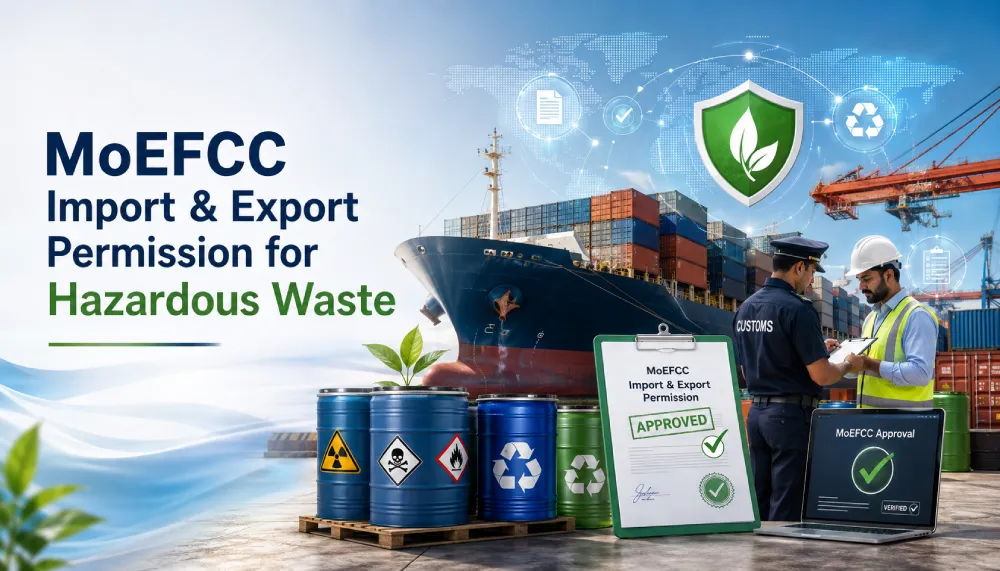
The movement of hazardous waste across international borders is strictly regulated to protect human health, natural resources, and the environment. Improper handling, transportation, recycling, or disposal of hazardous waste can lead to severe environmental pollution, public health risks, and long-term ecological damage. To address these concerns, the Government of India has established a comprehensive legal framework governing the import and export of hazardous and other wastes.
The Hazardous and Other Wastes (Management and Transboundary Movement) Rules, 2016, notified under the Environment (Protection) Act, 1986, regulate the import, export, storage, recycling, recovery, reuse, and disposal of hazardous waste in India. These rules ensure that hazardous waste is managed in an environmentally sound manner while preventing illegal transboundary movement.
The Ministry of Environment, Forest and Climate Change (MoEFCC) is the nodal authority responsible for granting permission for the import and export of hazardous and other wastes. Businesses intending to import or export eligible hazardous waste must obtain prior approval from the Ministry before carrying out such activities. Without the necessary permission, the import or export of regulated hazardous waste is not permitted under Indian law.
Import of hazardous waste into India is generally allowed only for specific purposes such as recycling, recovery, reuse, utilisation, or co-processing. Importing hazardous waste solely for disposal is strictly prohibited. Similarly, exporters must comply with the applicable legal requirements and obtain the necessary approvals before exporting hazardous waste from India.
At Bharati Global Compliances, we provide complete consultancy and documentation support for obtaining MoEFCC Import and Export Permission for Hazardous Waste. Our experts assist manufacturers, importers, exporters, recyclers, and waste management companies in complying with the applicable regulations and completing the approval process efficiently.
What is MoEFCC Import and Export Permission?
MoEFCC Import and Export Permission is an official approval issued by the Ministry of Environment, Forest and Climate Change (MoEFCC) that authorizes businesses to import or export specified categories of hazardous and other wastes in accordance with the Hazardous and Other Wastes (Management and Transboundary Movement) Rules, 2016.
The permission ensures that hazardous waste is transported, recycled, recovered, reused, or utilised in an environmentally responsible manner without causing adverse effects on human health or the environment.
Businesses involved in importing or exporting hazardous waste are required to comply with the prescribed documentation, technical requirements, environmental safeguards, and regulatory conditions before permission is granted.
Legal Framework Governing Hazardous Waste Import and Export
The import and export of hazardous waste in India is regulated under various environmental laws and government notifications. These regulations are designed to ensure environmentally sound management of hazardous waste and to fulfil India’s international commitments regarding transboundary movement of waste.
The primary legal framework includes:
- Environment (Protection) Act, 1986
- Hazardous and Other Wastes (Management and Transboundary Movement) Rules, 2016
- Applicable notifications issued by the Ministry of Environment, Forest and Climate Change (MoEFCC)
- Basel Convention on the Control of Transboundary Movements of Hazardous Wastes and Their Disposal
- Guidelines issued by the Central Pollution Control Board (CPCB)
- Directions issued by the respective State Pollution Control Boards (SPCBs)
Compliance with these regulations is mandatory for all businesses dealing with the import or export of hazardous and other wastes.
Who Needs MoEFCC Import and Export Permission?
Businesses involved in the international movement of hazardous waste generally require permission from the Ministry of Environment, Forest and Climate Change before carrying out import or export activities.
MoEFCC permission is commonly required for:
- Hazardous waste importers
- Hazardous waste exporters
- Metal scrap importers
- Lead scrap importers
- Battery scrap importers
- Waste tyre and rubber scrap importers
- Used oil importers
- Electronic waste recyclers
- E-Waste importers
- Recycling industries
- Metal recovery units
- Waste processing facilities
- Resource recovery companies
- Co-processing industries
- Hazardous waste treatment facilities
Businesses should carefully determine whether their products fall under the applicable schedules of the Hazardous and Other Wastes Rules before initiating any import or export transaction.
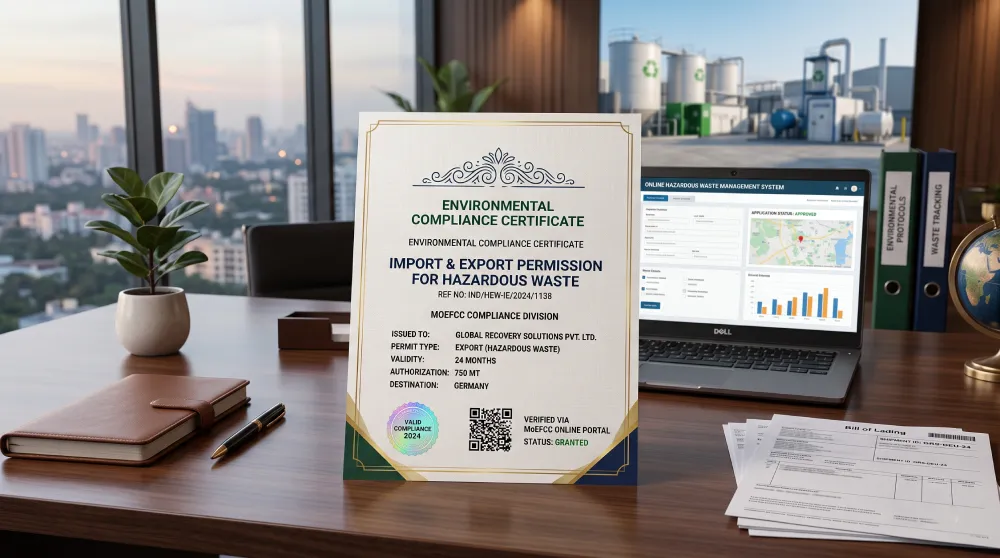
Hazardous Wastes Requiring MoEFCC Permission
The requirement for MoEFCC permission depends on the classification of hazardous and other wastes under the applicable schedules of the Hazardous and Other Wastes (Management and Transboundary Movement) Rules, 2016.
Some commonly regulated waste categories include:
- Lead Scrap
- Battery Scrap
- Waste Lead Acid Batteries
- Used Oil
- Waste Lubricating Oil
- Waste Tyres
- Rubber Scrap
- Copper Scrap containing hazardous substances
- Aluminium Scrap containing hazardous materials
- Zinc Scrap
- Electronic Waste (E-Waste)
- Electrical and Electronic Assemblies
- Metal Recovery Waste
- Industrial Hazardous Waste
- Chemical Waste
- Waste containing heavy metals
The exact permission requirements depend upon the waste category, its intended use, and the applicable schedule under the Hazardous Waste Rules.
Objectives of MoEFCC Permission
The Ministry grants import and export permission to ensure that hazardous waste is managed responsibly and in accordance with environmental protection standards.
The key objectives include:
- Prevent illegal import and export of hazardous waste.
- Protect human health and the environment.
- Promote environmentally sound recycling and recovery.
- Encourage resource conservation through responsible waste utilisation.
- Ensure compliance with Indian environmental laws.
- Fulfil India’s obligations under international environmental conventions.
- Monitor transboundary movement of hazardous waste.
- Strengthen environmental governance and regulatory compliance.
Businesses obtaining MoEFCC approval demonstrate their commitment to sustainable waste management and responsible environmental practices.
Import and Export of Hazardous and Other Wastes
The import and export of hazardous and other wastes in India is governed by the Hazardous and Other Wastes (Management and Transboundary Movement) Rules, 2016. These rules classify hazardous waste into different schedules and specify whether prior permission from the Ministry of Environment, Forest and Climate Change (MoEFCC) is required before importing or exporting such materials.
Businesses involved in international trade of hazardous waste must understand the applicable regulatory provisions before initiating any shipment. Compliance with these requirements helps ensure lawful trade while protecting human health and the environment.
Import of Hazardous Waste Listed in Part A of Schedule III
Hazardous wastes listed under Part A of Schedule III can be imported only after obtaining prior informed consent from the exporting country and receiving approval from the Ministry of Environment, Forest and Climate Change (MoEFCC).
Importers must ensure that the waste is intended only for approved purposes such as recycling, recovery, reuse, utilisation, or co-processing. Importing hazardous waste for disposal is not permitted under Indian regulations.
Import of Other Wastes Listed in Part B of Schedule III
The import of wastes covered under Part B of Schedule III is permitted subject to approval from the MoEFCC.
Where the import involves used electrical and electronic assemblies (E-Waste) listed under Part B, the importer is also required to obtain the applicable E-Waste Extended Producer Responsibility (EPR) Authorisation before importing such products.
Import of Wastes Listed in Part D of Schedule III
Certain categories of waste listed under Part D of Schedule III may be imported without obtaining prior permission from the Ministry, subject to compliance with the applicable conditions prescribed under the Hazardous Waste Rules and other relevant regulations.
Importers should carefully verify the classification of their waste before proceeding with any shipment.
Import of Hazardous Waste Listed in Schedule VI
The import of hazardous and other wastes listed under Schedule VI is prohibited. Such wastes cannot be imported into India under the provisions of the Hazardous and Other Wastes (Management and Transboundary Movement) Rules, 2016.
Import of Unlisted Hazardous Waste
If hazardous waste is not specifically listed under Schedule III but exhibits hazardous characteristics as specified in Part C of Schedule III, prior written permission from the MoEFCC is required before import.
The Ministry evaluates each application individually to determine whether the proposed import complies with the applicable environmental and regulatory requirements.
Exemption from Import Permission
The Hazardous Waste Rules provide limited exemptions for certain imports.
One such exemption applies to hazardous and other waste samples up to 1000 grams or 1000 millilitres imported exclusively for testing, research, or product development purposes.
Such samples are generally exempt from obtaining prior import permission, provided they are imported strictly for research and laboratory analysis and comply with all other applicable regulations.
Responsibilities of Importers
Importers of hazardous and other wastes are responsible for ensuring full compliance with the applicable environmental regulations.
Some of the major responsibilities include:
- Obtain prior approval from the MoEFCC wherever required.
- Ensure the waste is imported only for permitted purposes.
- Maintain proper records of imported hazardous waste.
- Store, handle, recycle, recover, or utilise the waste in an environmentally sound manner.
- Obtain valid authorisation from the State Pollution Control Board (SPCB).
- Submit annual returns within the prescribed time.
- Comply with all conditions specified in the import permission.
- Produce records during inspections conducted by regulatory authorities.
Failure to comply with these responsibilities may result in regulatory action under the applicable environmental laws.
Record Maintenance and Annual Returns
Every importer or exporter dealing with hazardous and other wastes is required to maintain detailed records of all transactions.
The records must be maintained in the prescribed Form 3 and should include information relating to:
- Quantity of waste imported or exported
- Source of waste
- Country of origin or destination
- Storage details
- Processing or recycling information
- Disposal records
- Transportation details
These records must be produced whenever requested by the competent authorities during inspection.
In addition, importers are required to submit an Annual Return in Form 4 to the concerned State Pollution Control Board (SPCB) on or before 30th June following the financial year to which the return relates.
Role of Port and Customs Authorities
Port and Customs authorities play an important role in regulating the transboundary movement of hazardous and other wastes.
Before allowing clearance of imported consignments, they ensure that the shipment is accompanied by the required documents, including:
- Movement document
- Laboratory analysis report
- Test certificate issued by a recognised or accredited laboratory in the exporting country
- Import permission issued by the MoEFCC, wherever applicable
If any doubt arises regarding the nature or composition of the imported waste, the Customs authorities may direct additional verification or laboratory analysis before granting clearance.
At Bharati Global Compliances, we assist businesses in identifying the applicable schedule, obtaining MoEFCC approvals, preparing statutory documentation, coordinating with regulatory authorities, and ensuring complete compliance with India’s hazardous waste import and export regulations.
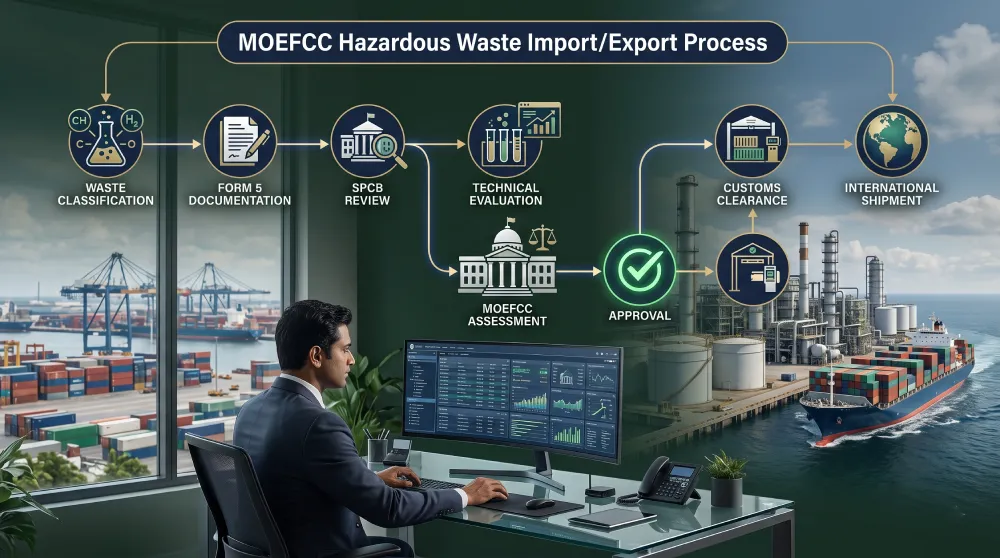
Procedure for Obtaining Import Permission for Hazardous Waste
Businesses intending to import hazardous and other wastes into India must obtain prior approval from the Ministry of Environment, Forest and Climate Change (MoEFCC) wherever required under the Hazardous and Other Wastes (Management and Transboundary Movement) Rules, 2016. The approval process ensures that the proposed import complies with environmental regulations and is intended only for permitted activities such as recycling, recovery, reuse, utilisation, or co-processing.
Step 1: Submission of Application
The applicant must submit an application in the prescribed Form 5 to the Ministry of Environment, Forest and Climate Change (MoEFCC). The application should be accompanied by all required supporting documents, including the Prior Informed Consent (PIC) from the exporting country wherever applicable.
At the same time, the applicant must send a copy of the application to the concerned State Pollution Control Board (SPCB) for information. The acknowledgement received from the SPCB should also be submitted to the Ministry as part of the application.
Step 2: Scrutiny of Documents
After receiving the application, the Ministry examines all submitted documents to ensure they are complete and comply with the applicable provisions of the Hazardous Waste Rules. If any information is missing or clarification is required, the applicant may be asked to provide additional documents.
Step 3: Review by the State Pollution Control Board
The concerned State Pollution Control Board reviews the application and may provide its observations or recommendations to the Ministry regarding the applicant’s facilities, authorisations, environmental compliance, and waste management capabilities.
Step 4: Technical Evaluation
The Ministry evaluates the complete application by considering:
- Comments received from the State Pollution Control Board.
- Nature and classification of the hazardous waste.
- Proposed recycling, recovery, reuse, or utilisation process.
- Environmental safeguards adopted by the applicant.
- Compliance with applicable environmental regulations.
The technical evaluation ensures that the proposed import will not adversely affect human health or the environment.
Step 5: Grant of Import Permission
If the Ministry is satisfied that all prescribed requirements have been fulfilled, it grants permission for the proposed import. As per the applicable rules, the approval is generally issued within 60 days from the date of receipt of a complete application.
Import permission is granted subject to various conditions, including:
- Availability of environmentally sound recycling or recovery facilities.
- Adequate arrangements for treatment and disposal of waste generated during processing.
- Valid Authorisation and Consent from the State Pollution Control Board.
- Prior Informed Consent from the exporting country, wherever applicable.
- Compliance with all conditions specified by the Ministry.
After granting approval, the Ministry forwards copies of the permission to the concerned:
- Port Authorities
- Customs Authorities
- Central Pollution Control Board (CPCB)
- State Pollution Control Board (SPCB)
This enables the respective authorities to monitor and ensure compliance during the import process.
Procedure for Obtaining Export Permission for Hazardous Waste
Businesses planning to export hazardous and other wastes from India are also required to obtain prior permission from the Ministry of Environment, Forest and Climate Change (MoEFCC) wherever applicable.
The export approval process ensures that hazardous waste is transported safely and in accordance with national regulations and international environmental agreements.
Step 1: Submission of Export Application
The exporter must submit Form 5 to the Ministry along with all required supporting documents.
The application should include:
- Details of the hazardous waste proposed for export.
- Insurance coverage for the proposed transboundary movement.
- Prior Informed Consent from the importing country, wherever required.
- Supporting technical and environmental documents.
Step 2: Application Review
The Ministry carefully examines the application, verifies the submitted documents, and evaluates whether the proposed export complies with the applicable provisions of the Hazardous Waste Rules and international obligations.
If required, additional information or clarification may be sought from the applicant before processing the application further.
Step 3: Grant of Export Permission
After successful evaluation of the application, the Ministry may grant permission for the proposed export.
The approval is generally issued within 60 days from the date of submission of a complete application and may include specific conditions that the exporter must comply with during transportation and disposal or recovery of the hazardous waste.
Copies of the export permission are forwarded to:
- Concerned State Pollution Control Board
- Pollution Control Board of the State where the export port is located
- Port Authorities
- Customs Authorities
These authorities monitor the movement of hazardous waste and ensure compliance with the conditions specified in the approval.
Documents Required for MoEFCC Import and Export Permission
The exact documentation may vary depending on the category of hazardous waste and the nature of the proposed import or export. However, the commonly required documents include:
- Duly filled Form 5
- Covering letter
- IEC (Import Export Code)
- GST Registration Certificate
- Certificate of Incorporation or Business Registration
- PAN Card of the applicant
- Authorisation issued by the State Pollution Control Board
- Consent to Operate (CTO)
- Consent to Establish (CTE), wherever applicable
- Prior Informed Consent (PIC) from the exporting or importing country, wherever applicable
- Details of hazardous waste proposed for import or export
- Process flow diagram
- Manufacturing process details
- Recycling or recovery process details
- Storage facility details
- Pollution control measures
- Insurance documents for transboundary movement (for export)
- Laboratory analysis report, wherever applicable
- Any additional documents required by the Ministry
Preparing complete and accurate documentation significantly improves the likelihood of obtaining timely approval and helps avoid unnecessary delays during the application process.
Timeline for Obtaining MoEFCC Permission
The time required to obtain MoEFCC Import or Export Permission depends on the completeness of the application, the category of hazardous waste, verification by the concerned authorities, and the availability of supporting documents.
Generally, the Ministry processes a complete application within:
Estimated Timeline: 45 to 60 Working Days
The processing time may vary depending on:
- Type of hazardous waste.
- Completeness of the application.
- Verification by the State Pollution Control Board.
- Requirement for additional documents or clarifications.
- Technical evaluation by the Ministry.
- Compliance with applicable environmental regulations.
Submitting accurate documentation and responding promptly to any queries from the Ministry can significantly reduce delays.
Validity of MoEFCC Import and Export Permission
The validity of the permission issued by the Ministry of Environment, Forest and Climate Change (MoEFCC) depends on the conditions specified in the approval letter and the nature of the proposed import or export.
Applicants must ensure that all import or export activities are completed within the validity period mentioned in the permission. If the approval expires before the shipment is completed, a fresh application or extension, wherever permitted, may be required.
Businesses should also continue to comply with all conditions imposed by the Ministry and maintain valid authorisations issued by the concerned State Pollution Control Board (SPCB) throughout the validity period.
Compliance Requirements After Obtaining Permission
Receiving MoEFCC approval is only one part of the compliance process. Importers and exporters must continue to comply with various statutory obligations after obtaining permission.
Some of the important post-approval compliance requirements include:
- Maintain records of imported or exported hazardous waste in the prescribed format.
- Submit Annual Returns to the concerned State Pollution Control Board within the prescribed timeline.
- Ensure environmentally sound handling, storage, recycling, recovery, or utilisation of hazardous waste.
- Comply with all conditions mentioned in the approval issued by the Ministry.
- Maintain valid authorisations and consents issued by the State Pollution Control Board.
- Produce records and documents during inspections conducted by regulatory authorities.
- Ensure safe transportation of hazardous waste in accordance with applicable regulations.
- Retain supporting documents for future audits and inspections.
Continuous compliance helps businesses avoid regulatory action and ensures smooth import and export operations.
Common Reasons for Rejection of Applications
Applications submitted to the Ministry may be delayed or rejected if they do not satisfy the prescribed legal and technical requirements.
Some common reasons include:
Incomplete Documentation
Missing application forms, incorrect information, or the absence of mandatory supporting documents can result in delays or rejection.
Invalid State Pollution Control Board Authorisation
Applicants must possess valid authorisation, Consent to Operate (CTO), and other applicable approvals from the concerned State Pollution Control Board before applying for MoEFCC permission.
Absence of Prior Informed Consent
For waste categories where Prior Informed Consent (PIC) is mandatory, failure to submit the required consent from the exporting or importing country may lead to rejection of the application.
Inadequate Waste Management Facilities
The Ministry may reject an application if the applicant does not have adequate infrastructure for environmentally sound recycling, recovery, treatment, or disposal of hazardous waste.
Non-Compliance with Environmental Regulations
Previous violations of environmental laws or failure to comply with applicable conditions may adversely affect the approval process.
Incorrect Classification of Waste
Incorrect identification or classification of hazardous waste under the applicable schedules may delay processing or result in rejection of the application.
Proper documentation and expert guidance can significantly improve the chances of obtaining approval without unnecessary delays.
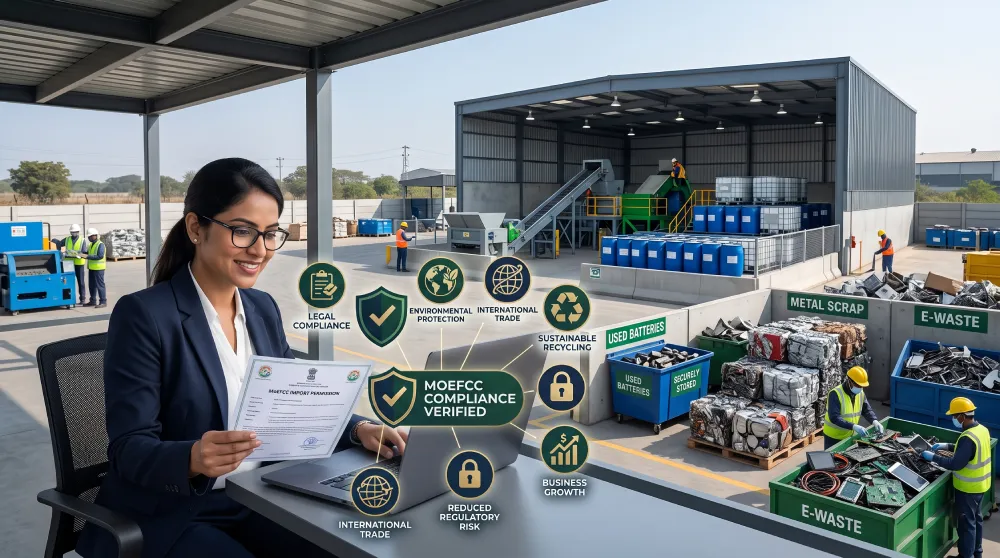
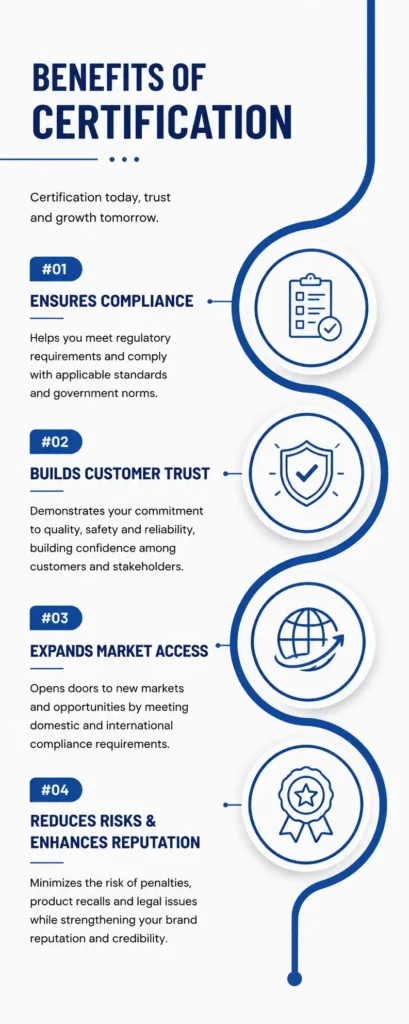
Benefits of Obtaining MoEFCC Import and Export Permission
Obtaining the required permission from the Ministry offers several legal, environmental, and commercial advantages for businesses involved in international trade of hazardous waste.
Key benefits include:
- Ensures compliance with Indian environmental regulations.
- Enables legal import and export of hazardous and other wastes.
- Facilitates international trade without regulatory hurdles.
- Demonstrates commitment to environmentally responsible waste management.
- Improves business credibility with government authorities and customers.
- Reduces the risk of penalties, shipment delays, and legal disputes.
- Supports sustainable recycling and resource recovery.
- Strengthens environmental compliance management systems.
- Enhances business reputation in domestic and international markets.
Why Choose Bharati Global Compliances?
Navigating the regulatory requirements for hazardous waste import and export can be complex without professional assistance. At Bharati Global Compliances, we provide comprehensive consultancy services to help businesses obtain MoEFCC approvals quickly and efficiently.
Our experienced compliance professionals offer complete support throughout the approval process, from document preparation to coordination with the relevant authorities.
Our services include:
- MoEFCC Import Permission Consultancy
- MoEFCC Export Permission Consultancy
- Documentation Preparation
- Application Filing Assistance
- Form 5 Preparation
- SPCB Compliance Support
- CPCB and Environmental Compliance Guidance
- Hazardous Waste Classification Assistance
- Regulatory Advisory Services
- End-to-End Compliance Management
- PAN India Support
With our expertise, businesses can complete the approval process confidently while ensuring full compliance with applicable environmental laws and government regulations.
Frequently Asked Questions (FAQs)
What is MoEFCC Import and Export Permission?
MoEFCC Import and Export Permission is an official approval issued by the Ministry of Environment, Forest and Climate Change (MoEFCC) that allows businesses to legally import or export hazardous and other wastes in accordance with the Hazardous and Other Wastes (Management and Transboundary Movement) Rules, 2016.
Is MoEFCC permission mandatory for importing hazardous waste?
Yes. Importers dealing with hazardous waste listed under the applicable schedules of the Hazardous Waste Rules are generally required to obtain prior permission from the MoEFCC before importing such waste into India. However, certain categories may be exempt under specific provisions of the Rules.
Can hazardous waste be imported for disposal in India?
No. The import of hazardous waste for disposal is prohibited in India. Hazardous waste may only be imported for approved purposes such as recycling, recovery, reuse, utilisation, or co-processing, subject to the applicable regulations.
Which businesses require MoEFCC Import and Export Permission?
MoEFCC permission is commonly required for:
- Hazardous waste importers and exporters
- Lead scrap importers
- Battery scrap importers
- Used oil importers
- Waste tyre and rubber scrap importers
- Electronic waste (E-Waste) recyclers
- Metal recovery industries
- Recycling and waste processing facilities
- Resource recovery companies
What documents are required for MoEFCC approval?
The commonly required documents include:
- Form 5
- IEC (Import Export Code)
- GST Registration Certificate
- Certificate of Incorporation
- PAN Card
- State Pollution Control Board Authorisation
- Consent to Operate (CTO)
- Prior Informed Consent (where applicable)
- Process flow diagram
- Hazardous waste details
- Laboratory analysis reports (where applicable)
- Supporting environmental compliance documents
Additional documents may be required depending on the type of hazardous waste and the nature of the proposed import or export.
How long does it take to obtain MoEFCC Import or Export Permission?
The processing time generally ranges between 45 to 60 working days, depending on the completeness of the application, technical evaluation, and verification by the concerned authorities.
Is Prior Informed Consent (PIC) mandatory?
Yes. Prior Informed Consent (PIC) is mandatory for specific categories of hazardous waste, particularly those covered under Part A of Schedule III. The applicant must obtain written consent from the exporting or importing country, wherever applicable.
Is EPR Authorisation required for importing E-Waste?
Yes. Importers of used electrical and electronic assemblies (E-Waste) covered under the applicable provisions may also be required to obtain E-Waste Extended Producer Responsibility (EPR) Authorisation before importing such products into India.
Who regulates the import and export of hazardous waste in India?
The Ministry of Environment, Forest and Climate Change (MoEFCC) is the nodal authority responsible for granting import and export permission. The Central Pollution Control Board (CPCB), State Pollution Control Boards (SPCBs), Customs Authorities, and Port Authorities also play important roles in monitoring compliance.
Can Bharati Global Compliances assist with MoEFCC Import and Export Permission?
Yes. Bharati Global Compliances provides complete consultancy services for obtaining MoEFCC Import and Export Permission. Our experts assist businesses with documentation, Form 5 preparation, regulatory compliance, application filing, coordination with authorities, and end-to-end support to ensure a smooth approval process.
Conclusion
Importing or exporting hazardous waste in India is governed by strict environmental regulations to safeguard public health and protect natural resources. Businesses involved in the transboundary movement of hazardous and other wastes must comply with the Hazardous and Other Wastes (Management and Transboundary Movement) Rules, 2016 and obtain the necessary approvals from the Ministry of Environment, Forest and Climate Change (MoEFCC) wherever applicable.
Obtaining MoEFCC permission not only ensures legal compliance but also demonstrates a company’s commitment to environmentally responsible waste management and sustainable business practices. Proper documentation, adherence to regulatory requirements, and timely compliance with post-approval obligations are essential for smooth import and export operations.
Whether you are importing lead scrap, battery scrap, used oil, waste tyres, electronic waste, or other regulated hazardous materials, professional guidance can simplify the approval process and help avoid unnecessary delays.
At Bharati Global Compliances, we offer end-to-end consultancy for MoEFCC Import and Export Permission, including documentation preparation, Form 5 filing, SPCB compliance, application management, and complete regulatory support. Our experienced consultants ensure that your business meets all statutory requirements efficiently, allowing you to focus on your core operations with confidence.