
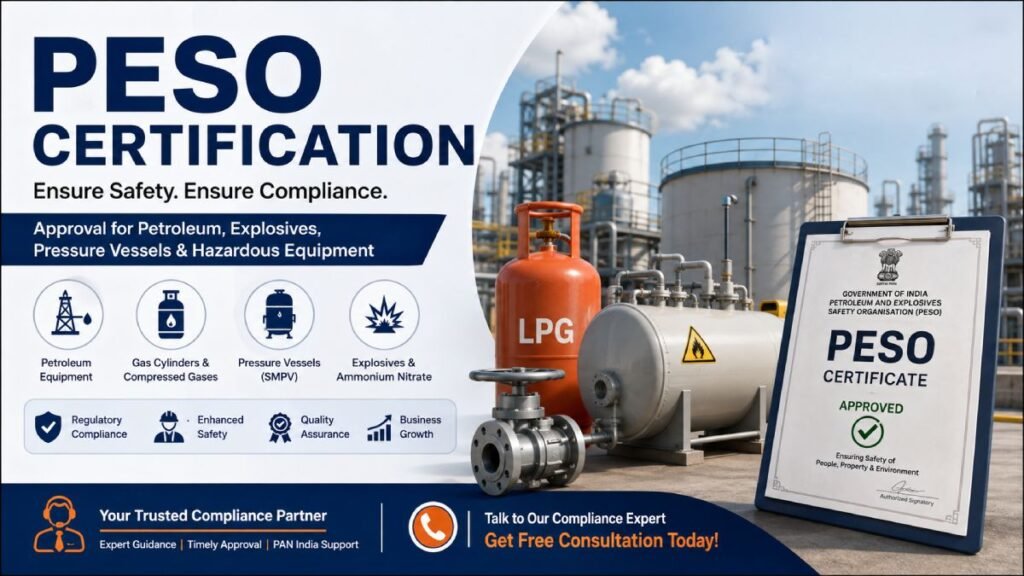
The Petroleum and Explosives Safety Organization (PESO) is the regulatory authority responsible for ensuring the safe manufacture, storage, transportation, import, export, handling, and use of hazardous substances in India. Industries dealing with petroleum products, compressed gases, explosives, pressure vessels, gas cylinders, and other hazardous materials must comply with PESO regulations before commencing commercial operations.
PESO plays a critical role in protecting public safety, industrial infrastructure, and the environment by regulating activities involving flammable, explosive, and high-pressure materials. Obtaining a PESO Certificate is mandatory for various industries to ensure compliance with the applicable safety laws and technical standards prescribed by the Government of India.
The organization traces its origins back to the British era when it was established as the Department of Explosives to regulate explosive materials across the country. Over the decades, its responsibilities have expanded significantly, making it one of India’s most important regulatory bodies for hazardous substances and industrial safety.
Today, PESO oversees numerous sectors including petroleum, compressed gases, pressure vessels, LNG, CNG, Auto LPG, CBG, gas cylinders, cross-country pipelines, ammonium nitrate, flameproof electrical equipment, explosives, and many other hazardous products requiring statutory approval.
Businesses engaged in manufacturing, importing, storing, transporting, or handling regulated products must obtain the necessary PESO approvals before entering the Indian market. Non-compliance may result in penalties, suspension of operations, product seizure, or cancellation of licenses under the applicable laws.
At Bharati Global Compliances, we provide complete consultancy services for PESO Certification in India, assisting manufacturers, importers, exporters, EPC companies, OEMs, and industrial organizations with documentation, application filing, liaison with PESO authorities, technical compliance, factory approvals, and end-to-end licensing support.
What is PESO Certification?
PESO Certification is the statutory approval issued by the Petroleum and Explosives Safety Organization (PESO) for products, equipment, installations, and industrial facilities that deal with hazardous materials such as petroleum, compressed gases, explosives, pressure vessels, and other regulated substances.
Formerly known as the Chief Controller of Explosives (CCOE), PESO functions under the Department for Promotion of Industry and Internal Trade (DPIIT), Ministry of Commerce and Industry, Government of India.
The primary objective of PESO Certification is to ensure that hazardous products and industrial operations comply with the prescribed safety requirements before they are manufactured, imported, installed, transported, stored, or operated within India.
PESO Certification is particularly important for industries operating in sectors where even a minor safety lapse can lead to serious accidents involving fire, explosion, environmental damage, or loss of human life. Therefore, products covered under PESO regulations must undergo technical evaluation and satisfy the applicable standards before approval is granted.
For imported equipment, internationally recognized certifications such as ATEX and IECEx are often accepted by PESO, provided they meet the prescribed regulatory requirements. Where such certifications are unavailable or insufficient, additional product testing in India may be required before approval.
Objectives of PESO Certification
The Petroleum and Explosives Safety Organization has been established to promote industrial safety while regulating hazardous substances throughout their lifecycle. Its certification system is designed to reduce operational risks and ensure compliance with national safety regulations.
The key objectives of PESO Certification include:
Ensuring Public Safety
PESO establishes strict technical and safety standards to minimize the risks associated with hazardous chemicals, petroleum products, compressed gases, explosives, and pressure equipment.
Regulating Hazardous Industries
The organization regulates industries involved in the manufacture, storage, transport, import, export, and handling of dangerous goods to ensure compliance with applicable laws.
Preventing Industrial Accidents
By enforcing safety requirements, inspection procedures, and technical standards, PESO helps reduce the likelihood of explosions, fires, gas leaks, and other industrial accidents.
Promoting Safe Infrastructure
PESO evaluates industrial facilities, storage installations, pressure vessels, gas cylinders, pipelines, and associated equipment to verify that they are designed and operated safely.
Supporting Regulatory Compliance
The certification process helps manufacturers and importers comply with various statutory requirements under Indian safety regulations, enabling smooth business operations without regulatory interruptions.
Regulatory Authority Governing PESO
The Petroleum and Explosives Safety Organization operates under the administrative control of the Department for Promotion of Industry and Internal Trade (DPIIT), Ministry of Commerce and Industry, Government of India.
PESO is responsible for administering multiple Acts, Rules, and technical regulations relating to hazardous substances, explosives, petroleum products, pressure vessels, gas cylinders, and associated industrial equipment.
Its headquarters is located in Nagpur, Maharashtra, while regional and circle offices across India monitor licensing, inspections, enforcement, and regulatory compliance.
The organization works closely with various government authorities, industrial bodies, testing laboratories, manufacturers, and inspection agencies to ensure that hazardous products and facilities operate according to the prescribed safety standards.
Industries Covered Under PESO Certification
PESO Certification applies to a wide range of industries dealing with hazardous materials and regulated equipment. These include petroleum refineries, oil and gas companies, chemical manufacturers, LPG bottling plants, LNG facilities, industrial gas suppliers, explosive manufacturers, engineering companies, pressure vessel manufacturers, storage terminal operators, and equipment importers.
The certification also covers businesses involved in manufacturing flameproof electrical equipment, compressed gas cylinders, cryogenic vessels, dispensing systems, fuel stations, pipeline infrastructure, and industrial safety equipment used in hazardous locations.
As India’s industrial infrastructure continues to expand, PESO approval has become an essential regulatory requirement for ensuring operational safety, legal compliance, and uninterrupted business activities across multiple sectors.
Mandatory Licensees and Stakeholders Covered Under PESO Certification
PESO Certification is mandatory for businesses involved in the manufacture, import, export, storage, transportation, handling, installation, testing, or operation of hazardous substances and regulated equipment. The objective is to ensure that these activities are carried out in accordance with the safety requirements prescribed by the Petroleum and Explosives Safety Organization.
Any individual, company, manufacturer, importer, contractor, or industrial establishment dealing with products regulated by PESO must obtain the appropriate licence or approval before commencing commercial operations.
The major stakeholders covered under PESO Certification include:
Petroleum Industry
Organizations involved in refining, manufacturing, storage, transportation, distribution, and marketing of petroleum products are required to obtain the applicable PESO approvals before operating their facilities.
Gas Cylinder Manufacturers and Importers
Manufacturers, importers, suppliers, testing stations, and businesses handling compressed gas cylinders must comply with PESO regulations to ensure product safety and operational compliance.
Static and Mobile Pressure Vessels (SMPV)
Companies engaged in manufacturing, fabricating, installing, testing, operating, or importing static and mobile pressure vessels used for compressed gases must obtain approvals under the applicable SMPV Rules.
Explosives Industry
Manufacturers, storage facilities, transport operators, and users dealing with explosives must obtain the required licences issued by PESO before commencing any regulated activity.
Ammonium Nitrate Businesses
Organizations involved in the manufacture, import, storage, sale, transportation, or handling of ammonium nitrate must comply with the applicable safety regulations administered by PESO.
Fabrication Workshops
Engineering companies and fabrication workshops manufacturing pressure vessels, storage tanks, cryogenic equipment, and similar products covered under PESO regulations are also required to obtain the necessary approvals.
Gas Cylinder Testing Stations
Testing laboratories and inspection agencies carrying out hydrostatic testing, periodic inspection, certification, and maintenance of gas cylinders must operate under valid PESO authorization.
Degassing and Purging Facilities
Facilities providing degassing and purging services under the Static and Mobile Pressure Vessels (Unfired) Rules are also covered under the PESO licensing framework.
Static and Mobile Pressure Vessels (SMPV) Rules
One of the most important regulations administered by PESO is the Static and Mobile Pressure Vessels (Unfired) Rules, 1981, commonly referred to as the SMPV Rules.
These rules regulate the design, manufacture, installation, testing, import, storage, transportation, operation, inspection, maintenance, and certification of pressure vessels used for storing compressed gases and hazardous liquids.
Pressure vessels operate under high internal pressure and therefore require strict engineering controls to prevent leakage, rupture, explosion, or other safety hazards. The SMPV Rules establish uniform technical standards that manufacturers and users must follow throughout the lifecycle of these vessels.
The regulations apply to various industrial sectors including petroleum, LNG, LPG, CNG, industrial gases, chemical manufacturing, cryogenic storage, fertilizer plants, refineries, and process industries.
What are Static and Mobile Pressure Vessels?
Pressure vessels are specially designed containers used to safely store gases, vapours, or liquids under pressure that exceeds atmospheric conditions.
Static Pressure Vessels
Static pressure vessels remain permanently installed at a fixed location and are commonly used in petroleum terminals, industrial plants, gas storage facilities, chemical industries, and manufacturing units.
Mobile Pressure Vessels
Mobile pressure vessels are designed for transportation of compressed gases and hazardous materials through road tankers, trailers, or other transport systems while maintaining the required level of safety during transit.
Both categories must comply with the technical requirements specified under the SMPV Rules before they are approved for commercial use.
Important Provisions under the SMPV Rules
The Static and Mobile Pressure Vessels (Unfired) Rules prescribe detailed safety requirements covering every stage of manufacturing and operation.
Approval of Design and Drawings
The design, engineering drawings, manufacturing specifications, fabrication procedures, and applicable design codes must receive prior approval from the Chief Controller before manufacturing begins.
Only approved designs complying with recognized engineering standards are permitted for production.
Restriction on Manufacturing
No pressure vessel covered under the SMPV Rules can be manufactured without obtaining prior approval from the competent authority.
Manufacturers must strictly follow the approved design, material specifications, welding procedures, inspection methods, and testing requirements during production.
Restriction on Import
Imported pressure vessels cannot be brought into India without obtaining the required approval from the Chief Controller.
The imported equipment must also comply with the applicable Indian safety regulations before being commissioned.
Filling and Transportation
Pressure vessels may only be filled, transported, and operated after satisfying all prescribed safety requirements.
Only vessels manufactured according to the approved standards and certified under the applicable rules are permitted for transportation of compressed gases.
Delivery Restrictions
Compressed gases stored in pressure vessels may only be supplied to individuals or organizations holding valid storage licences issued under the applicable regulations.
The quantity delivered must remain within the storage limits authorized under the licence issued by the competent authority.
Safety During Operations
Industrial premises handling compressed gases must implement adequate operational safety measures.
Smoking, open flames, welding activities, and other potential ignition sources are strictly prohibited near storage areas where flammable or hazardous gases are handled.
Personnel responsible for operating pressure vessels should possess adequate technical knowledge and receive proper training regarding hazardous material handling, emergency response procedures, and operational safety practices.
Maintenance and Inspection
Pressure vessels require periodic inspection, testing, maintenance, and certification to ensure continued compliance with safety regulations.
Any modification, repair, alteration, or structural change affecting the pressure vessel must be reported for inspection and approval before the equipment is returned to service.
Proper maintenance not only ensures regulatory compliance but also significantly reduces operational risks associated with hazardous materials.
At Bharati Global Compliances, our experienced consultants assist manufacturers, EPC contractors, industrial facilities, importers, and equipment suppliers in understanding the applicable SMPV requirements, preparing technical documentation, coordinating with PESO authorities, and obtaining approvals with complete regulatory compliance.
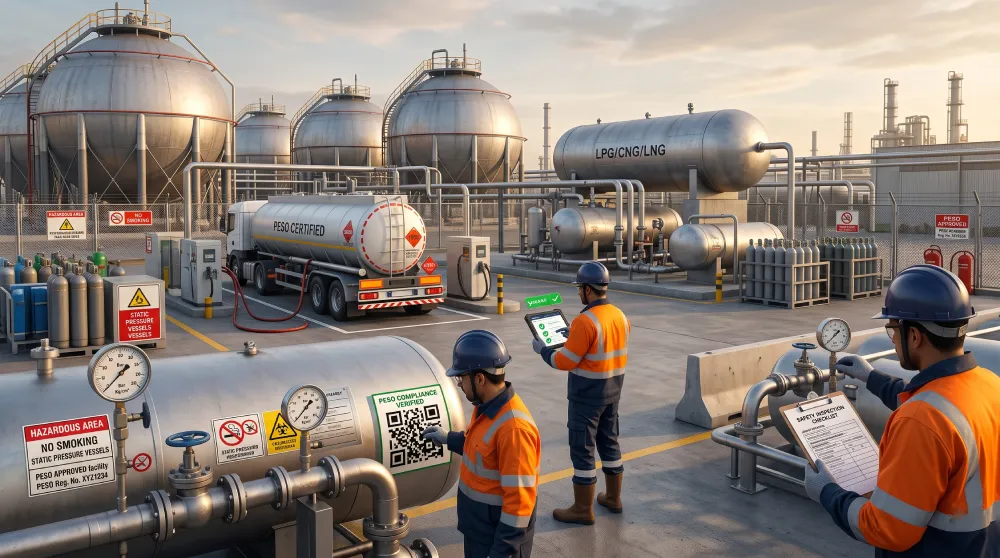
Process of PESO Certification in India
Obtaining a PESO Certificate involves a systematic evaluation of the product, technical documentation, manufacturing facility, and applicable safety standards. The Petroleum and Explosives Safety Organization verifies whether the product complies with the prescribed regulatory requirements before granting approval.
The exact certification process may vary depending on the product category, applicable rules, and licensing requirements. However, the general procedure for obtaining PESO Certification is outlined below.
Step 1: Identify the Applicable PESO Approval
The first step is to determine whether the product, equipment, pressure vessel, electrical equipment, gas cylinder, or industrial installation falls under the scope of PESO regulations.
Different products are governed by different Acts and Rules administered by PESO. Therefore, identifying the correct approval category is essential before initiating the application process.
Our experts at Bharati Global Compliances evaluate your product specifications and identify the exact PESO approval applicable to your business.
Step 2: Preparation of Technical Documentation
Once the applicable certification category is identified, all technical documents are prepared in accordance with PESO requirements.
The documentation generally includes:
- Product Technical Specifications
- Engineering Drawings
- Product Catalogue
- Manufacturing Details
- Test Reports
- Quality Certificates
- Hazard Classification
- Installation Details
- Manufacturer Information
- Application Forms
For imported products, internationally recognized certificates such as ATEX or IECEx Certificates and supporting test reports are generally required.
The test reports submitted should normally not be older than two years unless otherwise accepted by the authority.
Step 3: Submission of Application
After completing the documentation, the application is submitted to the Petroleum and Explosives Safety Organization along with the prescribed fees and supporting documents.
For imported products, the application is usually submitted through the Authorized Indian Representative (AIR) appointed by the foreign manufacturer.
The application must be complete in every aspect to avoid unnecessary observations and delays during scrutiny.
Step 4: Scrutiny of Documents
PESO officials carefully examine all submitted documents to verify their completeness and technical accuracy.
During this stage, the authority reviews:
- Product specifications
- Technical drawings
- Test certificates
- Compliance reports
- Quality management documents
- Manufacturing information
- Applicable standards
- Supporting declarations
If any clarification or additional document is required, PESO may issue technical observations which must be addressed before further processing.
Step 5: Product Evaluation and Factory Inspection
Depending on the product category, PESO may conduct a technical evaluation and factory inspection before granting approval.
For certain regulated products such as pressure vessels, storage tanks, and industrial equipment, on-site inspection of the manufacturing facility may be carried out to verify:
Manufacturing Infrastructure
The authority checks whether adequate production facilities and equipment are available for manufacturing the approved products.
Quality Control System
The inspection verifies that the manufacturer follows an effective quality management system capable of maintaining consistent product quality.
Testing Facilities
Available testing equipment and inspection facilities are evaluated to ensure compliance with the prescribed technical standards.
Production Process
The manufacturing process is examined to verify that it complies with the approved design, specifications, and safety requirements.
Where internationally recognized approvals such as IECEx or ATEX are available, the inspection requirements may vary depending upon the product and applicable regulations.
Step 6: Grant of PESO Certificate
After successful completion of technical evaluation, document verification, inspection (where applicable), and compliance review, the Petroleum and Explosives Safety Organization grants the required approval or licence.
Once approved, the manufacturer or importer is legally authorized to manufacture, import, install, market, or supply the regulated product in accordance with the conditions specified in the licence.
For foreign manufacturers, the licence is generally issued in the name of the Authorized Indian Representative (AIR) appointed for regulatory compliance in India.
Documents Required for PESO Certification
Accurate documentation plays a crucial role in obtaining timely approval from PESO. Submission of incomplete or incorrect documents may lead to unnecessary delays or rejection of the application.
The documents generally required include:
Application Documents
The prescribed application form, declaration forms, authorization documents, and the agreement with the Authorized Indian Representative (where applicable).
Business Registration Documents
Business registration certificates of the manufacturer, manufacturing plant, and Authorized Indian Representative.
Product Certification Documents
International product certificates such as:
- ATEX Certificate
- IECEx Certificate
- Quality Assessment Reports (QAR)
- Quality Assessment Notification (QAN)
where applicable.
Product Test Reports
Latest accredited laboratory test reports demonstrating compliance with the applicable standards and technical requirements.
Manufacturer Profile
Detailed information regarding the manufacturing company, production capabilities, product portfolio, and quality assurance systems.
Manufacturing Infrastructure Details
Information relating to production equipment, inspection facilities, testing instruments, calibration systems, and manufacturing processes.
ISO Certification
Copies of applicable ISO certifications demonstrating implementation of recognized quality management systems.
Production Facility Information
Videos or photographs of the manufacturing facility, production lines, quality inspection areas, and testing laboratories, wherever required by PESO.
Commercial Information
Business information such as:
- Sales data
- Customer details
- Product application
- Installation locations
- Intended use of equipment
- Hazard classification information
Additional documents may also be requested depending on the product category and applicable regulatory requirements.
Timeline for PESO Certification
The average processing time for obtaining a PESO Certificate generally ranges between 90 and 100 working days, provided all documents are complete and no major observations are raised during the review process.
However, the actual timeline may vary depending on factors such as:
- Product category
- Complexity of technical evaluation
- Factory inspection requirements
- Availability of test reports
- Response time for technical queries
- Verification of supporting documents
Proper planning and complete documentation significantly reduce processing delays.
Validity of PESO Licence
A PESO Licence is generally valid for three years from the date of issue, subject to compliance with the applicable licence conditions.
Before the licence expires, the licence holder must apply for renewal within the prescribed timeline to ensure uninterrupted regulatory compliance and continued business operations.
At Bharati Global Compliances, we manage the complete PESO Certification process—from identifying the applicable approval category and preparing technical documentation to coordinating with the authorities, responding to observations, and obtaining the licence efficiently with minimal delays.
Benefits of PESO Certification
Obtaining a PESO Certificate is more than just a statutory requirement—it demonstrates a company’s commitment to industrial safety, regulatory compliance, and operational excellence. Businesses dealing with hazardous substances, petroleum products, compressed gases, pressure vessels, or explosive materials benefit significantly from securing the required PESO approvals.
Ensures Legal Compliance
PESO Certification enables manufacturers, importers, storage operators, and industrial facilities to comply with the safety regulations prescribed by the Government of India. Compliance helps businesses avoid legal complications, operational restrictions, and penalties arising from non-compliance.
Facilitates Smooth Import and Market Entry
Many regulated products cannot be imported, installed, or sold in India without obtaining the required PESO approval. The certification simplifies customs clearance and allows businesses to introduce their products into the Indian market without regulatory hurdles.
Enhances Industrial Safety
PESO regulations focus on minimizing risks associated with hazardous materials. Compliance with these standards helps organizations establish safer manufacturing facilities, storage installations, transportation systems, and operational practices.
Improves Customer Confidence
Products approved by PESO demonstrate compliance with recognized safety requirements. This enhances the confidence of customers, industrial buyers, EPC contractors, government organizations, and project consultants while selecting certified equipment.
Supports Business Growth
Many government projects, oil and gas companies, petrochemical industries, and infrastructure projects require suppliers to provide products approved under applicable PESO regulations. Certification therefore creates new business opportunities across various industrial sectors.
Reduces Operational Risks
Following PESO safety requirements significantly reduces the chances of fire, explosion, gas leakage, equipment failure, and industrial accidents, thereby protecting employees, assets, and the surrounding environment.
Common Challenges in Obtaining PESO Certification
Although the certification process is well defined, many businesses experience delays because of incomplete documentation or lack of familiarity with regulatory requirements. Understanding these challenges in advance helps applicants prepare effectively.
Identifying the Correct Approval Category
Different products are regulated under different Acts, Rules, and technical standards administered by PESO. Selecting the incorrect approval category may delay the certification process or require resubmission of the application.
Preparation of Technical Documentation
PESO requires comprehensive technical documentation, including engineering drawings, product specifications, test reports, quality certificates, and manufacturing information. Preparing these documents in the prescribed format is often one of the most challenging stages for applicants.
Product Testing Requirements
Depending on the product category, applicants may need accredited laboratory test reports or internationally recognized certifications such as ATEX or IECEx. In certain cases, additional testing in India may also be required.
Responding to Technical Observations
During document scrutiny, PESO may seek clarifications or issue technical observations regarding the submitted documents. Delayed or incomplete responses can increase the overall processing time.
Factory Inspection Coordination
For products requiring manufacturing facility inspections, applicants must coordinate with the authorities, ensure production readiness, and demonstrate compliance with the applicable quality and safety requirements during the audit.
Licence Renewal and Regulatory Updates
PESO licences require timely renewal and continued compliance with evolving regulations. Businesses must monitor regulatory changes and maintain proper documentation to ensure uninterrupted operations.
Why Choose Bharati Global Compliances for PESO Certification?
Obtaining a PESO Certificate requires technical expertise, regulatory understanding, and accurate documentation. At Bharati Global Compliances, we provide complete consultancy services to simplify the certification process for manufacturers, importers, exporters, EPC contractors, and industrial organizations across India.
Our experienced compliance professionals assist clients throughout every stage of the approval process, ensuring timely and efficient certification.
Our PESO Certification Services Include
Regulatory Assessment
We evaluate your products, equipment, or industrial facility to determine the applicable PESO approval category and compliance requirements.
Documentation Support
Our team prepares and reviews all technical documents, application forms, engineering details, declarations, and supporting records required for submission.
Application Filing
We assist in preparing and submitting the PESO application while ensuring compliance with the prescribed documentation requirements.
Technical Coordination
Our experts coordinate with testing laboratories, manufacturers, Authorized Indian Representatives (AIR), and regulatory authorities to facilitate smooth processing of the application.
Compliance Management
We provide continuous support in responding to technical observations, coordinating inspections, addressing regulatory queries, and ensuring compliance with applicable safety standards.
Renewal and Ongoing Support
In addition to initial certification, we also assist businesses with licence renewal, amendments, additional product approvals, and ongoing regulatory compliance.
Why Businesses Trust Bharati Global Compliances
Businesses across India choose Bharati Global Compliances because we focus on delivering reliable, transparent, and professional certification services tailored to industry requirements.
Our strengths include:
- Experienced compliance consultants
- End-to-end PESO certification assistance
- Accurate documentation support
- Timely application processing
- Coordination with testing agencies and authorities
- PAN India consultancy services
- Support for both Indian and foreign manufacturers
- Transparent communication throughout the certification process
Whether you are planning to manufacture, import, install, or supply products regulated under PESO, our team helps you navigate the approval process efficiently while ensuring full compliance with applicable safety regulations.
Frequently Asked Questions (FAQs)
Is PESO Certification mandatory in India?
Yes. PESO Certification is mandatory for products, equipment, and industrial facilities covered under the Petroleum Act, Explosives Act, Gas Cylinder Rules, SMPV Rules, and other applicable regulations. Manufacturing, importing, storing, transporting, or handling regulated products without the required approval may attract legal action.
Who issues PESO Certification?
PESO Certification is issued by the Petroleum and Explosives Safety Organization (PESO), functioning under the Department for Promotion of Industry and Internal Trade (DPIIT), Ministry of Commerce and Industry, Government of India.
Who needs PESO Certification?
PESO Certification is required for manufacturers, importers, exporters, EPC contractors, petroleum companies, gas cylinder manufacturers, pressure vessel manufacturers, chemical industries, LPG and LNG businesses, storage facilities, and organizations handling hazardous materials regulated under PESO.
What products require PESO Approval?
PESO approval applies to various regulated products, including:
- Pressure Vessels
- Gas Cylinders
- LPG Equipment
- LNG Equipment
- CNG Equipment
- Petroleum Storage Systems
- Explosives
- Ammonium Nitrate
- Flameproof Electrical Equipment
- Hazardous Area Equipment
- Petroleum Dispensing Equipment
- Industrial Gas Equipment
What is the validity of a PESO Licence?
Generally, a PESO Licence is valid for three years, subject to the applicable rules. Businesses should apply for renewal before the licence expires to ensure uninterrupted operations.
What is the average timeline for PESO Certification?
The average processing time is approximately 90 to 100 working days, depending on the product category, technical evaluation, documentation, inspection requirements, and regulatory review.
Conclusion
PESO Certification plays a vital role in ensuring the safe manufacture, import, storage, transportation, and handling of hazardous materials in India. Businesses dealing with petroleum products, compressed gases, pressure vessels, explosives, flameproof equipment, and other regulated products must comply with PESO regulations to operate legally and safely.
Obtaining PESO approval not only fulfills statutory obligations but also enhances industrial safety, improves customer confidence, and supports smooth business operations. Since the certification process involves technical documentation, product evaluation, inspections, and regulatory coordination, professional guidance can significantly simplify the approval process.
At Bharati Global Compliances, our experienced compliance consultants offer complete assistance throughout the PESO Certification journey. From identifying the applicable approval category to preparing documentation, coordinating with authorities, and obtaining the licence, we help businesses achieve timely and hassle-free compliance.
Get Expert PESO Certification Support
Looking for reliable assistance with PESO Certification in India?
Bharati Global Compliances offers complete consultancy services for manufacturers, importers, exporters, EPC contractors, and industrial organizations across India.
Talk to Our Compliance Experts Today and get professional support for PESO Approval, documentation, regulatory compliance, and licence processing.