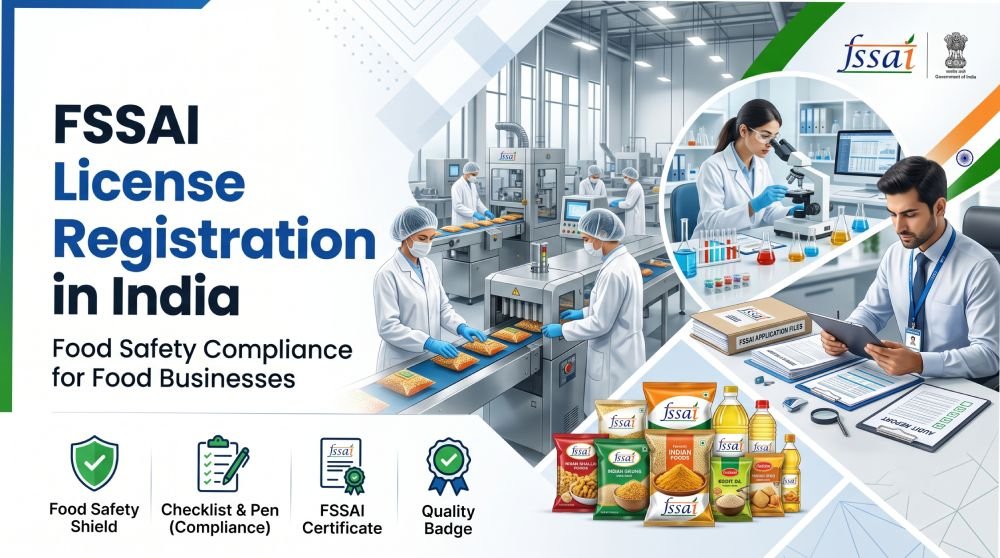
Starting or operating a food business in India requires compliance with the regulations laid down by the Food Safety and Standards Authority of India (FSSAI). Whether you are a food manufacturer, restaurant owner, cloud kitchen, retailer, wholesaler, importer, exporter, distributor, or food processing unit, obtaining the appropriate FSSAI License or Registration is a legal requirement under the Food Safety and Standards Act, 2006.
An FSSAI License demonstrates that your business follows the prescribed food safety standards, hygiene practices, and quality control measures. It not only ensures regulatory compliance but also enhances customer trust, strengthens your brand reputation, and allows you to operate your business without legal complications.
At Bharati Global Compliances, we provide complete assistance for FSSAI Registration, State License, and Central License across India. Our compliance experts handle the entire process—from identifying the correct license category and preparing documentation to filing the application and coordinating with the concerned authorities—ensuring a smooth and hassle-free registration experience.
What is FSSAI?
The Food Safety and Standards Authority of India (FSSAI) is the statutory authority established under the Food Safety and Standards Act, 2006, functioning under the Ministry of Health and Family Welfare, Government of India.
FSSAI is responsible for regulating and supervising the food industry in India by laying down science-based standards for food products. It ensures that food manufactured, processed, stored, distributed, sold, or imported in the country is safe, hygienic, and fit for human consumption.
Every Food Business Operator (FBO) is required to obtain the applicable FSSAI Registration or License before commencing business operations. Depending on the nature of the business, annual turnover, production capacity, and operational scale, businesses may require Basic Registration, a State License, or a Central License.
Why is an FSSAI License Important?
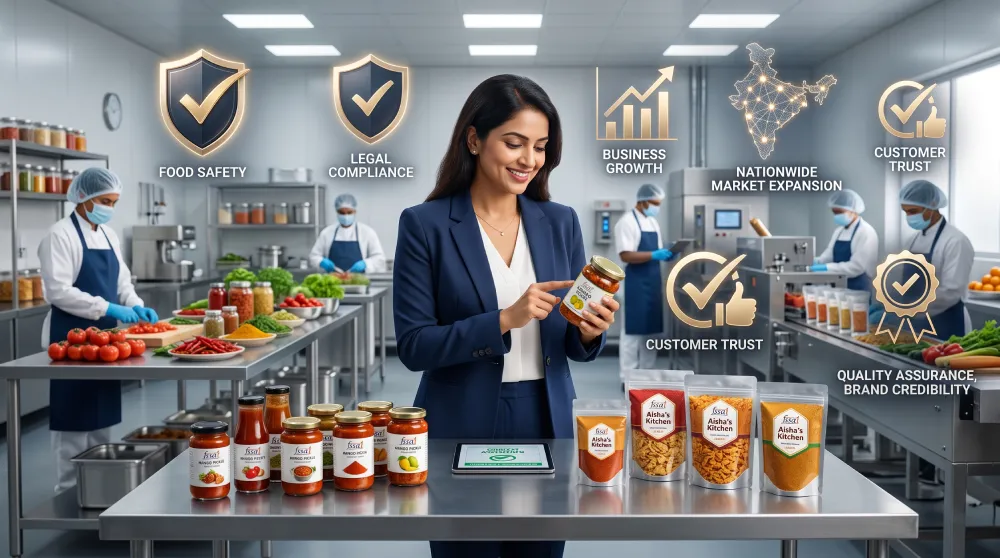
Obtaining an FSSAI License is not just a legal requirement—it also helps businesses establish credibility and maintain high food safety standards.
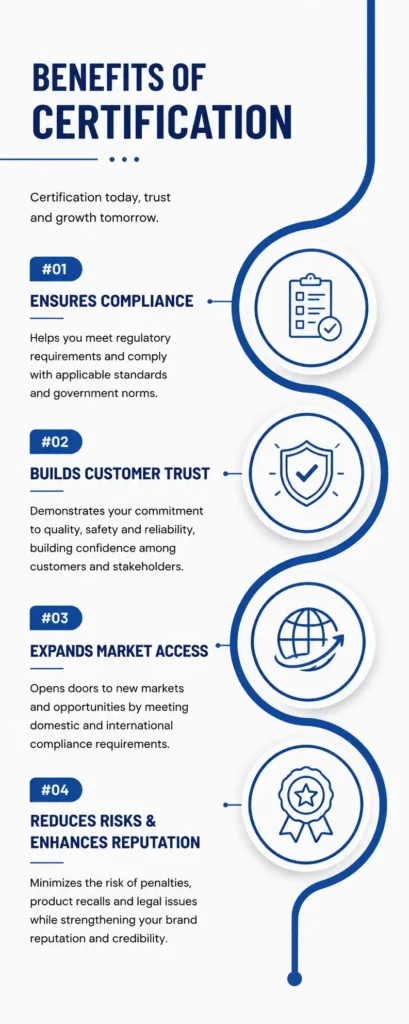
Some of the major benefits of FSSAI Registration include:
- Ensures compliance with the Food Safety and Standards Act, 2006.
- Builds consumer trust and confidence.
- Improves food quality and hygiene standards.
- Enhances business credibility and brand value.
- Facilitates business expansion across India.
- Helps obtain approvals from marketplaces and e-commerce platforms.
- Reduces the risk of legal penalties and regulatory action.
- Supports smooth import and export of food products.
- Demonstrates commitment to food safety and public health.
- Increases customer confidence in your products and services.
Who Needs an FSSAI License?
Every business involved in the manufacturing, processing, storage, transportation, distribution, sale, or import of food products is required to obtain the appropriate FSSAI Registration or License.
FSSAI Registration is generally mandatory for:
- Food Manufacturers
- Food Processing Units
- Restaurants
- Hotels
- Cafes
- Cloud Kitchens
- Sweet Shops
- Bakeries
- Food Retailers
- Wholesalers
- Distributors
- Food Importers
- Food Exporters
- Food Packaging Units
- Storage and Cold Storage Facilities
- Online Food Sellers
- E-commerce Food Businesses
- Food Delivery Partners
- Caterers
- Dairy Units
- Meat Processing Units
- Beverage Manufacturers
- Spice Manufacturers
- Edible Oil Manufacturers
- Grocery Stores
- Supermarkets
- Food Transporters
Regardless of the size of the business, obtaining the correct category of FSSAI License is essential to operate legally in India.
Types of FSSAI Registration and License
The Food Safety and Standards Authority of India issues different categories of licenses based on the size and turnover of the business.
FSSAI Basic Registration
Basic Registration is intended for small food business operators with an annual turnover of up to ₹12 lakh.
This category is generally applicable to:
- Small Manufacturers
- Home-based Food Businesses
- Petty Retailers
- Hawkers
- Temporary Stall Holders
- Small Distributors
- Local Food Vendors
FSSAI State License
The State License is applicable to medium-sized food businesses operating within a single state and meeting the prescribed turnover and operational criteria.
It is generally required by:
- Medium-scale Manufacturers
- Restaurants
- Hotels
- Food Processing Units
- Storage Facilities
- Distributors
- Marketers
- Transporters
- Medium-sized Retail Businesses
FSSAI Central License
The Central License is mandatory for large food businesses, importers, exporters, multi-state operators, and businesses falling under the eligibility criteria specified by FSSAI.
It is generally required for:
- Large Manufacturers
- Food Importers
- Food Exporters
- Multi-State Food Businesses
- Large Food Processing Industries
- Central Government Agencies
- Large Warehouses
- Major Food Distribution Companies
- Businesses Supplying Government Departments
Documents Required for FSSAI License Registration
The documents required for FSSAI Registration or License vary depending on the type of food business and the category of license being applied for. Submitting complete and accurate documents helps ensure faster approval and minimizes the chances of delays or objections.
Commonly required documents include:
- PAN Card of the Applicant or Business
- Aadhaar Card or Other Identity Proof
- Passport-size Photograph
- Address Proof of the Business Premises
- Proof of Possession of Premises (Ownership, Rent Agreement, or Lease Deed)
- Certificate of Incorporation, Partnership Deed, LLP Agreement, or Business Registration Certificate
- GST Registration Certificate (if applicable)
- Manufacturing or Processing Unit Layout Plan
- List of Machinery and Equipment
- Manufacturing Process Flow Chart
- List of Food Products to be Manufactured or Sold
- Food Safety Management System (FSMS) Plan
- NOC from the Local Authority or Municipality (where applicable)
- Water Testing Report from a Recognized Laboratory (for manufacturers)
- Import Export Code (IEC) for Food Importers and Exporters
- Declaration Form
- Authorization Letter (if applicable)
Additional documents may be required depending on the nature and scale of the food business.
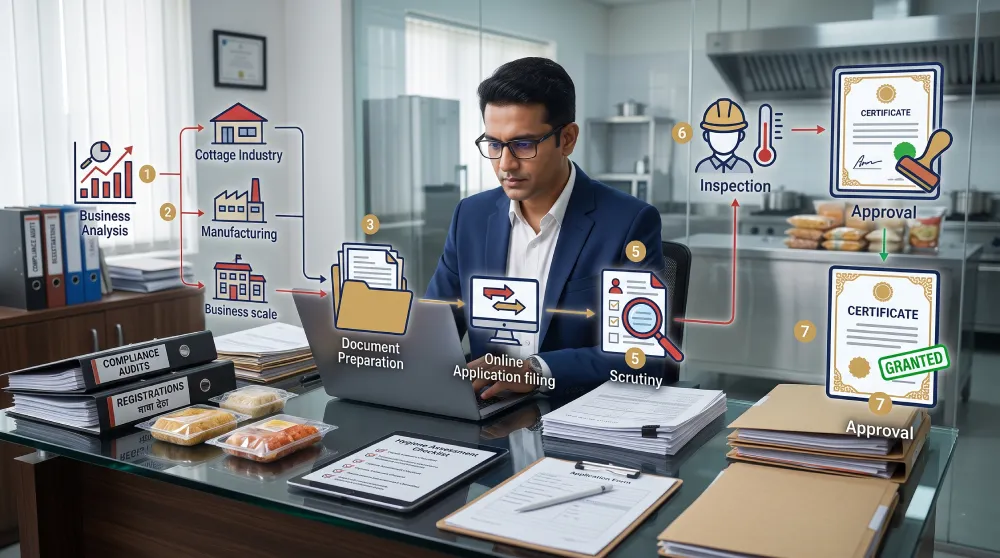
FSSAI License Registration Process
Obtaining an FSSAI License involves a systematic application and verification process. Our experts ensure that every stage is handled professionally to avoid unnecessary delays.
Step 1: Business Assessment
The first step is to evaluate the nature of your food business, annual turnover, production capacity, and operational activities to determine whether you require Basic Registration, State License, or Central License.
Step 2: Documentation
Once the appropriate license category is identified, all required documents are collected, verified, and organized in accordance with FSSAI guidelines.
Step 3: Online Application Filing
Our compliance professionals prepare and submit the online application through the official FSSAI portal along with all supporting documents and the prescribed government fee.
Step 4: Application Scrutiny
The concerned FSSAI authority reviews the application and verifies the submitted documents. If additional information or clarification is required, the applicant is notified accordingly.
Step 5: Inspection (If Applicable)
For certain categories of licenses, the Food Safety Department may conduct an inspection of the business premises to verify hygiene standards, infrastructure, manufacturing facilities, and food safety practices.
Step 6: Grant of FSSAI License
After successful verification and approval, the Food Safety and Standards Authority of India issues the FSSAI Registration Certificate or License, along with a unique 14-digit FSSAI License Number.
Timeline for FSSAI Registration
The processing time depends on the type of license and the completeness of the application.
Estimated timelines are:
- Basic FSSAI Registration: 7 to 10 Working Days
- FSSAI State License: 15 to 30 Working Days
- FSSAI Central License: 30 to 60 Working Days
The timeline may vary depending on document verification, inspection requirements, and departmental processing.
Validity of FSSAI License
An FSSAI License can be obtained for a validity period ranging from 1 year to 5 years, depending on the duration selected by the applicant at the time of application.
Businesses should choose the validity period based on their long-term operational requirements to avoid frequent renewals.
Renewal of FSSAI License
The FSSAI License must be renewed before its expiry to ensure uninterrupted business operations. It is recommended to apply for renewal at least 30 days before the license expiration date.
Failure to renew the license on time may result in penalties, suspension, or cancellation of the license, affecting the legal operation of the food business.
Timely renewal helps businesses maintain continuous compliance with the Food Safety and Standards Act, 2006, and avoid unnecessary disruptions.
Functions of FSSAI
The Food Safety and Standards Authority of India (FSSAI) plays a vital role in regulating and monitoring the food industry to ensure that food products available in the market are safe, hygienic, and of high quality. It establishes scientific standards and enforces regulations that every Food Business Operator (FBO) must follow.
The key functions of FSSAI include:
Framing Food Safety Standards
FSSAI develops science-based standards and regulations for food products to ensure their quality, safety, packaging, labeling, storage, and distribution. These standards help maintain uniformity across the food industry while protecting consumer health.
Granting FSSAI Registration and License
FSSAI issues Basic Registration, State License, and Central License to eligible Food Business Operators (FBOs). No food business can legally operate in India without obtaining the applicable FSSAI Registration or License.
Monitoring Food Safety Compliance
The authority regularly monitors food businesses to ensure compliance with the Food Safety and Standards Act, 2006. It verifies whether businesses are maintaining hygiene standards, following manufacturing guidelines, and complying with food safety regulations.
Inspection and Food Testing
FSSAI conducts inspections and facilitates laboratory testing of food products to verify their quality, composition, and safety. These inspections help identify adulterated, contaminated, or substandard food products available in the market.
Promoting Food Safety Awareness
FSSAI conducts awareness campaigns, training programs, and educational initiatives to promote safe food handling practices among food business operators and educate consumers about healthy and hygienic food choices.
Scientific Research and Risk Assessment
The authority carries out scientific studies, risk assessments, and technical evaluations to identify emerging food safety concerns and formulate appropriate regulatory measures for protecting public health.
Advising the Government
FSSAI provides technical advice and recommendations to the Central and State Governments on matters related to food safety, food standards, quality control, and public health policies.
Maintaining Records and Regulatory Data
The authority maintains records of licensed Food Business Operators and monitors compliance across the food industry. It also takes appropriate action against businesses found violating the provisions of the Food Safety and Standards Act.
Why Choose Bharati Global Compliances for FSSAI Registration?
Obtaining an FSSAI License involves selecting the correct license category, preparing accurate documentation, filing the application, and ensuring compliance with the applicable regulations. At Bharati Global Compliances, we simplify the entire process by providing end-to-end consultancy services for businesses across India.
Our experienced professionals understand the regulatory requirements and help clients obtain their FSSAI Registration or License quickly and efficiently.
Our FSSAI Services Include
- FSSAI Basic Registration
- FSSAI State License
- FSSAI Central License
- FSSAI License Renewal
- Modification of FSSAI License
- FSSAI License Conversion
- Duplicate FSSAI License
- Food Product Approval Assistance
- Documentation Support
- Online Application Filing
- Compliance Advisory Services
- End-to-End Registration Assistance
Why Businesses Trust Bharati Global Compliances
Businesses across India choose us because of our commitment to accuracy, transparency, and timely service.
Our key strengths include:
- Experienced Compliance Consultants
- PAN India Service Coverage
- Complete Documentation Assistance
- Quick Application Processing
- Transparent Pricing
- Dedicated Customer Support
- Expert Regulatory Guidance
- Hassle-Free Online Process
- Timely Updates Throughout the Application
- High Approval Success Rate
Whether you are launching a new food business or expanding your existing operations, our experts ensure that your FSSAI Registration process is completed smoothly while meeting all statutory requirements.
Common Mistakes to Avoid While Applying for an FSSAI License
Many Food Business Operators (FBOs) face unnecessary delays or rejection due to incorrect documentation, selecting the wrong license category, or failing to comply with FSSAI guidelines. Understanding these common mistakes can help businesses obtain their FSSAI License quickly and without complications.
Choosing the Wrong License Category
One of the most common mistakes is applying for the incorrect type of FSSAI License. Businesses must select the appropriate category—Basic Registration, State License, or Central License—based on their annual turnover, production capacity, business activities, and operational locations.
Submitting Incomplete Documents
Missing or incorrect documents can significantly delay the approval process. Before submitting the application, ensure that all mandatory documents are complete, valid, and accurately prepared.
Providing Incorrect Business Information
Any mismatch in the business name, registered address, product details, manufacturing activities, or ownership information may result in objections from the FSSAI authority. All information provided in the application should match the supporting documents.
Ignoring Food Safety Requirements
Food businesses must maintain proper hygiene, sanitation, and food safety practices as prescribed by FSSAI. Non-compliance with these standards may lead to rejection of the application or adverse observations during inspection.
Delaying License Renewal
An FSSAI License should be renewed before its expiry. Failure to renew the license within the prescribed time may result in penalties, suspension, or cancellation of the license, affecting the smooth operation of the business.
Benefits of Obtaining an FSSAI License
An FSSAI License is more than just a legal requirement—it is a mark of credibility and quality for food businesses. It assures customers that the business follows prescribed food safety standards and maintains high levels of hygiene throughout its operations.
Some of the key benefits include:
- Ensures compliance with the Food Safety and Standards Act, 2006.
- Builds customer trust and brand credibility.
- Improves food quality and hygiene standards.
- Enhances business reputation in the market.
- Increases customer confidence in food products.
- Facilitates business expansion across India.
- Simplifies approvals from retailers and e-commerce platforms.
- Supports food import and export activities.
- Reduces the risk of legal action and financial penalties.
- Promotes safe food handling and manufacturing practices.
Penalty for Non-Compliance with FSSAI Regulations
Operating a food business without the required FSSAI Registration or License is a violation of the Food Safety and Standards Act, 2006. The authority may impose penalties, suspend operations, or take legal action against businesses that fail to comply with the prescribed regulations.
Non-compliance may result in:
- Monetary penalties as prescribed under the Act.
- Suspension or cancellation of the FSSAI License.
- Seizure of food products found unsafe or non-compliant.
- Closure of business operations in serious cases.
- Legal proceedings for repeated or severe violations.
To avoid these consequences, businesses should ensure timely registration, maintain compliance with food safety standards, and renew their licenses before expiry.
Industries We Serve
At Bharati Global Compliances, we provide FSSAI Registration and Licensing services to businesses across a wide range of food sectors, including:
- Food Manufacturers
- Restaurants and Cafés
- Cloud Kitchens
- Hotels and Resorts
- Bakeries and Confectioneries
- Sweet Shops
- Dairy Processing Units
- Beverage Manufacturers
- Spice Manufacturers
- Edible Oil Manufacturers
- Food Importers and Exporters
- Wholesalers and Distributors
- Supermarkets and Grocery Stores
- Food Packaging Units
- Cold Storage Facilities
- E-commerce Food Businesses
- Catering Services
- Food Transporters
- Online Food Delivery Partners
- Startups and Home-Based Food Businesses
Whether you are starting a new food venture or expanding an existing business, Bharati Global Compliances provides complete assistance to obtain the right FSSAI License quickly, accurately, and in compliance with all applicable regulations.
Frequently Asked Questions (FAQs)
What is an FSSAI License?
An FSSAI License is a mandatory approval issued by the Food Safety and Standards Authority of India (FSSAI) to Food Business Operators (FBOs). It certifies that the food business complies with the food safety and hygiene standards prescribed under the Food Safety and Standards Act, 2006.
Who needs an FSSAI License in India?
Every individual or business involved in the manufacturing, processing, packaging, storage, transportation, distribution, sale, import, or export of food products must obtain the applicable FSSAI Registration or License before commencing operations.
What are the different types of FSSAI Licenses?
FSSAI provides three categories of licenses based on the nature and scale of the food business:
- Basic Registration – For small food businesses with an annual turnover up to ₹12 lakh.
- State License – For medium-sized food businesses operating within a single state.
- Central License – For large businesses, food importers, exporters, multi-state operators, and businesses meeting the prescribed eligibility criteria.
How long does it take to obtain an FSSAI License?
The estimated processing time depends on the type of license applied for:
- Basic Registration: 7–10 Working Days
- State License: 15–30 Working Days
- Central License: 30–60 Working Days
The timeline may vary depending on document verification and inspection requirements.
What is the validity of an FSSAI License?
An FSSAI License can be issued for a period ranging from 1 year to 5 years, depending on the validity selected by the applicant during the application process.
When should an FSSAI License be renewed?
The renewal application should be submitted at least 30 days before the expiry date of the existing license to avoid penalties, suspension, or cancellation.
What documents are required for FSSAI Registration?
The required documents vary depending on the license category. Commonly required documents include:
- PAN Card
- Identity and Address Proof
- Business Registration Certificate
- Proof of Business Premises
- Manufacturing Layout (if applicable)
- Equipment List
- Food Safety Management System (FSMS) Plan
- Product List
- Water Testing Report (for manufacturers)
- Import Export Code (for importers/exporters)
- Declaration Form
Additional documents may be required depending on the business activity.
Is an FSSAI License mandatory for home-based food businesses?
Yes. Home-based food businesses, cloud kitchens, home bakers, and small food vendors are generally required to obtain Basic FSSAI Registration, subject to eligibility criteria.
Can one FSSAI License be used for multiple business locations?
No. Separate FSSAI Licenses may be required for different premises or business locations depending on the nature of operations and FSSAI regulations.
Can Bharati Global Compliances help with FSSAI Registration?
Yes. Bharati Global Compliances provides complete consultancy for FSSAI Basic Registration, State License, Central License, Renewal, Modification, and Compliance Services. Our experts handle documentation, application filing, follow-ups, and end-to-end regulatory support across India.