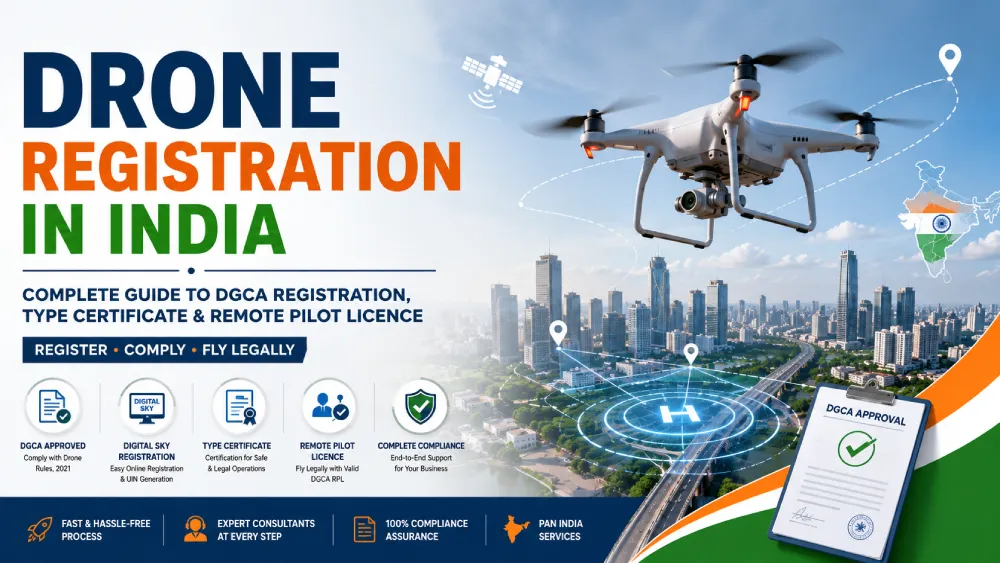
Drone technology has rapidly transformed industries across the world, and India is no exception. Over the past few years, drones—also known as Unmanned Aircraft Systems (UAS)—have become an essential tool for businesses, government agencies, and individuals. From agriculture and infrastructure inspections to filmmaking, logistics, surveying, disaster management, and defence, drones are improving efficiency, reducing operational costs, and enabling tasks that were once difficult or risky to perform.
Recognizing the immense potential of drone technology, the Government of India has introduced a modern regulatory framework to promote innovation while ensuring the safe and secure operation of drones within Indian airspace. The introduction of the Drone Rules, 2021 marked a significant step towards creating a transparent and digital ecosystem for drone registration, certification, manufacturing, and operations.
Under these rules, most drones must be registered on the Digital Sky Platform, and eligible drone models must obtain a Type Certificate issued by the Directorate General of Civil Aviation (DGCA) before they can be legally operated in India. In addition, drone operators engaged in commercial activities may also be required to obtain a Remote Pilot Licence, depending on the category of drone and its intended use.
Whether you are a drone manufacturer, importer, dealer, service provider, or an individual planning to operate a drone, understanding the applicable legal requirements is essential. Non-compliance with the Drone Rules may result in operational restrictions, regulatory action, or penalties.
At Bharati Global Compliances, we provide end-to-end consultancy for Drone Registration in India, including DGCA Type Certification, Digital Sky Registration, UIN assistance, Remote Pilot Licence guidance, documentation support, and regulatory compliance services. Our experienced professionals simplify the entire process, allowing businesses and individuals to operate drones legally and confidently.
What is Drone Registration?
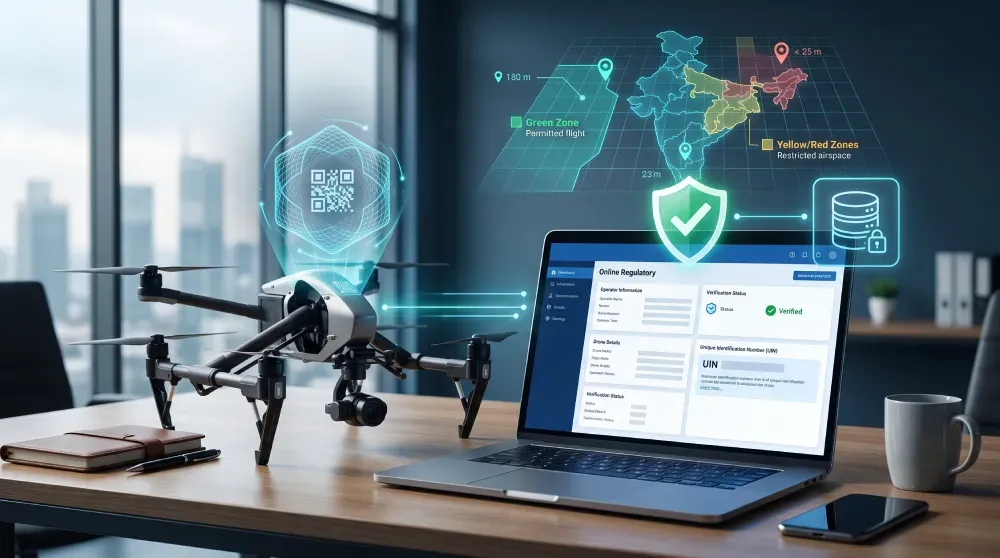
Drone Registration is the official process of registering an Unmanned Aircraft System (UAS) on the Digital Sky Platform as prescribed under the Drone Rules, 2021. The registration process enables the Government to maintain a digital record of drones operating within Indian airspace and ensures proper identification, traceability, and regulatory compliance.
After successful registration, every eligible drone is assigned a Unique Identification Number (UIN). Similar to a vehicle registration number, the UIN uniquely identifies the drone and links it to its owner, manufacturer, flight control module, and other relevant details. This digital identification helps regulatory authorities monitor drone operations and improve accountability.
Drone registration is an important legal requirement for most drones operating in India. It ensures that only approved drone models are flown and that operators comply with applicable safety standards established by the DGCA.
Why is Drone Registration Important?
With the increasing use of drones for commercial and industrial applications, maintaining safety within Indian airspace has become a top priority. Drone registration helps establish an organized ecosystem where drones can operate responsibly while minimizing risks to people, property, and other aircraft.
Some of the key reasons why Drone Registration is important include:
- Ensures compliance with the Drone Rules, 2021.
- Provides legal authorization to operate eligible drones.
- Enables issuance of a Unique Identification Number (UIN).
- Improves traceability and accountability of drone operations.
- Supports safe integration of drones into Indian airspace.
- Builds confidence among customers and regulatory authorities.
- Facilitates commercial drone operations.
- Promotes responsible and secure use of drone technology.
- Helps prevent unauthorized drone operations.
Proper registration also simplifies future approvals, transfers, renewals, and regulatory compliance requirements.
Drone Rules, 2021
The Drone Rules, 2021 form the primary regulatory framework governing the manufacture, import, ownership, registration, certification, operation, transfer, and maintenance of drones in India.
These rules were introduced by the Government of India to replace earlier regulations with a simpler and more business-friendly system. The objective is to encourage innovation while ensuring public safety, national security, and efficient management of Indian airspace.
According to the Drone Rules, 2021, an unmanned aircraft system must generally conform to an approved Type Certificate and be registered on the Digital Sky Platform before it can be legally operated, unless specifically exempted under the applicable provisions.
The rules apply to various stakeholders, including:
- Drone manufacturers
- Drone importers
- Drone owners
- Drone operators
- Leasing companies
- Maintenance organizations
- Drone service providers
- Training organizations
By establishing a fully digital approval process, the Drone Rules aim to make drone-related compliance faster, more transparent, and easier for businesses and individuals.
Who Needs Drone Registration?
Drone Registration is generally required for individuals and organizations that own or operate eligible drones in India. Depending on the nature of operations and the category of the drone, additional approvals such as a Type Certificate or Remote Pilot Licence may also be required.
Drone Registration is commonly applicable to:
- Drone manufacturers
- Drone importers
- Drone distributors
- Drone dealers
- Commercial drone operators
- Survey and mapping companies
- Agricultural drone service providers
- Infrastructure inspection companies
- Construction firms
- Mining companies
- Media and film production houses
- Logistics companies
- Research organizations
- Educational institutions
- Government agencies
- Defence contractors (subject to applicable regulations)
Whether you are using drones for commercial operations, aerial photography, mapping, inspections, agriculture, or industrial applications, ensuring compliance with the Drone Rules is essential before commencing operations.
Types of Unmanned Aircraft Systems (UAS)
Under the Drone Rules, 2021, drones are officially referred to as Unmanned Aircraft Systems (UAS). Depending on their design and mode of operation, drones are classified into different categories. This classification helps determine the applicable operational requirements, certification procedures, and regulatory obligations.
The three primary types of Unmanned Aircraft Systems are:
Aeroplane
Aeroplane drones are fixed-wing aircraft designed to fly using aerodynamic lift generated by their wings. These drones are capable of covering long distances, making them suitable for applications such as aerial surveying, mapping, agriculture, defence, and environmental monitoring.
Rotorcraft
Rotorcraft drones generate lift through rotating propellers or rotors. They are the most commonly used drones in India due to their ability to hover, take off vertically, and operate in confined spaces. Rotorcraft are widely used for photography, videography, infrastructure inspection, surveillance, and commercial services.
Hybrid
Hybrid drones combine the features of both fixed-wing and rotorcraft systems. They can perform vertical take-off and landing while also offering efficient long-distance flight. Hybrid drones are commonly used for advanced commercial, industrial, and defence applications where both endurance and maneuverability are required.
Categories of Unmanned Aircraft Systems
Each type of Unmanned Aircraft System is further classified based on its level of automation and operational control.
Remotely Piloted Aircraft System (RPAS)
A Remotely Piloted Aircraft System is operated by a trained remote pilot using a ground control station or remote controller. The pilot maintains complete control of the aircraft throughout the flight. Most commercial drones currently operating in India fall under this category.
Model Remotely Piloted Aircraft System
Model remotely piloted aircraft are primarily intended for recreational, educational, research, or hobby purposes. Depending on their specifications and intended use, they may be subject to different regulatory requirements under the Drone Rules.
Autonomous Unmanned Aircraft System
Autonomous drones operate using advanced software, artificial intelligence, sensors, and navigation systems. These drones are capable of performing missions with minimal or no direct human intervention by following pre-programmed flight paths and operational instructions.
Classification of Drones Based on Weight
The Drone Rules, 2021 classify drones according to their Maximum All-Up Weight (AUW), including payload. This classification determines the applicable registration, certification, licensing, and operational requirements.
Nano Drone
A Nano Drone has a maximum all-up weight of up to 250 grams. These drones are generally used for recreational purposes, educational activities, and basic photography. Certain regulatory exemptions may apply depending on their intended use.
Micro Drone
A Micro Drone weighs more than 250 grams but not more than 2 kilograms. These drones are commonly used for photography, videography, surveying, inspections, and commercial applications.
Small Drone
A Small Drone has a maximum all-up weight of more than 2 kilograms and up to 25 kilograms. Small drones are widely used in agriculture, industrial inspections, infrastructure projects, mapping, and logistics.
Medium Drone
A Medium Drone weighs more than 25 kilograms and up to 150 kilograms. These drones are generally deployed for specialized commercial and industrial operations requiring higher payload capacity.
Large Drone
A Large Drone has a maximum all-up weight of more than 150 kilograms. These drones are designed for heavy-duty industrial operations, defence applications, cargo transportation, and other specialized missions.
Type Certificate for Drone
A Type Certificate is one of the most important regulatory approvals under the Drone Rules, 2021. It confirms that a particular drone model complies with the technical, safety, and airworthiness requirements prescribed by the Directorate General of Civil Aviation (DGCA).
Before an eligible drone model can be operated in India, it must generally conform to an approved Type Certificate unless specifically exempted under the Drone Rules.
The Type Certificate verifies various aspects of the drone, including:
- Aircraft design
- Structural integrity
- Flight performance
- Safety features
- Control systems
- Propulsion system
- Navigation equipment
- Communication systems
- Manufacturing quality
- Compliance with applicable technical standards
The Directorate General of Civil Aviation (DGCA) issues the Type Certificate after reviewing the recommendations submitted by the Quality Council of India (QCI) or an Authorised Testing Entity (ATE) based on successful evaluation and testing of the drone model.
Only drone models that successfully meet the prescribed compliance requirements are eligible for certification and legal operation in India.
Exemption from Type Certificate
The Drone Rules provide certain exemptions from obtaining a Type Certificate in specific situations.
Generally, a Type Certificate may not be required for:
- Manufacturing drones intended for research and development purposes.
- Importing drones where certification requirements are specifically exempted under applicable regulations.
- Model Remotely Piloted Aircraft Systems used under permitted conditions.
- Nano drones operating within the exemptions specified under the Drone Rules.
Although exemptions are available for certain categories, businesses and drone operators should carefully verify the latest regulatory requirements before manufacturing, importing, or operating any unmanned aircraft system in India.
At Bharati Global Compliances, our experts help businesses determine whether their drone requires a Type Certificate and provide complete assistance with DGCA certification, documentation, and regulatory compliance.
Process of Obtaining a Type Certificate for Drones
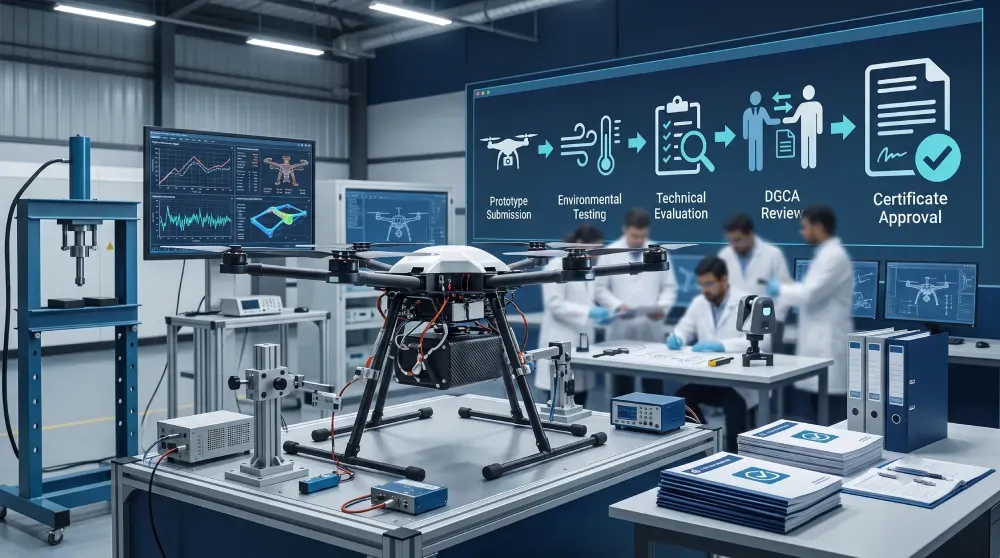
Manufacturers who intend to manufacture or commercially introduce a drone model in India must obtain a Type Certificate from the Directorate General of Civil Aviation (DGCA), wherever applicable under the Drone Rules, 2021. The certification process ensures that the drone complies with the prescribed technical, operational, and safety requirements before it is allowed to operate in Indian airspace.
The general process for obtaining a Type Certificate is as follows:
Step 1: Create an Account on the Digital Sky Platform
The applicant must first create an account and complete the required profile on the Digital Sky Platform. This platform serves as the official online portal for submitting applications related to drone certification, registration, licensing, and other regulatory approvals.
Step 2: Submit Prototype Details
After successfully creating the account, the applicant must provide complete information about the prototype drone model. This includes technical specifications, design details, product category, intended use, and other relevant information required for evaluation.
Step 3: Submit the Application and Required Documents
The applicant must complete the Type Certificate application by submitting the prescribed form along with the applicable government fee and all supporting technical documents. Accurate documentation helps speed up the certification process and reduces the chances of application rejection.
Step 4: Prototype Testing
Once the application is received, the prototype drone is tested by an Authorised Testing Entity (ATE) approved under the Drone Rules. The testing agency evaluates the drone’s design, performance, safety features, structural integrity, flight characteristics, communication systems, and overall compliance with the applicable standards.
After completing the evaluation, the testing agency prepares a detailed test report and forwards its recommendations to the Directorate General of Civil Aviation.
Step 5: Review by DGCA
Based on the test report and recommendations received from the authorised testing agency or the Quality Council of India (QCI), the DGCA reviews the complete application. If the drone successfully meets all prescribed technical and safety requirements, the authority proceeds with the approval process.
Step 6: Grant of Type Certificate
Upon successful verification of all requirements, the Directorate General of Civil Aviation issues the Type Certificate for the specific drone model. Once certified, the drone becomes eligible for registration and commercial operation in accordance with the applicable provisions of the Drone Rules.
Documents Required for Obtaining a Type Certificate
To obtain a Type Certificate, applicants are required to submit detailed technical and legal documents for evaluation. The exact documentation may vary depending on the category and specifications of the drone.
The commonly required documents include:
- Certificate of Incorporation or business registration documents
- Trademark or brand ownership details (where applicable)
- Authorisations and approvals required under applicable government regulations
- Equipment Type Approval (ETA), wherever applicable
- Product design drawings
- Technical specifications of the drone
- Prototype details
- Engineering design documents
- Flight performance reports
- Ground test reports
- Flight test reports
- Risk assessment reports
- Quality control documents
- UAS Flight Manual
- Manufacturer’s Operating Manual
- Maintenance Manual
- Maintenance Inspection Schedule
- Product photographs
- Any additional technical documents required by DGCA or the authorised testing agency
Preparing complete and accurate documentation significantly improves the chances of obtaining certification without unnecessary delays.
Drone Registration in India
After obtaining the applicable Type Certificate, eligible drones must be registered on the Digital Sky Platform before they can be legally operated in India. Upon successful registration, the system generates a Unique Identification Number (UIN) for the drone.
The UIN acts as the official identification number of the drone and links it with the manufacturer’s serial number, the flight control module, and the registered owner. Similar to a vehicle registration number, the UIN helps establish accountability, traceability, and regulatory oversight for drone operations.
Drone registration is an important legal requirement for most commercial drone operations and ensures that only approved drones are permitted to fly within Indian airspace.
Process of Drone Registration
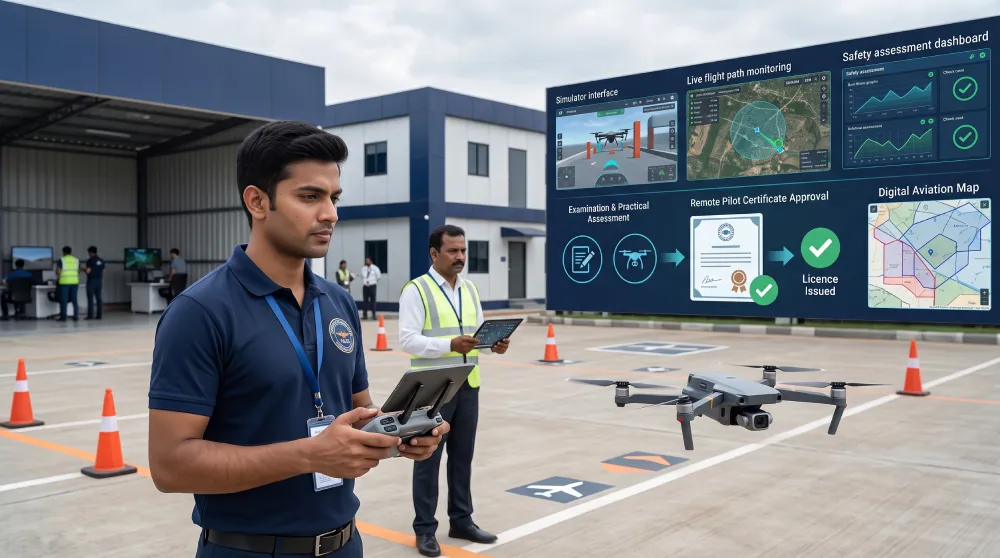
The registration process has been designed to be completely digital through the Digital Sky Platform.
Step 1: Account Creation
The applicant must create an account and complete the required profile on the Digital Sky Platform.
Step 2: Application Submission
After logging into the portal, the applicant must submit the prescribed registration application along with the required information, including the applicable Type Certificate details and the prescribed registration fee.
Step 3: Verification of Details
The information submitted by the applicant is verified through the Digital Sky Platform. During this stage, the authority checks the accuracy of the submitted information and confirms that the drone complies with the applicable regulatory requirements.
Step 4: Issuance of Unique Identification Number (UIN)
Once the verification process is successfully completed, the Digital Sky Platform issues a Unique Identification Number (UIN) for the drone. The UIN is digitally linked with the drone’s serial number and other technical details, enabling legal operation of the drone in India.
Documents Required for Drone Registration
Applicants generally need to provide the following documents while registering a drone:
- Name and address of the applicant or organisation
- Certificate of Incorporation or business registration documents
- GST Registration Certificate
- Details of directors or authorised signatories
- Identity proof of the authorised person
- Aadhaar Card or other government-issued identity proof
- Drone specifications
- Manufacturer details
- Product photographs
- Type Certificate details (where applicable)
At Bharati Global Compliances, we assist manufacturers, importers, businesses, and drone operators in preparing documentation, completing Digital Sky registration, obtaining Type Certificates, and ensuring full compliance with the latest DGCA regulations.
Transfer of Drone Ownership
The Drone Rules, 2021 allow the transfer of ownership of a registered drone from one person or organization to another. A drone may be transferred through sale, lease, gift, merger, acquisition, or any other legally recognized mode. To ensure transparency and maintain an updated ownership record, the transfer must be completed through the Digital Sky Platform.
The transfer application generally requires details of both the transferor and the transferee, along with the Unique Identification Number (UIN) of the drone. Once the application is verified and approved, the ownership records are updated accordingly.
Keeping the ownership details updated is important to ensure regulatory compliance and avoid future legal complications.
Deregistration of a Drone
There may be situations where a registered drone is permanently damaged, lost, destroyed, or no longer intended for operation. In such cases, the owner should apply for deregistration of the drone through the Digital Sky Platform.
Deregistration helps maintain accurate records of active drones operating in Indian airspace and prevents misuse of inactive or damaged drones. The application generally requires the relevant drone details, the reason for deregistration, and other supporting information as prescribed by the competent authority.
Remote Pilot Licence
A Remote Pilot Licence (RPL) is an official authorization issued by the Directorate General of Civil Aviation (DGCA) that permits an individual to legally operate eligible drones in India. The licence certifies that the pilot has completed the required training and possesses the necessary knowledge and skills to fly drones safely and responsibly.
Depending on the category of the drone and its intended use, obtaining a Remote Pilot Licence may be mandatory under the Drone Rules, 2021. Commercial drone operators are generally required to hold a valid licence before undertaking drone operations.
The licence specifies the category and classification of drones that the holder is authorized to operate.
Eligibility for a Remote Pilot Licence
An applicant must satisfy the prescribed eligibility criteria before applying for a Remote Pilot Licence.
Generally, an applicant should:
- Be at least 18 years of age.
- Have passed Class 10 or an equivalent examination from a recognized board.
- Successfully complete training from a DGCA-authorized Remote Pilot Training Organisation (RPTO).
- Pass the prescribed assessment conducted by the training organisation.
Meeting these eligibility requirements is essential before the licence application can be processed.
Documents Required for a Remote Pilot Licence
Applicants are generally required to submit the following documents while applying for a Remote Pilot Licence:
- Identity proof
- Address proof
- Aadhaar Card or other government-issued identity proof
- Recent passport-size photograph
- Educational qualification certificate
- Training completion certificate
- Details of the authorised training organisation
- Contact information
- Any additional documents required by DGCA
Providing complete and accurate documents helps ensure faster processing of the licence application.
Procedure for Obtaining a Remote Pilot Licence
The process for obtaining a Remote Pilot Licence involves several stages to ensure that the applicant has received the required training and meets the prescribed competency standards.
Step 1: Complete Drone Pilot Training
The applicant must enrol in a DGCA-authorized Remote Pilot Training Organisation (RPTO) and successfully complete the prescribed training programme. The training includes theoretical instruction, simulator sessions, and practical flying exercises designed to prepare candidates for safe drone operations.
Step 2: Pass the Assessment
After completing the training programme, the applicant must successfully clear the examination and practical assessment conducted by the authorised training organisation. Candidates who qualify become eligible for the next stage of the licensing process.
Step 3: Submission of Licence Application
The authorised Remote Pilot Training Organisation submits the licence application on behalf of the successful candidate through the Digital Sky Platform, along with the required documents and applicable fee.
Step 4: Issue of Remote Pilot Certificate
Upon successful verification of the application, a Remote Pilot Certificate is generated through the Digital Sky Platform, confirming that the applicant has successfully completed the prescribed training and assessment.
Step 5: Grant of Remote Pilot Licence
After reviewing the application and supporting documents, the Directorate General of Civil Aviation issues the Remote Pilot Licence through the Digital Sky Platform. The licence authorizes the holder to operate the specified category of drones in accordance with the applicable Drone Rules.
Validity of a Remote Pilot Licence
A Remote Pilot Licence is generally valid for 10 years, provided it remains registered on the Digital Sky Platform and is not suspended, cancelled, or revoked by the competent authority.
To continue operating drones legally, licence holders should ensure that their licence remains valid and complies with all applicable regulatory requirements.
Exemption from Remote Pilot Licence
Certain drone operations are exempt from the requirement of obtaining a Remote Pilot Licence under the Drone Rules, 2021.
Some common exemptions include:
- Operation of Nano Drones used for permitted purposes.
- Operation of Micro Drones for approved non-commercial or recreational activities, subject to the applicable provisions of the Drone Rules.
- Other exemptions specifically notified by the Government of India or DGCA from time to time.
Before operating any drone without a licence, it is advisable to verify the latest regulatory requirements, as exemptions may vary depending on the category of the drone and its intended use.
At Bharati Global Compliances, our experts provide complete assistance with Remote Pilot Licence applications, DGCA documentation, Digital Sky compliance, and regulatory guidance, helping individuals and businesses meet all applicable legal requirements with ease.
Authorisation for Remote Pilot Training Organisation (RPTO)
A Remote Pilot Training Organisation (RPTO) is an institution authorised by the Directorate General of Civil Aviation (DGCA) to provide training to individuals seeking a Remote Pilot Licence. These organisations play a vital role in developing skilled drone pilots by offering structured training programmes that cover theoretical knowledge, simulator sessions, and practical flying experience.
Only DGCA-authorised RPTOs are permitted to conduct drone pilot training and recommend eligible candidates for the issuance of a Remote Pilot Licence. Organisations planning to establish a drone training centre must first obtain the necessary authorisation from the DGCA and comply with all applicable regulatory requirements.
Documents Required for RPTO Authorisation
To obtain authorisation as a Remote Pilot Training Organisation, applicants are generally required to submit the following documents:
- Certificate of Incorporation or business registration documents
- PAN Card of the organisation
- GST Registration Certificate
- Details of directors or authorised signatories
- Identity and address proof of authorised persons
- Proof of ownership or lease agreement for the training premises
- Details of the proposed training infrastructure
- Drone specifications and technical details
- Training equipment details
- Instructor qualifications
- Operational manuals
- Safety procedures and emergency response plans
- Any additional documents required by DGCA
Submitting complete and accurate documentation helps ensure faster approval and avoids unnecessary delays during the evaluation process.
Procedure for Obtaining RPTO Authorisation
Organisations intending to establish a Remote Pilot Training Organisation must follow the approval process prescribed by the Directorate General of Civil Aviation.
Step 1: Create an Account on the Digital Sky Platform
The applicant must first create an account on the Digital Sky Platform and complete the required organisational profile before submitting the application.
Step 2: Submit the Application
After logging into the portal, the applicant must complete the prescribed application form by providing details of the organisation, training infrastructure, instructors, equipment, and other required information.
Step 3: Upload Documents and Pay the Application Fee
The required supporting documents must be uploaded along with the applicable government fee. The application is then forwarded to the DGCA for technical evaluation and verification.
Step 4: Review by DGCA
The DGCA carefully reviews the application, verifies the submitted documents, and evaluates whether the organisation meets the prescribed eligibility criteria and operational requirements.
Step 5: Grant of Authorisation
If the organisation successfully satisfies all regulatory requirements, the DGCA grants authorisation to operate as a Remote Pilot Training Organisation (RPTO). Once authorised, the organisation can provide approved drone pilot training programmes and recommend successful candidates for Remote Pilot Licences.
Validity of RPTO Authorisation
The authorisation granted to a Remote Pilot Training Organisation is generally valid for 10 years, unless it is suspended, cancelled, or surrendered in accordance with the applicable provisions of the Drone Rules.
The authorisation may be renewed by submitting the prescribed application before its expiry, subject to compliance with the prevailing regulatory requirements.
Exemptions Under the Drone Rules
The Drone Rules, 2021 provide certain exemptions from registration, certification, and licensing requirements in specific circumstances.
Depending on the intended use and applicable regulatory provisions, exemptions may be available for:
- Drones used exclusively for research and development.
- Prototype drones undergoing testing and evaluation.
- Certain Nano Drone operations.
- Specific categories of Model Remotely Piloted Aircraft.
- Other exemptions notified by the Government of India or DGCA from time to time.
Before relying on any exemption, businesses and drone operators should carefully verify the latest regulatory provisions to ensure compliance with applicable laws.
Government Fees for Drone Registration and Certification
The Government of India has prescribed nominal fees for various drone-related approvals under the Drone Rules. The applicable fee depends on the specific service being requested.
Some commonly applicable services include:
- Issuance of Type Certificate
- Drone Registration and Unique Identification Number (UIN)
- Transfer of Drone Ownership
- Deregistration of Drone
- Issuance or Renewal of Remote Pilot Licence
- Authorisation or Renewal of Remote Pilot Training Organisation
Applicants should verify the latest fee structure on the Digital Sky Platform or through the relevant DGCA notifications before submitting their applications.
Why Choose Bharati Global Compliances for Drone Registration?
Obtaining approvals from the DGCA can be challenging without proper knowledge of the applicable regulations and documentation requirements. At Bharati Global Compliances, we simplify the entire compliance process by providing end-to-end consultancy for drone manufacturers, importers, operators, startups, educational institutions, and businesses across India.
Our experienced professionals assist clients at every stage of the approval process, ensuring timely documentation, regulatory compliance, and smooth coordination with the concerned authorities.
Our Drone Compliance Services include:
- DGCA Drone Registration Assistance
- Type Certificate Consultancy
- Digital Sky Platform Registration
- UIN Registration Support
- Remote Pilot Licence Assistance
- RPTO Authorisation Consultancy
- Documentation Preparation
- Compliance Review
- Regulatory Advisory
- End-to-End DGCA Support
- PAN India Service
Frequently Asked Questions (FAQs)
Is Drone Registration mandatory in India
Yes. Most drones are required to be registered on the Digital Sky Platform before they can be legally operated in India, unless specifically exempted under the Drone Rules, 2021.
What is a Unique Identification Number (UIN)
A UIN is a unique registration number issued through the Digital Sky Platform after successful drone registration. It acts as the official identification number of the drone.
Who issues the Type Certificate for drones?
The Directorate General of Civil Aviation (DGCA) issues the Type Certificate after evaluating the recommendations submitted by the authorised testing agency or the Quality Council of India, wherever applicable.
Is a Remote Pilot Licence mandatory?
A Remote Pilot Licence is required for operating eligible drones in accordance with the Drone Rules. However, certain categories of Nano and Micro Drones may be exempt under specific conditions.
How long is a Remote Pilot Licence valid?
A Remote Pilot Licence is generally valid for 10 years, subject to the applicable provisions of the Drone Rules and continued compliance with regulatory requirements
Can a drone be transferred to another owner
Yes. A registered drone can be transferred through the Digital Sky Platform by following the prescribed transfer procedure and updating the ownership records.
Can Bharati Global Compliances assist with Drone Registration?
Yes. Bharati Global Compliances provides complete assistance for DGCA Drone Registration, Type Certification, UIN Registration, Remote Pilot Licence, RPTO Authorisation, documentation, and end-to-end regulatory compliance services across India.
Conclusion
The Drone Rules, 2021 have established a transparent and business-friendly framework for the safe operation of drones in India. Whether you are a manufacturer, importer, commercial operator, or training organisation, complying with the applicable DGCA requirements is essential for operating drones legally and responsibly.
With expert guidance from Bharati Global Compliances, businesses and individuals can complete the entire Drone Registration process efficiently. From Type Certification and Digital Sky Registration to UIN allocation and Remote Pilot Licence assistance, our compliance experts provide reliable support at every stage, helping you navigate India’s evolving drone regulations with confidence.