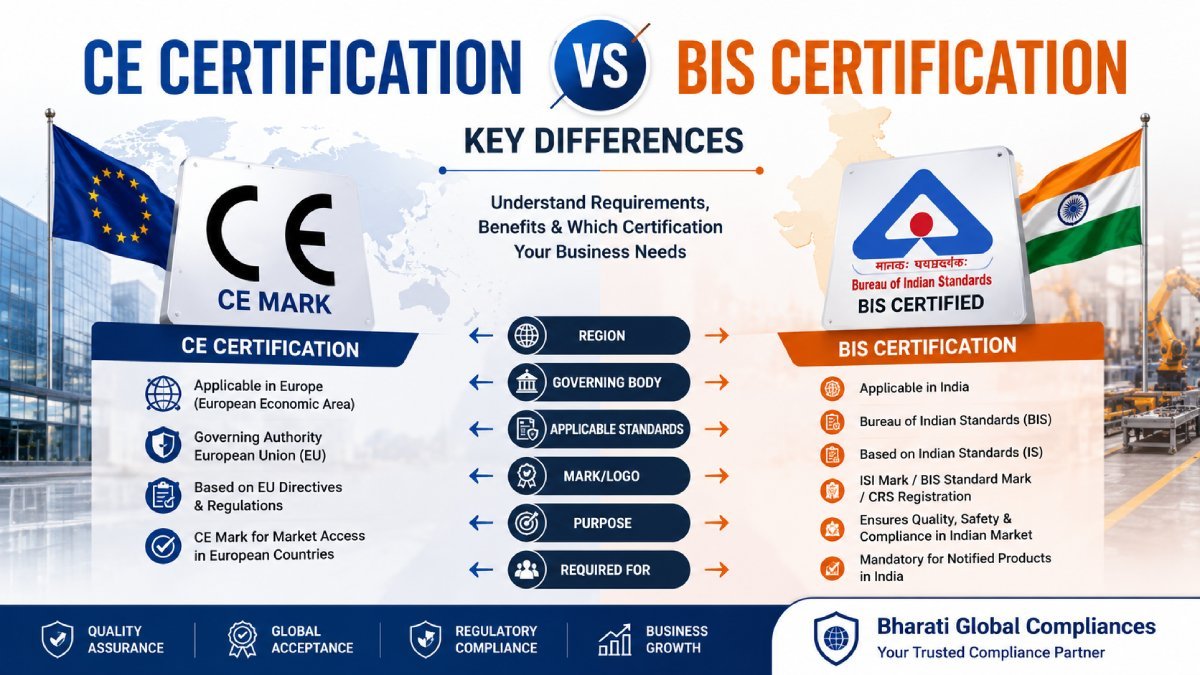
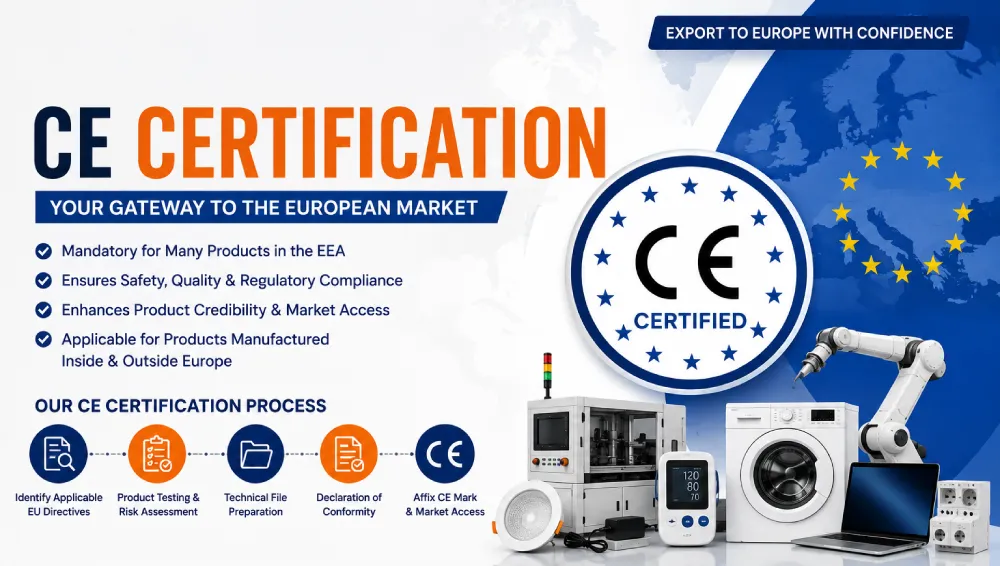
If you are planning to export your products to the European market, obtaining CE Certification is one of the most important compliance requirements. The CE Mark indicates that a product complies with the European Union’s safety, health, environmental, and consumer protection regulations. It also allows manufacturers to legally market eligible products across the European Economic Area (EEA).
The CE Mark is mandatory for a wide range of products such as electrical equipment, machinery, medical devices, construction products, toys, pressure equipment, and many other regulated categories. Without CE compliance, these products cannot be legally placed on the European market.
At Bharati Global Compliances, we provide end-to-end assistance for CE Certification, including product assessment, technical documentation, testing coordination, conformity evaluation, and compliance support to help manufacturers and exporters access European markets confidently.
What is CE Certification?
CE Certification, commonly known as CE Marking, is a declaration by the manufacturer that a product complies with all applicable European Union directives and regulations. The initials CE stand for Conformite Europeenne, which means European Conformity.
Rather than representing product quality, the CE Mark confirms that the product satisfies essential safety, health, and environmental protection requirements established by the European Union.
Once a product receives CE Marking, it can be freely marketed across the member countries of the European Economic Area (EEA), including all EU nations along with Iceland, Liechtenstein, and Norway.
Manufacturers located outside Europe can also obtain CE Certification, provided their products meet the applicable EU directives and conformity assessment procedures.

Why is CE Certification Important?
CE Marking provides manufacturers with legal access to European markets while demonstrating compliance with internationally accepted safety standards.
Some key benefits include:
- Enables free movement of products across the European Economic Area (EEA)
- Demonstrates compliance with EU safety and environmental regulations
- Enhances customer confidence and product credibility
- Reduces barriers to international trade
- Improves product acceptance in global markets
- Supports smooth customs clearance for exports
- Strengthens brand reputation among international buyers
Applicable EU Directives for CE Certification
CE Marking is applicable only to products covered under one or more European Union Directives or Regulations. Before applying for CE Certification, manufacturers must identify the relevant legislation applicable to their product category.
Some of the most common EU Directives and Regulations include:
- Low Voltage Directive (LVD)
- Electromagnetic Compatibility (EMC) Directive
- Machinery Directive
- Radio Equipment Directive (RED)
- Medical Devices Regulation (MDR)
- Personal Protective Equipment (PPE) Regulation
- Toy Safety Directive
- Pressure Equipment Directive (PED)
- Construction Products Regulation (CPR)
- Gas Appliances Regulation
- Measuring Instruments Directive (MID)
- ATEX Directive for Explosive Atmospheres
- RoHS Directive
- EcoDesign Directive
Selecting the correct directive is one of the most critical steps because it determines the applicable standards, testing requirements, documentation, and conformity assessment procedure.
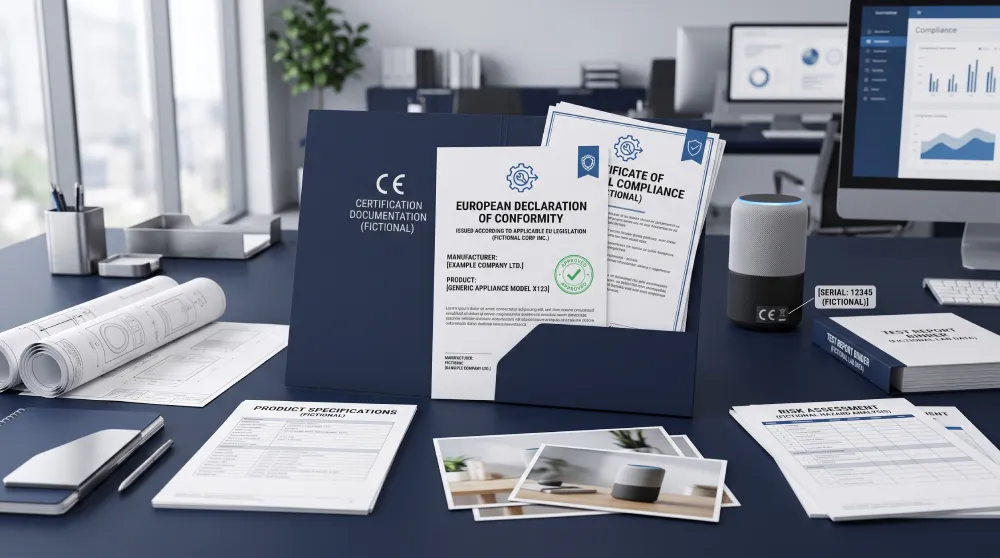
Documents Required for CE Certification
Manufacturers are required to maintain complete technical documentation before obtaining CE Marking. Depending on the product category, the following documents are generally required:
- Product Description and Technical Specifications
- Product Photographs
- Bill of Materials (BOM)
- Product Design Drawings
- Product Test Reports
- Risk Assessment Report
- User Manual
- Manufacturing Process Details
- Quality Control Documents
- Declaration of Conformity (DoC)
- Technical Construction File (Technical Dossier)
- ISO Certificate (if applicable)
- Manufacturer Authorization Letter
- Business Registration Documents
The technical documentation should clearly demonstrate that the product complies with all applicable EU safety and performance requirements.
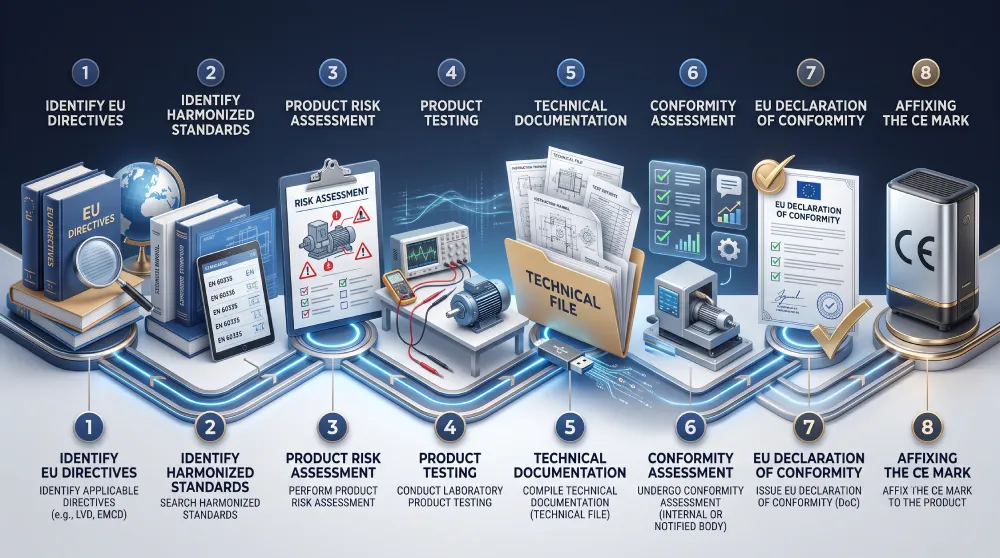
CE Certification Process
Obtaining CE Certification involves a systematic conformity assessment process. The exact procedure depends on the product category and applicable EU legislation.
Step 1: Identify Applicable EU Directives
Determine which European Directives or Regulations apply to your product based on its intended use and technical characteristics.
Step 2: Identify Harmonized Standards
Select the relevant European Harmonized Standards (EN Standards) applicable to the product.
Step 3: Product Risk Assessment
Conduct a detailed risk assessment to identify potential hazards and ensure compliance with all essential safety requirements.
Step 4: Product Testing
The product is tested according to applicable European standards through accredited laboratories or internal testing where permitted.
Step 5: Prepare Technical Documentation
Compile the complete Technical Construction File containing design information, test reports, calculations, user manuals, and compliance records.
Step 6: Conformity Assessment
Depending on the applicable directive, the manufacturer may perform self-declaration or obtain assessment from a Notified Body.
Step 7: Declaration of Conformity
After successful evaluation, the manufacturer prepares and signs the EU Declaration of Conformity confirming compliance with all applicable requirements.
Step 8: Affix the CE Mark
Once all compliance requirements are fulfilled, the CE Mark can be affixed to the product, allowing it to be legally marketed throughout the European Economic Area (EEA).
Technical Documentation (Technical Dossier) for CE Certification
A Technical Dossier, also known as the Technical File, is one of the most important requirements for CE Certification. It contains all technical information demonstrating that the product complies with applicable European Union Directives and Harmonized Standards.
Manufacturers are responsible for preparing and maintaining this documentation before placing their products on the European market. The technical file must be kept available for inspection by market surveillance authorities for the period specified under the applicable EU legislation.
A complete Technical Dossier generally includes:
- Product Description
- Product Design Drawings
- Technical Specifications
- Bill of Materials (BOM)
- Risk Assessment Report
- Product Test Reports
- Manufacturing Process Details
- Quality Control Procedures
- Applicable EU Directives
- Harmonized Standards Applied
- User Manual and Safety Instructions
- Product Labels and Markings
- Declaration of Conformity
- Photographs of the Product
- Packaging Details
Proper technical documentation significantly reduces the chances of delays or non-compliance during the CE Certification process.
EU Declaration of Conformity (DoC)
The EU Declaration of Conformity (DoC) is an official document signed by the manufacturer stating that the product complies with all applicable European Union legislation.
By issuing this declaration, the manufacturer accepts full responsibility for the product’s compliance with all relevant EU requirements.
The Declaration of Conformity generally contains:
- Manufacturer’s Name and Address
- Product Name and Model Number
- Product Identification Details
- Applicable EU Directives
- Harmonized Standards Used
- Name of the Responsible Person
- Place and Date of Issue
- Authorized Signature
The Declaration of Conformity must accompany the product whenever required by applicable legislation.
Self-Declaration vs Notified Body Certification
The CE Certification route depends on the product category and the applicable conformity assessment procedure.
Self-Declaration
For many low-risk products, manufacturers can perform a self-assessment after ensuring compliance with all applicable directives and standards. In such cases, the manufacturer prepares the Technical File, signs the Declaration of Conformity, and affixes the CE Mark without involving a third-party certification body.
Notified Body Certification
Certain high-risk products require assessment by an EU-designated Notified Body before CE Marking can be applied.
Products commonly requiring Notified Body involvement include:
- Medical Devices
- Personal Protective Equipment (High Risk)
- Pressure Equipment
- Lifts
- Gas Appliances
- Certain Machinery
- Marine Equipment
The Notified Body evaluates the product design, testing reports, technical documentation, and manufacturing process before issuing the required conformity assessment.
Validity of CE Certification
CE Marking generally does not have a fixed expiry date. It remains valid as long as:
- The product design remains unchanged.
- Applicable EU Directives and Harmonized Standards remain the same.
- Manufacturing processes continue to comply with regulatory requirements.
- Technical documentation is properly maintained.
- Product quality and safety remain consistent.
If significant design changes are made or EU regulations are updated, manufacturers may need to reassess the product and update the Technical File before continuing to use the CE Mark.
Who Needs CE Certification?
CE Certification is mandatory for manufacturers, importers, and exporters dealing with products covered under applicable European legislation.
Businesses that typically require CE Marking include:
- Manufacturers exporting products to Europe
- Importers supplying CE-regulated products
- Original Equipment Manufacturers (OEMs)
- Private Label Brand Owners
- Medical Device Manufacturers
- Electrical and Electronics Manufacturers
- Machinery Manufacturers
- Industrial Equipment Manufacturers
- Construction Product Manufacturers
- Toy Manufacturers
- PPE Manufacturers
- Telecom Equipment Manufacturers
Companies planning to enter the European market should verify whether their products fall under CE Marking requirements before export.
Cost of CE Certification
The cost of CE Certification depends on several factors, including the type of product, applicable European Directives, testing requirements, and whether a Notified Body is involved.
Some of the major factors affecting the overall certification cost include:
- Product Category
- Applicable EU Directives
- Product Complexity
- Number of Product Variants
- Laboratory Testing Charges
- Notified Body Fees (if applicable)
- Technical Documentation Preparation
- Factory Inspection (where required)
- Consultancy Charges
Since every product has different compliance requirements, the total certification cost varies from one product to another.
Timeline for CE Certification
The time required to obtain CE Certification depends on the product category, testing requirements, and completeness of technical documentation.
A typical timeline is as follows:
| Process | Estimated Timeline |
|---|---|
| Product Assessment | 2–5 Working Days |
| Documentation Preparation | 5–10 Working Days |
| Product Testing | 2–6 Weeks |
| Technical File Preparation | 1–2 Weeks |
| Notified Body Review (if applicable) | 2–8 Weeks |
| Final CE Marking | After Successful Compliance |
Products requiring only self-declaration generally receive compliance much faster than products requiring Notified Body assessment.
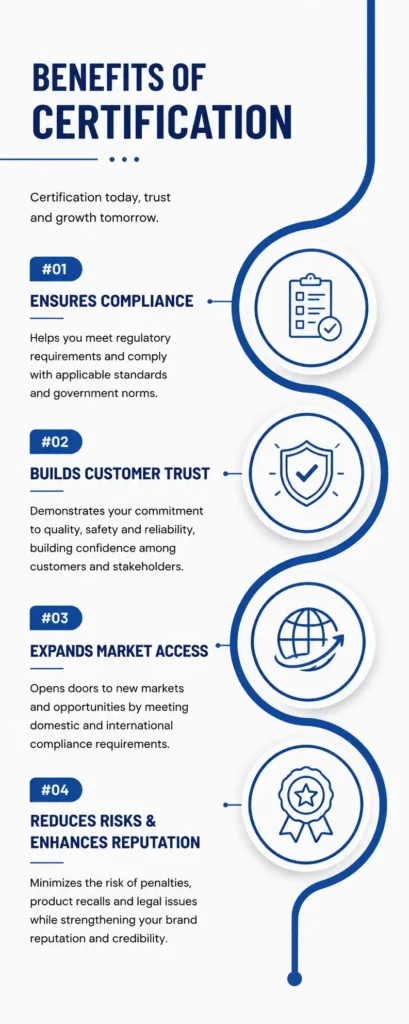
Benefits of CE Certification
Obtaining CE Certification offers significant commercial and regulatory advantages for manufacturers and exporters.
Some key benefits include:
- Access to the European Economic Area (EEA)
- Compliance with European Union Regulations
- Improved Product Credibility
- Increased Customer Confidence
- Enhanced International Brand Reputation
- Competitive Advantage in Global Markets
- Reduced Trade Barriers
- Better Export Opportunities
- Easier Customs Clearance
- Improved Product Safety and Reliability
- Demonstrates Commitment to International Quality Standards
Why Choose Bharati Global Compliances for CE Certification?
Bharati Global Compliances offers complete assistance for CE Certification, helping manufacturers, exporters, and importers meet European regulatory requirements efficiently.
Our services include:
- Product Eligibility Assessment
- Applicable Directive Identification
- Harmonized Standards Guidance
- Technical Documentation Support
- Product Testing Coordination
- Risk Assessment Assistance
- Technical File Preparation
- Declaration of Conformity Assistance
- End-to-End Certification Support
- Dedicated Compliance Experts
- Fast Processing
- PAN India Consultancy Services
Our experienced consultants simplify the CE Certification process, ensuring smooth compliance with European regulations while minimizing delays.
Conclusion
CE Certification is essential for manufacturers intending to sell regulated products within the European Economic Area. It demonstrates compliance with EU safety, health, and environmental requirements while improving customer confidence and expanding international market opportunities.
Whether your product requires self-declaration or assessment by a Notified Body, maintaining accurate technical documentation and following the correct conformity assessment procedure are essential for successful CE Marking.
At Bharati Global Compliances, we provide comprehensive support throughout the CE Certification process—from product assessment and documentation to testing coordination and regulatory compliance—helping businesses achieve faster approvals and seamless access to European markets.
Frequently Asked Questions (FAQs)
What is CE Certification?
CE Certification indicates that a product complies with applicable European Union safety, health, environmental, and performance requirements, allowing it to be sold in the European Economic Area (EEA).
Is CE Certification mandatory?
Yes. CE Marking is mandatory for products covered under applicable EU Directives and Regulations before they can be sold in the European market
Who needs CE Certification?
Manufacturers, importers, exporters, private label brands, and authorized representatives dealing with CE-regulated products require CE Certification.
Which products require CE Marking?
Products such as electrical equipment, machinery, medical devices, toys, PPE, construction products, radio equipment, pressure equipment, and several other regulated categories require CE Marking
How long does it take to obtain CE Certification?
The timeline generally ranges from 2 to 12 weeks, depending on the product category, testing requirements, technical documentation, and whether a Notified Body assessment is required.
Is product testing mandatory for CE Certification?
Yes. Most products require testing to demonstrate compliance with applicable European standards. Testing requirements vary depending on the product category.
What is a Technical File?
A Technical File (Technical Dossier) is a collection of documents that demonstrates the product’s compliance with applicable EU Directives and Harmonized Standards.
What is the Declaration of Conformity (DoC)?
The Declaration of Conformity is a document signed by the manufacturer confirming that the product complies with all applicable European Union legislation.
Can foreign manufacturers obtain CE Certification?
Yes. Manufacturers located outside Europe can obtain CE Certification provided their products comply with applicable EU requirements.
Why choose Bharati Global Compliances for CE Certification?
Bharati Global Compliances offers complete CE Certification support, including product assessment, documentation, testing coordination, regulatory guidance, and end-to-end compliance assistance for manufacturers and exporters across India.