The telecommunications industry has transformed the way people communicate, work, and access digital services. From traditional voice communication to advanced technologies such as 5G, IoT, fiber networks, and smart communication systems, telecom equipment has become an essential part of everyday life. As the industry continues to evolve, maintaining the quality, safety, security, and interoperability of telecom products has become increasingly important.
To regulate telecom equipment in India and ensure that only compliant products enter the market, the Department of Telecommunications (DoT), Government of India, established the Telecommunication Engineering Centre (TEC). TEC is the national authority responsible for developing technical standards, specifications, and certification requirements for telecom equipment used across the country.
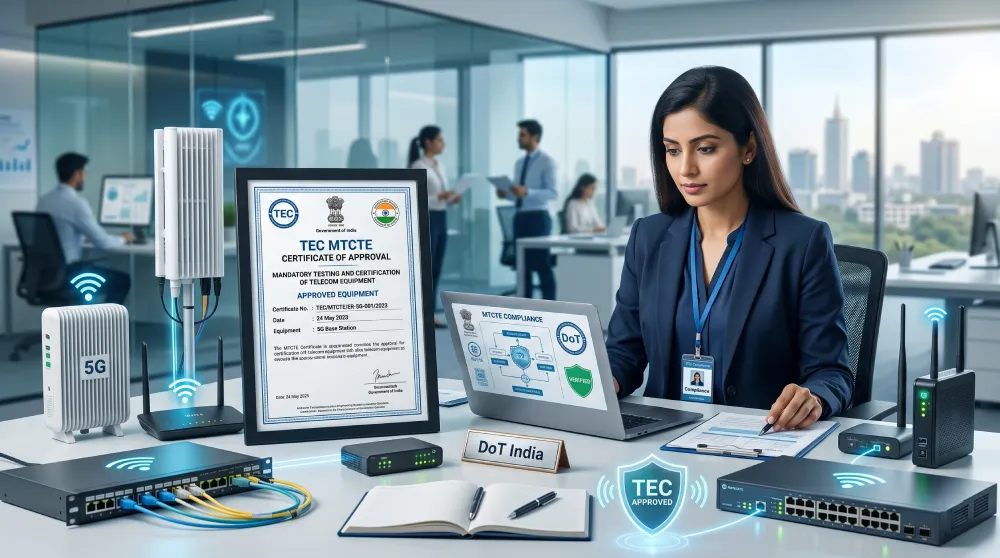
To strengthen product compliance, TEC introduced the Mandatory Testing and Certification of Telecom Equipment (MTCTE) framework. Under this scheme, specified telecom products must undergo testing at TEC-designated laboratories before they can be manufactured, imported, sold, or used in India. Products that successfully meet the prescribed Essential Requirements (ERs) are granted a TEC Certificate, demonstrating compliance with Indian regulatory standards.
Whether you are a manufacturer, importer, brand owner, or authorized representative, obtaining TEC/MTCTE Approval is essential for ensuring legal market access and building customer confidence. At Bharati Global Compliances, we provide complete consultancy services for TEC Certification, including documentation, testing coordination, application filing, compliance management, and end-to-end approval support across India.
What is TEC Approval?
The Telecommunication Engineering Centre (TEC) is the technical body functioning under the Department of Telecommunications (DoT), Government of India. It develops technical standards, testing procedures, and certification requirements for telecom equipment to ensure that products comply with national safety, performance, and security standards.
TEC Approval confirms that a telecom product satisfies the prescribed Essential Requirements and is eligible to be sold, imported, or deployed in the Indian market. Depending on the product category, certification may be mandatory or voluntary under TEC regulations.
What is MTCTE (Mandatory Testing and Certification of Telecom Equipment)?
Mandatory Testing and Certification of Telecom Equipment (MTCTE) is a regulatory certification scheme introduced by the Department of Telecommunications under the Indian Telegraph (Amendment) Rules, 2017.
Under MTCTE, notified telecom equipment must successfully complete testing at TEC-recognized laboratories before being manufactured, imported, distributed, or sold in India.
The certification process verifies that telecom products meet essential technical requirements related to:
- Product Safety
- Electromagnetic Compatibility (EMC)
- Electromagnetic Interference (EMI)
- Technical Performance
- Radio Frequency Compliance
- Network Compatibility
- Security Requirements (where applicable)
After successful evaluation, TEC issues the MTCTE Certificate, allowing the product to be legally marketed in India.

Objectives of TEC/MTCTE Certification
The primary objectives of the TEC/MTCTE certification scheme include:
- Ensuring the safety and reliability of telecom equipment.
- Preventing network interference caused by non-compliant products.
- Protecting consumers from unsafe telecom devices.
- Maintaining interoperability across telecom networks.
- Ensuring compliance with Indian regulatory standards.
- Supporting secure communication infrastructure.
- Promoting high-quality telecom manufacturing.
- Encouraging fair competition among manufacturers.
- Facilitating easier market access for compliant products.
- Strengthening India’s telecom ecosystem through standardized equipment.
Types of TEC Certification Covered Under MTCTE
The Telecommunication Engineering Centre (TEC) offers multiple certification schemes under the MTCTE framework to regulate telecom equipment in India. Depending on the type of product, its intended use, and applicable regulatory requirements, manufacturers and importers may need to obtain one of the following certifications.
Mandatory TEC Certification
Mandatory TEC Certification is required for telecom equipment that falls under the MTCTE notification issued by the Department of Telecommunications (DoT). Products covered under this scheme cannot be manufactured, imported, sold, or used in India without obtaining TEC approval.
The certification ensures that telecom equipment complies with the Essential Requirements (ERs) related to safety, electromagnetic compatibility (EMC), electromagnetic interference (EMI), technical performance, and security wherever applicable.
Under Mandatory Certification, TEC provides two certification schemes.
General Certification Scheme (GCS)
The General Certification Scheme is the standard approval process for telecom equipment. Applicants must submit complete technical documentation along with test reports generated by TEC-designated laboratories or laboratories recognized under Mutual Recognition Agreements (MRAs).
TEC evaluates the submitted documents, verifies compliance with the Essential Requirements, and issues the certificate after successful assessment.
This certification process generally takes around 40 to 45 working days, depending on document verification and testing.
Simplified Certification Scheme (SCS)
The Simplified Certification Scheme is designed to reduce documentation requirements for eligible telecom products.
Under this scheme, applicants submit a Self Declaration of Conformity (SDoC), compliance checklist, and required documents. Although complete test reports are generally not required during submission, TEC reserves the right to request them whenever necessary.
The approval process is comparatively faster and usually takes 15 to 20 working days, provided all documents are accurate and complete.
Voluntary TEC Certification
Voluntary TEC Certification is available for telecom products that are not covered under the mandatory MTCTE notification but whose manufacturers wish to demonstrate compliance with TEC technical standards.
Although this certification is optional, it provides significant advantages by improving product credibility, enhancing customer confidence, and increasing acceptance in both government and private procurement projects.
Manufacturers often choose voluntary certification to strengthen their market reputation and showcase compliance with recognized technical standards.
Voluntary Security Certification
Voluntary Security Certification focuses specifically on the cybersecurity aspects of telecom equipment.
As telecom infrastructure becomes increasingly connected, protecting communication networks from cyber threats has become essential. This certification evaluates various security parameters, including authentication, encryption, secure communication protocols, vulnerability management, access control, software integrity, logging mechanisms, and remote access protection.
Obtaining Voluntary Security Certification demonstrates that the product meets TEC’s recommended cybersecurity standards and follows industry best practices.
CAS/SMS Certification
CAS/SMS Certification is intended for organizations involved in broadcasting, digital television, cable networks, and Direct-to-Home (DTH) services.
This certification ensures that Conditional Access Systems (CAS) and Subscriber Management Systems (SMS) comply with security and operational requirements established by TEC, the Ministry of Information and Broadcasting (MIB), and the Telecom Regulatory Authority of India (TRAI).
The certification helps prevent content piracy, protects subscriber information, ensures secure billing systems, and supports reliable access control mechanisms for broadcasting services.
Essential Requirements Evaluated Under MTCTE
Before granting TEC approval, telecom equipment is evaluated against various Essential Requirements (ERs), including:
- Product Safety
- Electromagnetic Compatibility (EMC)
- Electromagnetic Interference (EMI)
- Technical Performance
- Radio Frequency Compliance
- Network Compatibility
- Security Requirements
- Product Reliability
- Quality Standards
- Interoperability with Telecom Networks
Which Certification Should You Choose?
The appropriate TEC certification depends on your product category and regulatory applicability.
- Mandatory TEC Certification is compulsory for products notified under MTCTE.
- General Certification Scheme (GCS) is suitable for products requiring complete technical evaluation.
- Simplified Certification Scheme (SCS) is designed for eligible products with reduced documentation.
- Voluntary TEC Certification is ideal for manufacturers seeking enhanced market credibility.
- Voluntary Security Certification is recommended for products requiring advanced cybersecurity assurance.
- CAS/SMS Certification is mandatory for broadcasting, cable TV, and DTH subscriber management systems.
At Bharati Global Compliances, our experienced consultants help manufacturers, importers, OEMs, and Authorized Indian Representatives (AIRs) identify the correct certification scheme, prepare documentation, coordinate product testing, and obtain TEC/MTCTE approval with complete regulatory support.
TEC/MTCTE Certification Process
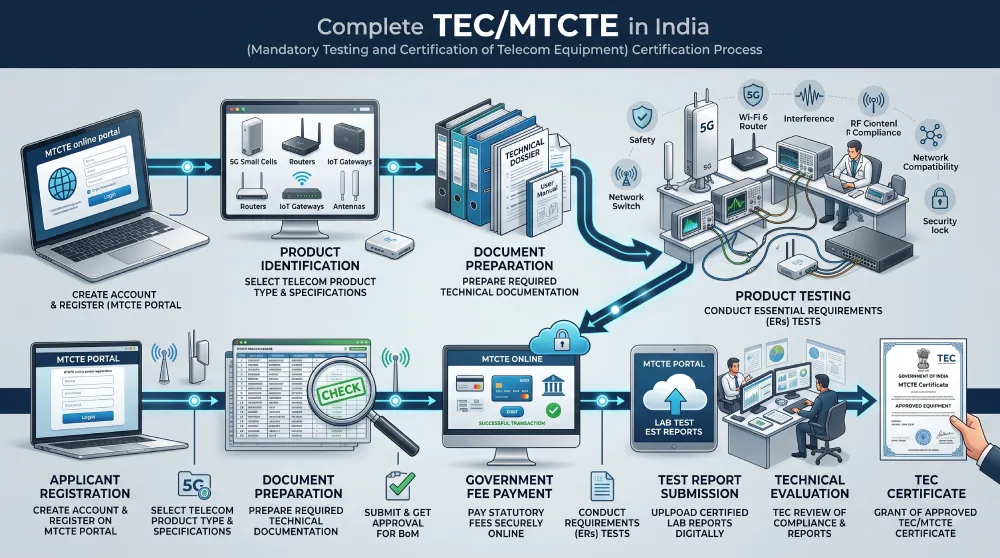
Obtaining TEC/MTCTE Certification involves multiple regulatory and technical steps. Applicants must ensure that the product complies with the Essential Requirements (ERs) prescribed by the Telecommunication Engineering Centre (TEC). Proper documentation, successful laboratory testing, and regulatory approval are required before the product can be legally sold or imported into India.
The complete certification process includes the following stages.
Step 1: Applicant Registration
The first step is creating an account on the official MTCTE portal. Manufacturers, importers, brand owners, or Authorized Indian Representatives (AIR) must register by submitting company details and basic business information.
Step 2: Product Identification
The applicant selects the telecom product category and applicable variants. During this stage, the Bill of Materials (BoM), product specifications, interfaces, and technical details are submitted for evaluation.
Step 3: Document Preparation
All mandatory documents are compiled and verified before submission. Proper documentation significantly reduces the chances of application rejection or unnecessary delays during technical scrutiny.
Step 4: Bill of Materials (BoM) Approval
TEC officials review the submitted Bill of Materials to verify the product configuration and determine the applicable Essential Requirements (ERs) for testing.
Step 5: Payment of Government Fees
After successful document verification, applicants are required to pay the prescribed government fee based on the applicable product category.
Step 6: Product Testing
The product is tested at a TEC-designated Conformity Assessment Body (CAB) laboratory. Testing is conducted according to the applicable Essential Requirements, including safety, EMC, EMI, technical performance, radio frequency compliance, and other mandatory parameters.
Step 7: Submission of Test Reports
After successful testing, laboratory reports are uploaded on the MTCTE portal along with any additional compliance documents required by TEC.
Step 8: Technical Evaluation
TEC experts review the submitted documents, laboratory reports, declarations, and technical information. If any clarification or correction is required, the applicant is notified through the portal.
Step 9: Grant of TEC Certificate
Once the product successfully complies with all regulatory requirements, TEC issues the MTCTE Certificate, allowing the telecom equipment to be manufactured, imported, marketed, or sold in India.
Benefits of TEC/MTCTE Certification
Obtaining TEC Certification provides several regulatory and commercial advantages for manufacturers and importers of telecom equipment.
- Ensures compliance with Department of Telecommunications (DoT) regulations.
- Enables legal sale and import of telecom products in India.
- Improves product credibility and customer confidence.
- Demonstrates compliance with Indian technical standards.
- Enhances product quality, safety, and performance.
- Reduces the risk of regulatory penalties and import delays.
- Facilitates smoother customs clearance for imported telecom equipment.
- Strengthens brand reputation in the Indian market.
- Supports participation in government and enterprise procurement projects.
- Improves overall market competitiveness.
Why Choose Bharati Global Compliances?
Navigating the TEC/MTCTE approval process can be technically complex and time-consuming. Bharati Global Compliances offers end-to-end consultancy services to simplify the entire certification journey.
Our experienced consultants provide complete support from documentation to final approval, ensuring timely and hassle-free certification.
Our services include:
- Product eligibility assessment
- Complete documentation support
- MTCTE portal registration
- Bill of Materials (BoM) preparation
- Coordination with TEC-approved laboratories
- Test report review and compliance verification
- Application filing and regulatory follow-up
- Response to technical queries and observations
- End-to-end project management
- Fast, transparent, and reliable certification assistance
With extensive experience in regulatory compliance, Bharati Global Compliances helps manufacturers, importers, OEMs, and Authorized Indian Representatives obtain TEC/MTCTE Certification efficiently while ensuring full compliance with Indian telecom regulations.
Conclusion
TEC/MTCTE Certification is a mandatory regulatory requirement for a wide range of telecom equipment sold, imported, or used in India. The certification ensures that products comply with the technical, safety, electromagnetic compatibility (EMC), security, and performance standards prescribed by the Telecommunication Engineering Centre (TEC) under the Department of Telecommunications (DoT).
Whether you are a manufacturer, importer, brand owner, or Authorized Indian Representative (AIR), obtaining the appropriate TEC approval is essential to achieve regulatory compliance and uninterrupted market access. Choosing the correct certification scheme, preparing accurate documentation, coordinating product testing, and responding to regulatory observations are crucial steps for obtaining approval without unnecessary delays.
At Bharati Global Compliances, we provide complete end-to-end assistance for TEC/MTCTE Certification, including eligibility assessment, documentation, application filing, laboratory coordination, compliance management, and post-certification support. Our experienced compliance professionals ensure a smooth, transparent, and time-efficient certification process, helping your telecom products meet all Indian regulatory requirements.
If you are planning to obtain TEC/MTCTE Approval for your telecom equipment, contact Bharati Global Compliances today for expert guidance and hassle-free certification services across India.
Frequently Asked Questions (FAQs)
What is TEC Certification?
TEC Certification is a regulatory approval issued by the Telecommunication Engineering Centre (TEC), Department of Telecommunications (DoT), confirming that telecom equipment complies with the prescribed technical, safety, and quality standards for the Indian market.
What is MTCTE?
MTCTE stands for Mandatory Testing and Certification of Telecom Equipment. It is a certification scheme introduced by the Department of Telecommunications that requires specified telecom products to undergo testing and approval before being sold or imported into India.
Who needs TEC/MTCTE Certification?
Manufacturers, importers, brand owners, telecom equipment suppliers, foreign OEMs, and Authorized Indian Representatives (AIR) dealing with notified telecom products must obtain TEC/MTCTE Certification.
Which products require MTCTE Approval?
Various telecom products such as routers, LAN switches, modems, IoT gateways, optical fibre equipment, base stations, smart electricity meters, tracking devices, SIM cards, broadband equipment, and several other notified telecom devices require MTCTE approval.
What documents are required for TEC Certification?
Commonly required documents include the company registration certificate, GST certificate, PAN card, MoA, AoA, authorization letter, product datasheet, Bill of Materials (BoM), technical specifications, user manual, laboratory test reports, trademark certificate (if applicable), and AIR authorization for foreign manufacturers.
How long does the TEC Certification process take?
The timeline depends on the certification scheme and product category. Generally, Simplified Certification takes 15–20 working days, General Certification takes 40–60 working days, while security and CAS/SMS certifications may require additional time.
Is laboratory testing mandatory?
Yes. Products covered under the MTCTE scheme must be tested at TEC-designated Conformity Assessment Body (CAB) laboratories as per the applicable Essential Requirements.
Can foreign manufacturers apply for TEC Certification?
Yes. Foreign manufacturers can obtain TEC Certification by appointing an Authorized Indian Representative (AIR) who will submit the application and coordinate regulatory compliance in India.
What happens if a product is sold without MTCTE approval?
Selling or importing a notified telecom product without the required TEC/MTCTE Certification may lead to regulatory action, import restrictions, product rejection, penalties, or other legal consequences.
Why choose Bharati Global Compliances for TEC Certification?
Bharati Global Compliances offers complete support for TEC/MTCTE Certification, including eligibility assessment, documentation, application filing, testing coordination, compliance management, regulatory follow-up, and timely certification with expert guidance.