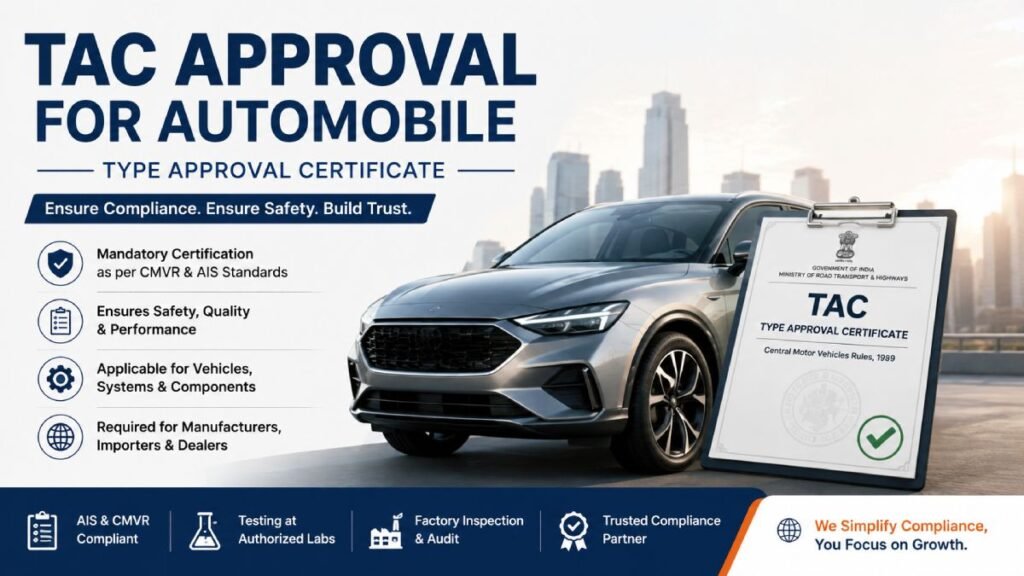
The Indian automotive industry is one of the fastest-growing manufacturing sectors, with strict regulations governing the safety, quality, and performance of vehicles and automotive components. Before any vehicle or automotive product can be legally manufactured, imported, or sold in India, it must comply with the technical and safety requirements prescribed under the Central Motor Vehicles Rules (CMVR), 1989. One of the most important compliance requirements under these regulations is obtaining a Type Approval Certificate (TAC).
TAC Approval confirms that a vehicle, automotive component, or system has successfully met the applicable technical specifications, safety standards, and regulatory requirements prescribed by the Government of India. The certification ensures that the approved product is suitable for use on Indian roads and complies with all mandatory automotive regulations.
The Ministry of Road Transport and Highways (MoRTH) is responsible for implementing vehicle safety and emission regulations in India. Various testing agencies authorized under Rule 126 of the Central Motor Vehicles Rules conduct testing and evaluation before issuing the Type Approval Certificate. These agencies verify whether the product complies with the applicable Automotive Industry Standards (AIS), Central Motor Vehicle Rules (CMVR), and other notified technical requirements.
Manufacturers, importers, and automotive component suppliers must obtain TAC Approval before introducing regulated automotive products into the Indian market. Failure to comply with these requirements may result in restrictions on manufacturing, import, sale, or registration of the product.
At Bharati Global Compliances, we provide complete consultancy services for TAC Approval for Automobile Products in India. Our experts assist manufacturers and importers with documentation preparation, application filing, product testing coordination, liaison with authorized testing agencies, compliance management, and end-to-end certification support.
What is TAC Approval?
Type Approval Certificate, commonly known as TAC, is a certificate of conformity issued to automotive vehicles, systems, or components after successful verification of their compliance with the applicable technical, safety, and regulatory requirements.
The objective of TAC Approval is to ensure that products entering the Indian automotive market meet the standards prescribed under the Central Motor Vehicles Rules before they are manufactured, imported, or supplied commercially.
Unlike product quality certifications, TAC Approval focuses primarily on road safety, vehicle performance, technical compliance, and regulatory conformity. During the approval process, the product undergoes detailed evaluation, testing, and verification to confirm that it satisfies all mandatory automotive standards applicable to its category.
Once the product successfully completes the prescribed testing and evaluation process, the authorized testing agency issues the Type Approval Certificate, allowing the manufacturer or importer to market the approved product in India.
For automotive manufacturers, TAC Approval demonstrates compliance with Indian automotive regulations while ensuring that vehicles and components meet the required standards for safety, durability, and performance.
Purpose of TAC Approval
The primary purpose of TAC Approval is to ensure that vehicles and automotive components manufactured or imported into India comply with the safety and technical standards notified by the Government of India.
The certification helps maintain uniform quality standards across the automotive industry while protecting road users from unsafe or non-compliant products. It also assists regulatory authorities in ensuring that every approved vehicle or automotive component satisfies the applicable performance requirements before being introduced into the market.
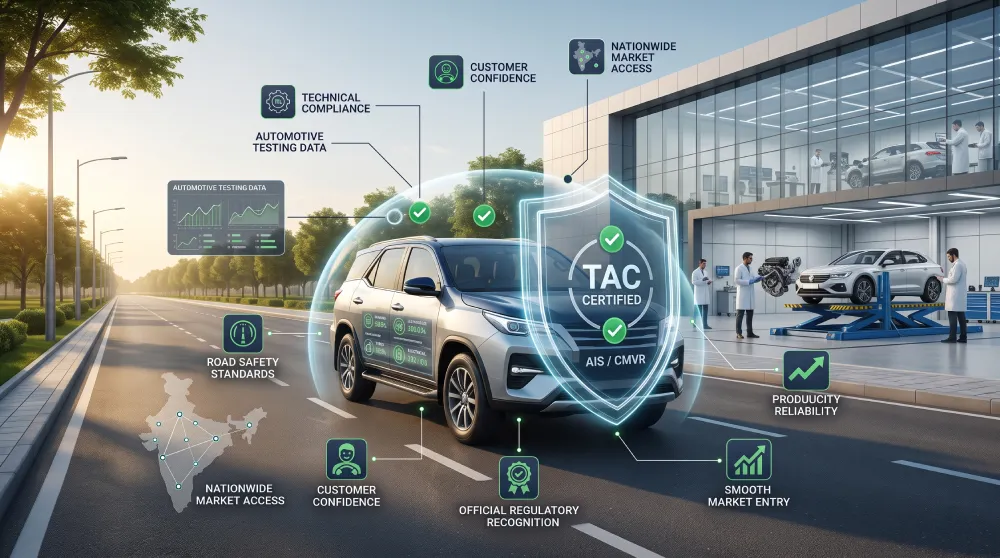
TAC Approval further supports manufacturers by providing official recognition of product compliance, thereby improving customer confidence and facilitating smooth market entry.
Regulatory Framework for TAC Approval
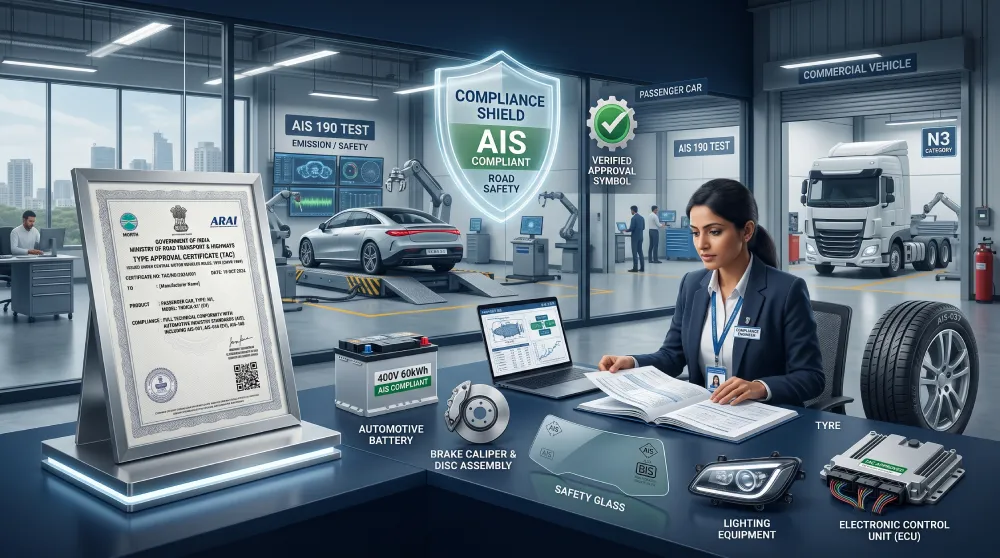
The Type Approval Certification system operates under the provisions of the Central Motor Vehicles Rules (CMVR), 1989, which prescribe the technical and safety requirements for motor vehicles and automotive components in India.
The Ministry of Road Transport and Highways (MoRTH) is the nodal authority responsible for implementing these regulations and enforcing vehicle safety and emission requirements.
To support the implementation of these regulations, the Ministry has constituted a Standing Committee on Emission Legislation that advises on the enforcement of vehicle safety, emission norms, and type approval requirements.
Under Rule 126 of the Central Motor Vehicles Rules, the Government of India has authorized specific testing agencies to conduct product testing, inspection, homologation, and certification activities for automotive products.
These agencies evaluate whether the product complies with the prescribed Automotive Industry Standards (AIS), CMVR requirements, and other notified technical regulations before granting TAC Approval.
What is Homologation?
Homologation is the process of certifying that a vehicle or automotive component complies with the technical regulations applicable in a particular country before it is introduced into the market.
In India, homologation involves testing and evaluating vehicles and automotive components to ensure compliance with the Central Motor Vehicles Rules, Automotive Industry Standards, emission norms, safety requirements, and other applicable government regulations.
The homologation process verifies various performance and safety parameters to confirm that the product is suitable for road use in India. Upon successful completion of testing and evaluation, the manufacturer receives the necessary approval to manufacture, import, sell, or register the product.
For manufacturers intending to export vehicles, homologation may also be required according to the regulations of the destination country.
ARAI Certification and AIS Certification
The Automotive Research Association of India (ARAI) is one of the leading automotive testing and certification agencies recognized by the Government of India under Rule 126 of the Central Motor Vehicles Rules.
Established in 1966 through the joint efforts of the Indian automotive industry and the Government of India, ARAI provides comprehensive testing, research, certification, and homologation services for vehicles, automotive systems, components, and related products.
Apart from domestic certification, ARAI also assists manufacturers in obtaining export homologation by conducting testing according to international standards recognized by several overseas certification authorities.
The Automotive Industry Standards (AIS) are technical standards developed specifically for the Indian automotive sector. These standards prescribe the technical specifications, testing requirements, safety criteria, and performance parameters applicable to different categories of vehicles and automotive components.
Compliance with the relevant AIS requirements is an important part of obtaining TAC Approval and ensuring that automotive products meet the mandatory safety and performance standards prescribed under Indian law.
Products Covered Under TAC Approval
Type Approval Certification (TAC) is applicable to a wide range of vehicles, automotive systems, and components that are regulated under the Central Motor Vehicles Rules (CMVR) and Automotive Industry Standards (AIS). Before these products can be manufactured, imported, supplied, or sold in the Indian market, they must undergo testing and obtain approval from an authorized testing agency.
The certification ensures that every regulated automotive product complies with the prescribed safety, quality, technical, and performance requirements established by the Government of India.
Some of the major products covered under the TAC Approval scheme include:
- Automotive Electronics
- Fuel and Gasoline Tanks
- Automotive Batteries
- Seat Belts
- Safety Glass
- Tyres and Tubes
- Brake Hoses
- Lighting Equipment
- Reflectors
- Door Locks
- Mirrors
- Horns
- Steering Components
- Speed Limiting Devices
- Automotive Lamps
- Vehicle Electrical Systems
- Electronic Control Units (ECUs)
- Automotive Components notified under AIS/CMVR
Depending on the product category, additional testing requirements and applicable Automotive Industry Standards (AIS) may also apply before certification is granted.
Who Needs TAC Approval?
Type Approval Certification is mandatory for businesses involved in manufacturing or importing regulated automotive products into India. Any organization intending to introduce a regulated vehicle or automotive component into the Indian market must obtain the required approval before commercial production, import, or sale.
Generally, TAC Approval is required by:
Indian Manufacturers
Manufacturers producing automobiles, vehicle systems, or automotive components in India must obtain TAC Approval before marketing products covered under the applicable regulations.
Foreign Manufacturers
Foreign manufacturers intending to export regulated automotive products to India are also required to obtain Type Approval through the prescribed certification process before supplying products to Indian customers.
Importers
Importers bringing regulated automotive vehicles or components into India must ensure that the imported products possess the required Type Approval Certification before customs clearance or commercial sale.
Authorized Representatives
Foreign manufacturers may appoint an Authorized Indian Representative to coordinate certification activities, documentation, communication with testing agencies, and regulatory compliance on their behalf.
Automotive Component Suppliers
Manufacturers and suppliers producing automotive parts that fall under mandatory AIS or CMVR requirements are also required to obtain the necessary approval before supplying such products to vehicle manufacturers or the aftermarket.
Eligibility Criteria for TAC Approval
To obtain Type Approval Certification, applicants must demonstrate that the product complies with the applicable regulatory, technical, and safety requirements prescribed by the Government of India.
The eligibility requirements generally include:
Compliance with Applicable Standards
The product must comply with the relevant Automotive Industry Standards (AIS), Central Motor Vehicle Rules (CMVR), and any other technical regulations applicable to its category.
Successful Product Testing
The vehicle or automotive component must successfully pass testing conducted by an authorized testing agency recognized under Rule 126 of the Central Motor Vehicles Rules.
Manufacturing Capability
The manufacturer should possess adequate manufacturing facilities, quality control systems, production infrastructure, and technical capabilities necessary to produce products that consistently comply with approved specifications.
Technical Documentation
Applicants must submit complete technical documentation, product specifications, engineering drawings, compliance reports, user manuals, installation instructions, and other documents required for technical evaluation.
Factory Compliance
Where applicable, the manufacturing facility may be inspected to verify that production processes and quality management systems comply with regulatory requirements.
Documents Required for TAC Approval
Proper documentation is one of the most important requirements during the Type Approval Certification process. Incomplete or inaccurate documentation may result in delays, additional observations, or rejection of the application.
Manufacturers and importers are generally required to submit the following documents:
Application Form
A duly completed application form in the prescribed format containing complete information regarding the applicant and the product.
Compliance Reports
Technical compliance reports demonstrating conformity with the applicable Automotive Industry Standards and Central Motor Vehicle Rules.
Test Reports
Product test reports prepared in accordance with the prescribed testing procedures and applicable technical standards.
Authorization Letter
In the case of traders or importers, an authorization letter issued by the manufacturer appointing the applicant as the authorized representative or distributor.
Product Sample
A representative sample of the product to be tested by the authorized testing agency.
Technical Documents
Complete technical documentation including:
- Product specifications
- Engineering drawings
- Installation instructions
- User manuals
- Operation manuals
- Maintenance manuals
- Product catalogues
Manufacturing Information
Details regarding the manufacturing facility, production process, quality assurance procedures, and technical capabilities of the manufacturer.
Additional Supporting Documents
Depending upon the product category and applicable regulations, the testing agency may request additional technical information, declarations, certificates, or supporting documents during the evaluation process.
At Bharati Global Compliances, we assist manufacturers and importers in preparing accurate documentation, identifying applicable standards, coordinating with testing agencies, and ensuring that every document complies with regulatory requirements before submission. This helps reduce processing delays and improves the overall efficiency of the TAC Approval process.