Applying for a BIS Certificate of Conformity (CoC) under Scheme IV requires manufacturers to submit comprehensive legal, technical, and quality-related documents. These documents help the Bureau of Indian Standards (BIS) evaluate whether the manufacturing facility, production process, and product comply with the applicable Indian Standards.
At Bharati Global Compliances, we assist manufacturers in preparing accurate documentation, minimizing errors, and ensuring smooth application processing.
Business & Legal Documents
The applicant must submit valid business registration and legal documents, including:
- Certificate of Incorporation / Partnership Deed / MSME Registration (if applicable)
- GST Registration Certificate
- Permanent Account Number (PAN)
- Factory Address Proof
- Import Export Code (IEC), where applicable
- Manufacturing Licence (if applicable)
- Organisation Structure
- Details of Directors / Partners / Proprietor
- Authorisation Letter for Signatory
- Identity & Address Proof of the Authorised Signatory
Manufacturing Documents
BIS evaluates the manufacturing capability of the applicant through the following documents:
- Manufacturing Process Flow Chart
- Factory Layout Plan
- Production Capacity Details
- List of Manufacturing Machinery
- List of Quality Control Equipment
- Calibration Certificates
- Process Control Documents
- Production Records
- Raw Material Inspection Procedure
- Finished Goods Inspection Procedure
Product Technical Documents
Technical documentation demonstrates that the product complies with the applicable Indian Standard.
Typical documents include:
- Product Specification Sheet
- Technical Drawings
- Bill of Materials (BOM)
- Product Catalogue
- Design Details
- Product Marking Artwork
- User Manual (where applicable)
- Safety Instructions
- Packaging Details
- Product Identification Method
Quality Management Documents
Manufacturers should maintain an effective quality management system.
Required documents generally include:
- Quality Manual
- Standard Operating Procedures (SOPs)
- Incoming Material Inspection Records
- In-Process Inspection Records
- Final Inspection Reports
- Internal Audit Reports
- Corrective & Preventive Action (CAPA) Records
- Complaint Handling Procedure
- Traceability Records
- Document Control Procedure
Product Testing Requirements
Product testing is a critical part of the BIS Certificate of Conformity process. The objective is to verify that the product meets all technical and safety requirements specified in the applicable Indian Standard.
Testing may be carried out:
- At a BIS-recognized laboratory
- Through an approved third-party laboratory
- At the manufacturer’s in-house laboratory (where permitted by BIS)
The test report submitted with the application should be valid, complete, and prepared according to the relevant Indian Standard.

Step-by-Step BIS Certificate of Conformity Process
Obtaining a BIS Certificate of Conformity involves multiple stages of technical evaluation, documentation review, testing, and factory assessment. Our experts at Bharati Global Compliances manage the complete certification process to ensure timely and accurate compliance.
Step 1 – Product Applicability Assessment
The first step is to determine whether the product is covered under the BIS Certificate of Conformity Scheme.
Our consultants evaluate:
- Product category
- Applicable Quality Control Order (QCO)
- Relevant Indian Standard (IS)
- Certification requirements
- Manufacturing scope
This assessment helps avoid incorrect applications and unnecessary delays.
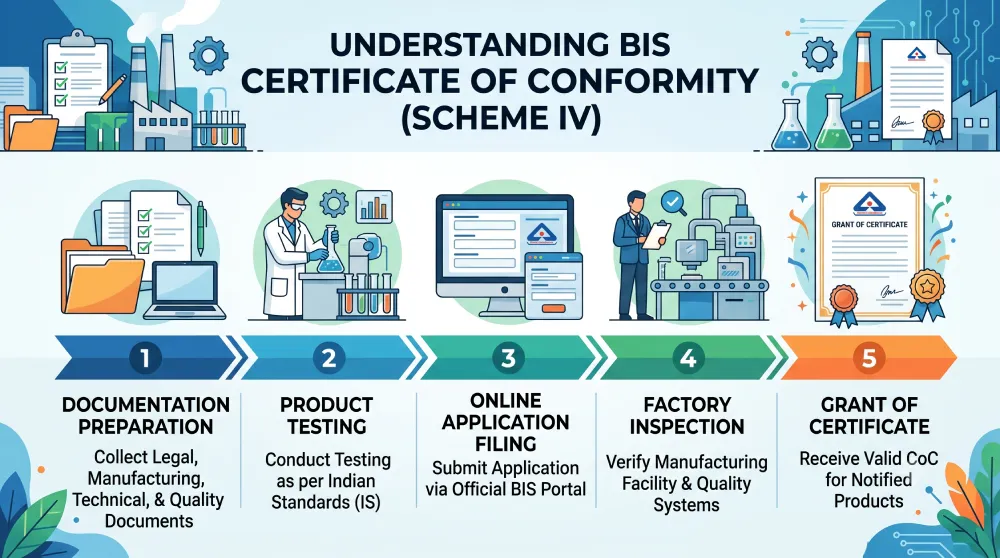
Step 2 – Documentation Preparation
After confirming product applicability, all required business, manufacturing, technical, and quality documents are collected and verified.
Our team carefully reviews every document to ensure it complies with BIS requirements before submission.
Step 3 – Product Testing
The product sample is tested as per the applicable Indian Standard to verify compliance with technical specifications, quality, and safety requirements.
Where necessary, our experts coordinate with recognized laboratories to facilitate timely testing and reporting.
Step 4 – Online BIS Application Filing
Once the required documents and test reports are ready, the application is submitted through the official BIS online portal.
The application typically includes:
- Manufacturer Information
- Factory Details
- Product Information
- Applicable Indian Standard
- Test Reports
- Supporting Documentation
- Prescribed Government Fees
Step 5 – Application Scrutiny by BIS
After submission, BIS reviews the application and supporting documents.
During this stage, BIS may:
- Verify submitted documents
- Request additional information
- Seek technical clarifications
- Review laboratory test reports
Our consultants coordinate directly with the applicant to respond promptly to any BIS observations.
Step 6 – Factory Inspection
Once the application is found satisfactory, BIS officials conduct a factory inspection to verify the manufacturer’s capability to consistently produce compliant products.
During the inspection, the audit team generally assesses:
- Manufacturing Infrastructure
- Production Process
- Quality Management System
- Testing Facilities
- Calibration Records
- Raw Material Controls
- Product Traceability
- Inspection Procedures
- Record Maintenance
Our experts help manufacturers prepare for the audit by conducting pre-assessment reviews and addressing potential compliance gaps.
Step 7 – Inspection & Testing Plan (ITP) Approval
As part of the certification process, BIS reviews the proposed Inspection & Testing Plan (ITP) to ensure that appropriate quality control measures are in place throughout the manufacturing process.
The ITP generally defines:
- Incoming material inspection
- In-process quality checks
- Final product testing
- Sampling procedures
- Acceptance criteria
- Record-keeping requirements
A well-prepared ITP helps demonstrate the manufacturer’s commitment to consistent product quality.
Step 8 – Grant of BIS Certificate of Conformity
After successful completion of document verification, product testing, factory inspection, and approval of the Inspection & Testing Plan, BIS issues the Certificate of Conformity (CoC).
The manufacturer can then supply the certified product in accordance with the applicable regulatory requirements and maintain compliance throughout the certificate’s validity.
Factory Inspection Under Scheme IV
The factory inspection is one of the most important stages of the BIS CoC certification process. BIS officials evaluate whether the manufacturing facility has the necessary infrastructure and quality systems to consistently produce products that comply with the applicable Indian Standards.
The inspection generally covers:
- Production Capability
- Manufacturing Equipment
- Testing Laboratory
- Calibration of Measuring Instruments
- Quality Assurance Procedures
- Storage & Material Handling
- Product Identification & Traceability
- Personnel Competency
- Documentation & Record Maintenance
Proper preparation before the inspection significantly increases the likelihood of a successful outcome.
How Bharati Global Compliances Helps
Our experienced compliance professionals provide complete support throughout the certification process, including:
- Product Applicability Review
- Documentation Preparation
- Technical Compliance Guidance
- Product Testing Coordination
- BIS Application Filing
- Factory Audit Preparation
- Inspection & Testing Plan Assistance
- BIS Query Resolution
- Certificate Approval Support
- Ongoing Compliance Assistance
With extensive experience in BIS certification projects, Bharati Global Compliances helps manufacturers reduce certification timelines, avoid compliance errors, and obtain the BIS Certificate of Conformity (Scheme IV) efficiently.

Certificate Validity under BIS Certificate of Conformity (Scheme IV)
The BIS Certificate of Conformity (CoC) is issued for a specified validity period as prescribed under the BIS (Conformity Assessment) Regulations, 2018. During this period, manufacturers must continue to comply with all applicable Indian Standards, quality requirements, and the approved Inspection & Testing Plan (ITP).
The certificate remains valid only if the manufacturer consistently maintains the required quality management system, production controls, and compliance with BIS regulations.
Failure to maintain compliance may result in suspension, cancellation, or other regulatory actions by the Bureau of Indian Standards.
Renewal of BIS Certificate of Conformity
Manufacturers must apply for renewal before the expiry of their existing Certificate of Conformity to ensure uninterrupted production and market supply.
The renewal process generally includes:
- Submission of Renewal Application
- Review of Previous Compliance History
- Updated Manufacturing Details
- Latest Quality Control Records
- Applicable Government Fees
- Compliance Verification by BIS
- Surveillance Assessment (where applicable)
Early renewal helps businesses avoid certification lapses and unnecessary business disruptions.
At Bharati Global Compliances, we monitor renewal timelines and assist clients with complete renewal documentation and regulatory coordination.
BIS Certificate of Conformity Timeline
The overall certification timeline depends on several factors, including documentation readiness, product testing, factory inspection scheduling, and BIS processing.
| Certification Activity | Estimated Timeline |
|---|---|
| Product Applicability Assessment | 1–2 Working Days |
| Documentation Preparation | 3–7 Working Days |
| Product Testing | Depends on Product & Laboratory |
| BIS Application Filing | 1–2 Working Days |
| Document Scrutiny | Subject to BIS Review |
| Factory Inspection | As Scheduled by BIS |
| Technical Clarifications | If Required |
| Grant of Certificate | After Successful Compliance |
Note: Actual timelines may vary depending on the product category, laboratory testing duration, factory readiness, and BIS processing schedules.
BIS Certificate of Conformity Fees
The total cost of obtaining a BIS Certificate of Conformity depends on several technical and regulatory factors. Apart from government charges, manufacturers should also consider testing, inspection, and consultancy expenses.
Government Charges May Include
- Application Fee
- Certification Fee
- Inspection Charges
- Product Testing Charges
- Surveillance Charges (where applicable)
- Renewal Fee
- Miscellaneous BIS Charges
Government fees are revised periodically by BIS. Applicants should verify the latest fee structure before applying.
Factors Affecting Certification Cost
The overall cost may vary based on:
- Product Category
- Applicable Indian Standard
- Number of Product Variants
- Number of Manufacturing Units
- Product Testing Requirements
- Factory Inspection Scope
- Technical Documentation
- Overseas Manufacturing Facility (if applicable)
- Corrective Actions Raised During Inspection
Bharati Global Compliances provides transparent consultancy and a product-specific cost estimate to help businesses plan their certification budget effectively.
Common Challenges in Obtaining a BIS Certificate of Conformity
Many manufacturers experience delays because of incomplete documentation or inadequate preparation. Identifying and addressing these issues in advance can significantly improve the approval process.
Some of the most common challenges include:
- Incorrect Product Classification
- Selection of the Wrong Indian Standard
- Incomplete Technical Documentation
- Invalid or Incomplete Test Reports
- Calibration Issues
- Quality Management Gaps
- Factory Audit Non-Conformities
- Delays in Laboratory Testing
- Inadequate Inspection & Testing Plan (ITP)
- Delayed Response to BIS Queries
Our experts help identify these issues early, reducing the likelihood of application rejection or prolonged processing times.
Penalties for Non-Compliance
Manufacturing, importing, or selling products covered under mandatory BIS requirements without a valid Certificate of Conformity may lead to legal and regulatory consequences.
Possible actions include:
- Restriction on Manufacturing or Sale
- Product Recall
- Seizure of Non-Compliant Products
- Financial Penalties
- Suspension or Cancellation of Certification
- Action under the Bureau of Indian Standards Act, 2016
To avoid compliance risks, manufacturers should ensure that certification is obtained before placing notified products on the Indian market.

Why Choose Bharati Global Compliances?
Choosing an experienced compliance partner can simplify the certification process and improve the chances of first-time approval.
Our Expertise
We provide complete consultancy for BIS Certificate of Conformity (Scheme IV), supporting manufacturers from product applicability assessment to certificate grant and renewal.
Our Services Include
- Product Applicability Assessment
- BIS CoC Consultancy
- Documentation Preparation
- Technical Compliance Support
- Product Testing Coordination
- BIS Online Application Filing
- Factory Inspection Preparation
- Inspection & Testing Plan (ITP) Assistance
- BIS Query Resolution
- Renewal & Surveillance Support
Why Businesses Trust Us
Manufacturers across India and international businesses choose Bharati Global Compliances because of our:
- Experienced BIS Compliance Consultants
- Industry-Specific Regulatory Expertise
- End-to-End Project Management
- Dedicated Relationship Manager
- Transparent Consultancy Process
- Fast Documentation Support
- PAN India Service Coverage
- Assistance for Foreign Manufacturers
- Post-Certification Compliance Guidance
- Timely Renewal Support
Our mission is to help businesses achieve regulatory compliance efficiently while minimizing delays and operational risks.
Frequently Asked Questions (FAQs)
What is a BIS Certificate of Conformity (CoC)?
A BIS Certificate of Conformity (CoC) is a certification issued by the Bureau of Indian Standards (BIS) under Scheme IV of the BIS (Conformity Assessment) Regulations, 2018. It confirms that a notified product complies with the applicable Indian Standard and fulfills the prescribed conformity assessment requirements.
Who needs a BIS Certificate of Conformity?
Manufacturers of products covered under applicable Quality Control Orders (QCOs) or government notifications are required to obtain a BIS Certificate of Conformity before manufacturing, importing, or selling those products in India.
Which authority issues the Certificate of Conformity?
The Bureau of Indian Standards (BIS) is the national standards body responsible for issuing the Certificate of Conformity under Scheme IV.
Is the Certificate of Conformity mandatory?
Yes. If a product is notified under a mandatory Quality Control Order or relevant government regulation, obtaining a valid Certificate of Conformity is compulsory before placing the product in the Indian market.
Can foreign manufacturers apply for BIS CoC?
Yes. Foreign manufacturers exporting notified products to India can apply for a BIS Certificate of Conformity. In most cases, they are required to appoint an Authorised Indian Representative (AIR) to coordinate with BIS.
What documents are required for BIS CoC?
Commonly required documents include:
- Business Registration Certificate
- Factory Details
- Product Specifications
- Manufacturing Process
- Test Reports
- Quality Management Documents
- Calibration Certificates
- Technical Drawings
- Inspection & Testing Plan
- Authorised Signatory Documents
The exact documentation depends on the product and applicable Indian Standard.
Is product testing mandatory?
Yes. Product testing is generally required to verify compliance with the applicable Indian Standard. Testing must be conducted according to BIS requirements through recognized laboratories where applicable.
Does BIS conduct a factory inspection?
Yes. BIS officials usually inspect the manufacturing facility to verify production capability, testing facilities, quality management systems, and compliance with applicable standards before granting the Certificate of Conformity.
How long does it take to obtain a BIS Certificate of Conformity?
The certification timeline depends on:
- Product Category
- Documentation Readiness
- Laboratory Testing
- Factory Inspection Schedule
- BIS Processing Time
Well-prepared applications generally move through the process more efficiently.
What is an Inspection & Testing Plan (ITP)?
An Inspection & Testing Plan (ITP) outlines the quality control procedures followed during manufacturing. It specifies inspection stages, testing frequency, sampling methods, acceptance criteria, and record-keeping requirements to ensure consistent product quality.
Get Expert BIS Certificate of Conformity (CoC) Consultancy
Obtaining a BIS Certificate of Conformity (Scheme IV) requires careful planning, technical documentation, product testing, and compliance with BIS regulations. A professionally managed certification process helps manufacturers reduce delays, avoid compliance issues, and bring products to market with confidence.
Bharati Global Compliances provides comprehensive consultancy services for manufacturers across India and international businesses seeking BIS approval.