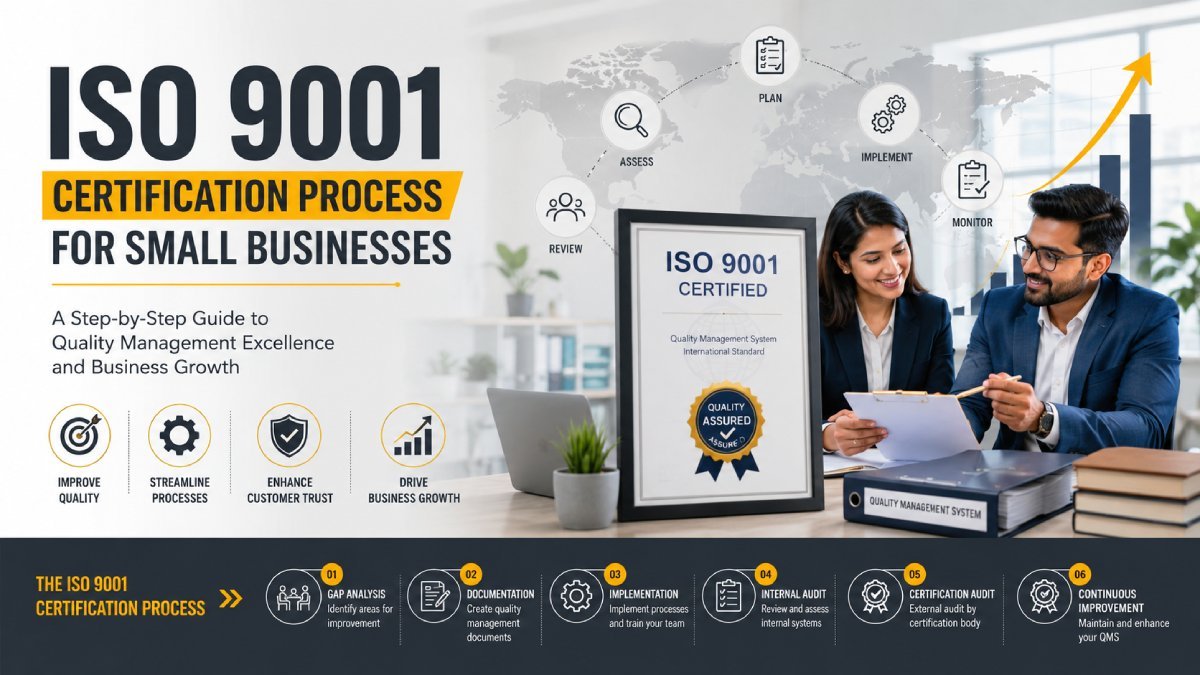
In today’s competitive market, delivering consistent quality and building customer trust are essential for every business. Whether you run a startup, manufacturing unit, trading company, or service-based organization, implementing a structured Quality Management System (QMS) can significantly improve your operations.
One of the most recognized quality standards worldwide is ISO 9001 Certification. It helps businesses streamline processes, improve efficiency, reduce errors, and enhance customer satisfaction.
Many small business owners believe ISO 9001 certification is only for large corporations. However, the standard is specifically designed to be flexible and can be implemented by businesses of all sizes.
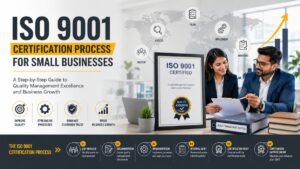
In this comprehensive guide, we’ll explain the ISO 9001 Certification Process for Small Businesses, including eligibility, documentation, implementation steps, certification timelines, costs, and how Bharati Global Compliances can help you achieve certification with ease.
What is ISO 9001 Certification?
ISO 9001 is an internationally recognized standard for Quality Management Systems (QMS) published by the International Organization for Standardization (ISO).
It provides a framework for businesses to consistently deliver products and services that meet customer expectations and regulatory requirements while continually improving their processes.
Unlike product certifications, ISO 9001 focuses on improving an organization’s management systems and operational efficiency.
Why ISO 9001 Matters for Small Businesses
Small businesses often operate with limited resources and lean teams. A well-implemented Quality Management System helps optimize operations and improve business performance.
ISO 9001 enables small businesses to:
- Improve customer satisfaction
- Standardize daily operations
- Reduce operational errors
- Increase productivity
- Build a professional business image
- Compete for larger contracts
- Meet customer and regulatory requirements
Who Should Apply for ISO 9001 Certification?
ISO 9001 Certification is suitable for:
- Startups
- MSMEs
- Manufacturing Companies
- Service Providers
- IT Companies
- Healthcare Organizations
- Educational Institutions
- Construction Companies
- Trading Businesses
- Logistics Companies
- Retail Businesses
- Exporters and Importers
The standard is applicable regardless of the organization’s size or industry.
Benefits of ISO 9001 Certification
Improved Customer Satisfaction
Consistent quality leads to better customer experiences and long-term business relationships.
Better Process Control
Documented procedures help reduce confusion, improve accountability, and ensure consistent performance.
Increased Operational Efficiency
Businesses can eliminate unnecessary activities, reduce waste, and improve productivity.
Stronger Market Reputation
ISO 9001 certification demonstrates a commitment to quality and professionalism, enhancing business credibility.
More Business Opportunities
Many government departments, multinational companies, and corporate clients prefer working with ISO-certified organizations.
Continuous Improvement
The ISO 9001 framework encourages regular monitoring, audits, and improvements to business processes.
Eligibility for ISO 9001 Certification
There are no strict eligibility requirements.
Any organization, regardless of:
- Business size
- Industry
- Number of employees
- Annual turnover
can implement ISO 9001 and apply for certification.
Documents Required for ISO 9001 Certification
The documentation requirements may vary depending on the organization’s size and operations. Common documents include:
- Business Registration Certificate
- PAN Card
- GST Registration (if applicable)
- Organization Structure
- Quality Policy
- Quality Objectives
- Process Documentation
- Standard Operating Procedures (SOPs)
- Employee Records
- Internal Audit Reports
- Management Review Records
- Corrective Action Reports
Maintaining proper documentation is essential for successful certification.
Step-by-Step ISO 9001 Certification Process
Step 1: Understand ISO 9001 Requirements
Begin by studying the ISO 9001:2015 standard and identifying the requirements applicable to your business.
Step 2: Conduct a Gap Analysis
Evaluate your current processes to identify areas that need improvement before implementing the Quality Management System.
Step 3: Develop Quality Management Documentation
Prepare all required policies, procedures, manuals, and records.
Documentation typically includes:
- Quality Manual
- Process Flow Charts
- Risk Assessments
- SOPs
- Work Instructions
- Forms and Records
Step 4: Implement the Quality Management System
Train employees and implement the documented procedures throughout the organization.
The system should become part of daily business operations.
Step 5: Conduct Internal Audit
Perform an internal audit to verify that the Quality Management System is functioning effectively.
Any identified non-conformities should be corrected before the certification audit.
Step 6: Management Review
Senior management reviews the performance of the QMS and approves corrective actions where necessary.
Step 7: Certification Audit
An accredited certification body conducts the external audit in two stages.
Stage 1 Audit
Review of documentation and organizational readiness.
Stage 2 Audit
Detailed evaluation of the implemented Quality Management System.
If all requirements are met, the organization receives ISO 9001 Certification.
ISO 9001 Certification Timeline
The certification timeline depends on:
- Organization size
- Business complexity
- Documentation readiness
- Number of employees
- Audit scheduling
Small businesses with proper planning can complete certification efficiently.
Cost Factors for ISO 9001 Certification
The overall certification cost depends on:
- Business size
- Number of employees
- Number of business locations
- Certification body fees
- Consultancy services
- Internal preparation efforts
Organizations should request customized quotations based on their specific requirements.
Common Challenges Faced by Small Businesses
Some businesses experience delays due to:
- Incomplete documentation
- Lack of employee awareness
- Poor process implementation
- Inadequate internal audits
- Delayed corrective actions
- Choosing inexperienced consultants
Working with experienced professionals can significantly simplify the certification process.
Why Choose Bharati Global Compliances?
Bharati Global Compliances is a trusted compliance consultancy based in New Delhi, providing end-to-end assistance for ISO Certification and other regulatory approvals across India.
Our experienced consultants support businesses with:
- ISO 9001 Certification
- ISO 14001 Certification
- ISO 22000 Certification
- ISO 27001 Certification
- ISO 45001 Certification
- Documentation Preparation
- QMS Implementation
- Internal Audit Assistance
- Certification Audit Coordination
- Compliance Consultancy
Whether you are a startup or an established enterprise, Bharati Global Compliances helps simplify the ISO certification journey with expert guidance and practical solutions.
Tips for Successful ISO 9001 Certification
To improve the chances of successful certification:
- Involve top management.
- Train employees regularly.
- Maintain accurate records.
- Conduct periodic internal audits.
- Focus on customer satisfaction.
- Monitor business performance.
- Continuously improve processes.
- Work with experienced consultants.
Frequently Asked Questions (FAQs)
Is ISO 9001 Certification mandatory?
No. ISO 9001 is generally a voluntary certification, but many organizations require it as a supplier qualification or contractual requirement.
How long is ISO 9001 Certification valid?
ISO 9001 Certification is generally valid for three years, subject to successful surveillance audits conducted periodically by the certification body.
Can startups apply for ISO 9001 Certification?
Yes. Startups and newly established businesses can implement ISO 9001 and obtain certification.
Does ISO 9001 improve customer trust?
Yes. ISO 9001 demonstrates a commitment to quality, consistency, and continual improvement, increasing customer confidence.
Who can help with ISO 9001 Certification?
Professional consultants like Bharati Global Compliances provide end-to-end assistance with documentation, implementation, audits, and certification support.
Conclusion
ISO 9001 Certification is an excellent investment for small businesses aiming to improve quality, operational efficiency, and customer satisfaction. By implementing a robust Quality Management System, organizations can streamline operations, reduce errors, and strengthen their competitive position in the market.
Although the certification process requires planning, documentation, and commitment, the long-term benefits far outweigh the effort. Partnering with an experienced consultancy like Bharati Global Compliances can make the certification journey smooth, efficient, and hassle-free.