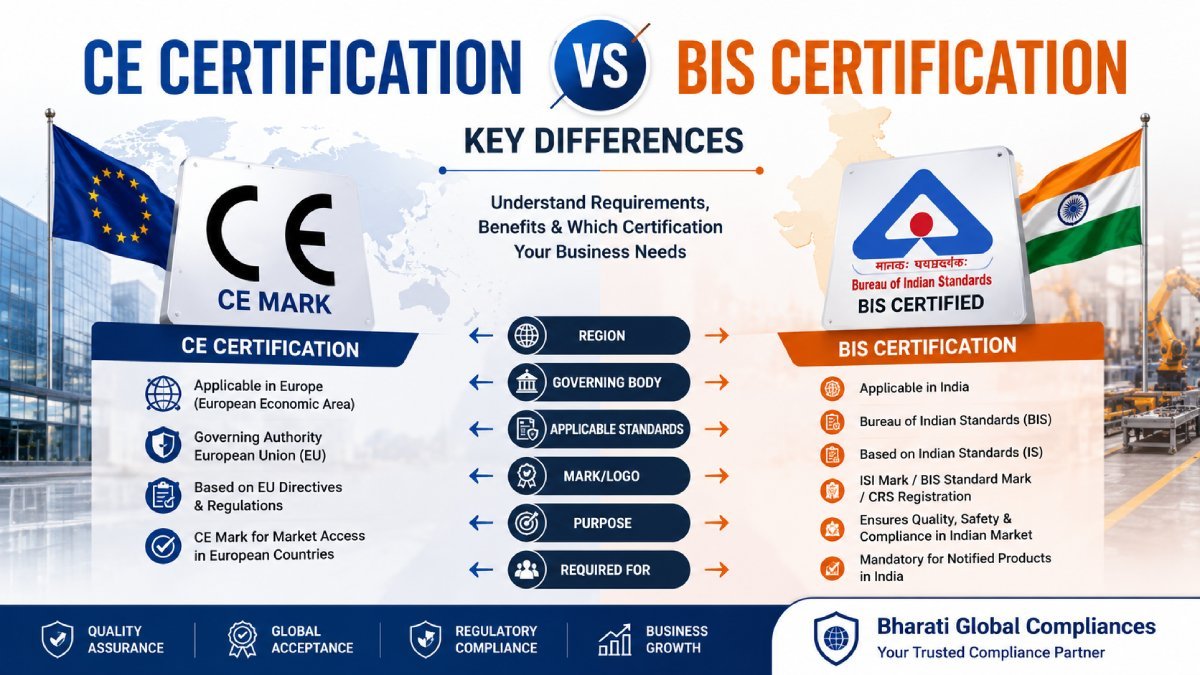
Businesses planning to manufacture, import, or export products often come across two important certifications: CE Certification and BIS Certification. While both are designed to ensure product quality, safety, and regulatory compliance, they serve entirely different markets and follow different legal requirements.
A common question among manufacturers and importers is “Do I need CE Certification or BIS Certification?” The answer depends on where your products will be sold and the regulations applicable to your product category.
In this guide, we’ll compare CE Certification vs BIS Certification, explain their differences, discuss when each certification is required, and help you determine the right compliance path for your business.
What is CE Certification?
CE Certification (Conformité Européenne) is a conformity marking that indicates a product complies with the health, safety, and environmental protection standards of the European Economic Area (EEA).
The CE Mark allows products to be legally marketed in European Union member countries and several associated markets.
Products that commonly require CE Certification include:
- Electrical equipment
- Medical devices
- Machinery
- Toys
- Construction products
- Personal protective equipment (PPE)
- Pressure equipment
- Measuring instruments
CE Certification demonstrates that a product meets applicable European Directives and Regulations.
What is BIS Certification?
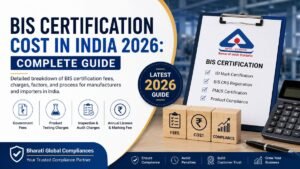
BIS Certification is issued by the Bureau of Indian Standards (BIS) and confirms that a product complies with Indian quality and safety standards.
Certain products cannot be manufactured, imported, distributed, or sold in India without mandatory BIS approval.
Depending on the product category, businesses may require:
- ISI Mark Certification
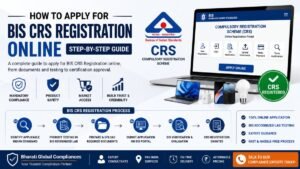
- BIS CRS Registration
- BIS FMCS
- Scheme X Certification
BIS Certification ensures products meet Indian regulatory requirements and consumer safety standards.
CE Certification vs BIS Certification
| Feature | CE Certification | BIS Certification |
|---|---|---|
| Regulatory Authority | European Union | Bureau of Indian Standards (BIS) |
| Applicable Region | European Economic Area (EEA) | India |
| Purpose | Market access in Europe | Market access in India |
| Product Standards | EU Directives & Regulations | Indian Standards (IS) |
| Mandatory | For specified products in EU | For specified products in India |
| Product Testing | As applicable | BIS-recognized laboratories |
| Factory Inspection | Required for certain products | Required under selected BIS schemes |
| Mark Used | CE Mark | ISI Mark / CRS Registration |
Major Differences Between CE and BIS Certification
1. Market Coverage
The biggest difference is the market where the certification is valid.
- CE Certification is intended for products entering European markets.
- BIS Certification is mandatory for products sold in India.
A product intended for both markets may require both certifications.
2. Regulatory Authority
CE Certification follows European Directives and Regulations.
BIS Certification is governed by the Bureau of Indian Standards Act, 2016 and related regulations.
3. Product Standards
CE Certification evaluates products against European standards.
BIS Certification requires compliance with Indian Standards (IS) issued by BIS.
The technical requirements often differ significantly.
4. Product Testing
Both certifications may require laboratory testing.
However:
- CE testing follows European harmonized standards.
- BIS testing must generally be conducted at BIS-recognized laboratories for mandatory certification schemes.
5. Certification Process
CE Certification Process
- Identify applicable EU Directive
- Determine conformity assessment
- Product testing
- Prepare Technical File
- Draft Declaration of Conformity
- Affix CE Mark
BIS Certification Process
- Identify applicable BIS standard
- Prepare documentation
- Product testing
- Submit application
- Factory inspection (where applicable)
- BIS review
- Grant of license
6. Product Labeling
CE-certified products display the CE Mark.
BIS-certified products display:
- ISI Mark
- BIS Standard Mark
- CRS Registration Number (for applicable products)
7. Legal Requirement
Neither certification replaces the other.
A product requiring BIS Certification in India cannot rely solely on CE Certification.
Similarly, CE Certification is essential for regulated products entering European markets.
Can a Product Need Both Certifications?
Yes.
Many manufacturers export products globally.
For example:
- A manufacturer producing electrical appliances in India for Europe may require CE Certification.
- The same product sold within India may also require BIS Certification.
Holding both certifications allows businesses to access multiple international markets while remaining legally compliant.
Benefits of CE Certification
- Access to European markets
- Improved customer confidence
- Compliance with EU regulations
- Reduced trade barriers
- Better international credibility
- Enhanced export opportunities
Benefits of BIS Certification
- Mandatory compliance in India
- Improved product safety
- Consumer trust
- Legal market access
- Reduced regulatory risks
- Increased brand reputation
Common Mistakes Businesses Make
Many businesses delay certification due to misconceptions.
Common mistakes include:
- Assuming CE Certification is valid in India
- Applying under the wrong BIS scheme
- Using non-approved laboratories
- Incomplete documentation
- Incorrect product classification
- Delaying compliance until product launch
Professional guidance helps avoid these costly errors.
Why Choose Bharati Global Compliances?
Bharati Global Compliances is a trusted regulatory compliance consultancy based in New Delhi, providing end-to-end assistance for businesses across India.
Our expert team helps manufacturers, importers, exporters, and startups obtain mandatory certifications with a smooth and transparent process.
Our services include:
- CE Certification
- CE Marking Consultancy
- BIS Certification
- BIS CRS Registration
- ISI Mark Certification
- BIS FMCS
- LMPC Certificate
- EPR Registration
- ISO Certification
- Product Testing Coordination
- Regulatory Compliance Consultancy
From documentation and technical guidance to application filing and certification support, Bharati Global Compliances ensures a hassle-free compliance journey.
Which Certification Should You Choose?
The right certification depends on your target market.
Choose CE Certification if:
- You plan to sell products in Europe.
- Your product falls under applicable EU Directives.
- You want to expand into international markets.
Choose BIS Certification if:
- Your products will be sold in India.
- Your product is covered under mandatory BIS regulations.
- You are a manufacturer or importer targeting the Indian market.
If your products are intended for both India and Europe, you may need both certifications to ensure full compliance.
Frequently Asked Questions (FAQs)
Is CE Certification valid in India?
No. CE Certification does not replace BIS Certification for products regulated under Indian laws.
Can I export products from India with only BIS Certification?
Not necessarily. Products entering European markets often require CE Certification, depending on the applicable regulations.
Is BIS Certification mandatory?
Yes, for products notified under mandatory BIS schemes.
Can one product have both CE and BIS Certification?
Yes. Many products intended for both Indian and European markets require both certifications.
Who can help with CE and BIS Certification?
Experienced compliance consultants like Bharati Global Compliances provide end-to-end support for both CE Certification and BIS Certification, ensuring accurate documentation and regulatory compliance.
Conclusion
Although CE Certification and BIS Certification both focus on product safety and compliance, they serve different regulatory frameworks and markets. CE Certification enables access to the European Economic Area, while BIS Certification is essential for selling regulated products in India.
Understanding these differences helps manufacturers, importers, and exporters avoid compliance issues, reduce delays, and expand confidently into domestic and international markets.
If you’re unsure which certification your product requires, consulting an experienced compliance partner can save time and simplify the process.