Get ISI Mark Certification with Expert BIS Compliance Support
Ensure your products meet applicable Indian Standards and build greater trust in the Indian market with ISI Mark Certification.
Bharati Global Compliances provides end-to-end support for ISI Mark Certification, including product standard identification, documentation, testing coordination, application support, factory inspection preparation and BIS compliance guidance.
Get Expert Consultation for ISI Certification
What is ISI Mark Certification?
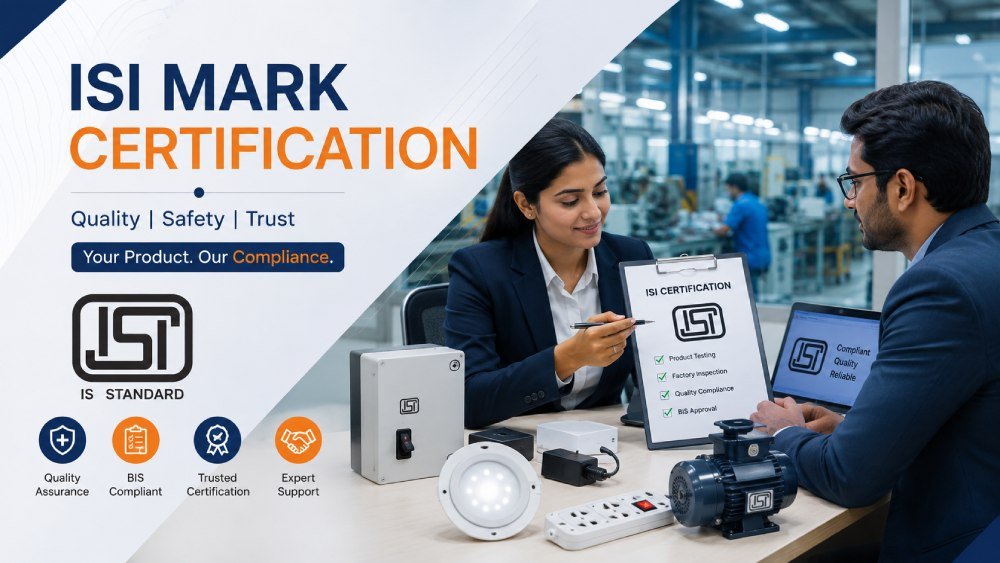
ISI Mark Certification is a product certification scheme operated by the Bureau of Indian Standards (BIS) under Scheme-I. It allows eligible manufacturers to use the BIS Standard Mark, commonly known as the ISI Mark, on products that conform to the applicable Indian Standard.
The certification process evaluates the manufacturer’s manufacturing infrastructure, production processes, quality control systems and testing capabilities. Product conformity may be established through laboratory testing, testing at the manufacturing premises, or a combination of applicable methods.
The ISI Mark helps demonstrate that a certified product has been assessed against the requirements of the relevant Indian Standard.
Why ISI Mark Matters for Your Business
- Demonstrates conformity with applicable Indian Standards
- Builds customer confidence
- Supports regulatory compliance where certification is mandatory
- Helps manufacturers access regulated markets
- Establishes a stronger quality reputation
- Provides a recognized conformity mark for eligible products
Who Needs ISI Mark Certification?
ISI certification is primarily relevant to manufacturers whose products fall under BIS Scheme-I and the applicable Indian Standards.
Depending on the product and applicable regulations, certification may be voluntary or mandatory.
Businesses should first verify:
- Whether the product has an applicable Indian Standard
- Whether the product is covered under Scheme-I
- Whether a QCO makes BIS certification mandatory
- Applicable testing requirements
- Manufacturing and quality-control requirements
- Product-specific BIS guidelines and documentation
BIS maintains product-wise information for Scheme-I and compulsory certification.
Not sure whether your product requires ISI Certification?
Talk to Our BIS Consultant
Products That May Require ISI Certification
ISI certification requirements are product-specific. Depending on the applicable Indian Standard and government notification, various categories may come under BIS certification.
Examples can include:
- Electrical products
- Electrical appliances
- Building and construction materials
- Cement and related products
- Steel and metal products
- Household products
- Industrial products
- Automotive components
- Pressure-related products
- Chemical products
- Consumer products
- Other products notified under applicable QCOs
The exact requirement should always be checked against the latest BIS product list, applicable Indian Standard and relevant government notification.
ISI Mark Certification – Eligibility
A manufacturer generally needs to demonstrate that it has the necessary infrastructure and capabilities to manufacture products conforming to the relevant Indian Standard.
Key requirements may include:
1. Manufacturing Facility
The applicant should have appropriate manufacturing infrastructure for the product.
2. Quality Control
Adequate quality-control and process-control arrangements should be available.
3. Testing Facilities
The manufacturer must meet the applicable testing requirements for the product.
4. Product Conformity
The product must comply with the requirements of the applicable Indian Standard.
5. Technical Documentation
Product specifications, manufacturing information, test records and other applicable documents may be required.
BIS specifically states that licensing decisions consider manufacturing infrastructure, process controls, quality control and testing capabilities, along with product conformity.
Documents Required for ISI Mark Certification
The exact documentation depends on the product and applicable Indian Standard. Common documents may include:
- Company registration documents
- Manufacturing unit address proof
- Factory layout
- Details of manufacturing machinery
- Manufacturing process flow
- List of testing equipment
- Calibration certificates
- Quality-control details
- Product specifications
- Raw material details
- Product test reports
- Technical documents
- Details of manufacturing personnel
- Quality-control personnel details
- Applicable Indian Standard details
- Trademark/brand-related documents, where applicable
- Authorization documents, where applicable
Note: Product-specific documentation requirements may vary.
ISI Mark Certification Process
Getting ISI certification involves multiple technical and regulatory steps. Bharati Global Compliances can assist businesses throughout the process.
Step 1 – Product & Indian Standard Identification
First, the applicable Indian Standard for the product is identified.
Step 2 – Requirement Assessment
We assess the product against applicable BIS requirements, testing requirements and certification scope.
Step 3 – Documentation Preparation
Required technical and business documents are prepared and reviewed.
Step 4 – Testing
The product is tested according to the applicable Indian Standard and BIS requirements.
Step 5 – BIS Application
The certification application is submitted through the applicable BIS online process.
BIS states that product certification applications are accepted through online mode.
Step 6 – Factory Assessment
Where applicable, BIS assesses the manufacturing premises, infrastructure, process controls, quality-control arrangements and testing capabilities.
Step 7 – Non-Conformity Resolution
If observations or non-conformities arise during the process, appropriate corrective action and documentation may be required.
Step 8 – Grant of Licence
After successful completion of the applicable assessment and conformity requirements, BIS may grant the licence for use of the Standard Mark for the approved scope.
Step 9 – Continued Compliance
After certification, manufacturers need to maintain applicable quality and testing requirements and comply with BIS surveillance and licence conditions.
ISI Certification Testing Requirements
Testing is an important part of the ISI certification process.
The exact tests depend on the product and applicable Indian Standard.
Testing may cover parameters such as:
- Performance
- Safety
- Strength
- Durability
- Electrical characteristics
- Material composition
- Dimensional requirements
- Functional requirements
- Chemical properties
- Other product-specific parameters
BIS explains that conformity may be established through third-party laboratory testing, testing at the manufacturing premises, or a combination of both, depending on the applicable certification requirements.
Bharati Global Compliances can help coordinate the applicable testing and compliance requirements for your product.
ISI Mark Certification Cost
The cost of ISI certification is not the same for every product.
The overall cost may depend on:
- Applicable Indian Standard
- Product category
- Number of product varieties
- Testing requirements
- Number of samples
- Laboratory testing charges
- Factory inspection requirements
- BIS application and licence-related fees
- Marking fee
- Additional technical requirements
- Travel/inspection-related requirements, where applicable
BIS publishes applicable certification and marking-fee information, while product-specific requirements can affect the overall compliance cost.
Want an Estimated Cost for Your Product?
Share your product details with our compliance team for a requirement-based quotation.
Get ISI Certification Cost Estimate
How Long Does ISI Certification Take?
The timeline depends on the product, applicable Indian Standard, testing requirements, documentation readiness, factory assessment and resolution of any observations.
Factors affecting the timeline include:
- Product testing
- Availability of required documents
- Manufacturing readiness
- Factory inspection scheduling
- Product-specific requirements
- Non-conformity, if any
- BIS application processing
Therefore, instead of promising a fixed timeline, Bharati Global Compliances provides a product-specific assessment and realistic process roadmap.
Why Choose Bharati Global Compliances?
Getting ISI certification can involve technical standards, testing, documentation and interaction with the certification process.
Bharati Global Compliances helps simplify the process for manufacturers and businesses.
Expert BIS Guidance
Our consultants help identify applicable BIS and ISI certification requirements.
End-to-End Support
From documentation and testing coordination to application and inspection preparation, we provide complete compliance assistance.
Product-Specific Approach
Certification requirements vary by product. We assess your specific product before recommending the applicable compliance route.
PAN India Support
We support businesses and manufacturers across India.
Transparent Process
We explain the certification requirements, documentation and cost factors before starting the process.
Dedicated Assistance
Our team provides ongoing support during the certification process and helps address applicable compliance queries.
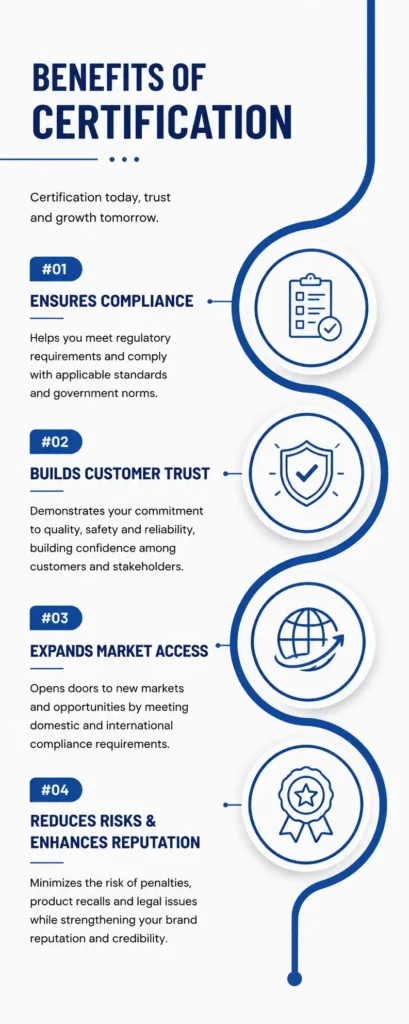
Benefits of ISI Mark Certification
Builds Consumer Trust
The ISI Mark can help communicate conformity with applicable Indian Standards.
Regulatory Compliance
For products covered by mandatory QCOs, obtaining the required BIS licence is an important regulatory requirement.
Better Market Acceptance
Certification can strengthen product credibility among distributors, buyers and customers.
Quality Assurance
The certification process evaluates relevant manufacturing and product conformity requirements.
Competitive Advantage
A recognized conformity mark can help businesses differentiate compliant products in the market.
Business Credibility
ISI certification can strengthen the professional image of manufacturers and brands.
Common Mistakes in ISI Certification
Manufacturers often face delays because of avoidable compliance issues.
Choosing the Wrong Indian Standard
The applicable standard must be correctly identified before starting the certification process.
Incomplete Documentation
Missing technical or factory documents can slow down the application process.
Inadequate Testing Facilities
Manufacturers need to meet applicable testing requirements.
Ignoring Product Variants
Different product varieties may require proper assessment and scope planning.
Unprepared Factory
Manufacturing infrastructure, process control and quality-control arrangements should be ready for applicable assessment.
Using the ISI Mark Without Proper Authorization
The Standard Mark should only be used according to the conditions of the applicable BIS licence. BIS provides provisions for action in case of licence-condition violations.
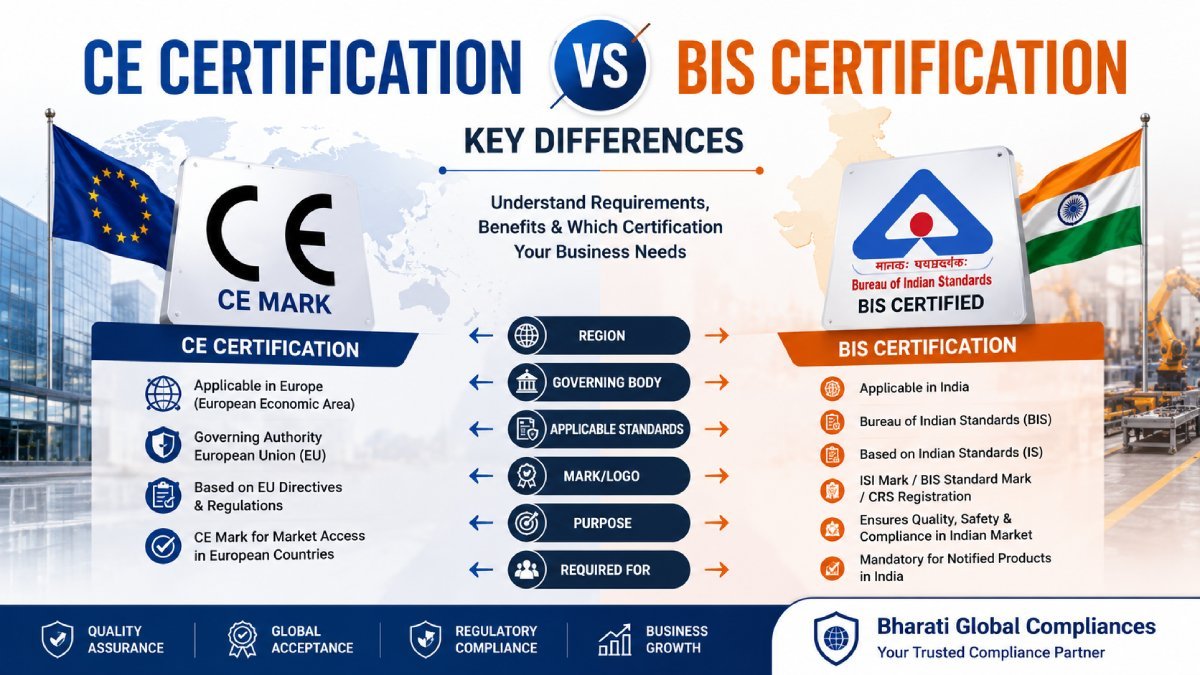
ISI Mark vs BIS Certification
The terms BIS Certification and ISI Mark Certification are often used interchangeably, but there is an important distinction.
BIS is the Bureau of Indian Standards, India’s national standards body.
ISI Mark is the Standard Mark associated with products certified under the applicable BIS product certification scheme, particularly Scheme-I.
So, ISI Mark Certification is a form of BIS Product Certification under Scheme-I.
ISI Certification for Indian Manufacturers
Indian manufacturers seeking certification for eligible products can apply under the applicable BIS product certification framework.
Before applying, manufacturers should evaluate:
- Applicable Indian Standard
- Product scope
- QCO applicability
- Factory infrastructure
- Testing facilities
- Quality-control arrangements
- Documentation
- Product testing requirements
BIS’s application guidance specifically recommends identifying the relevant Indian Standard and reviewing the required manufacturing infrastructure, process controls, quality-control and testing capabilities before applying.
ISI Certification for Foreign Manufacturers
Foreign manufacturers may need a different BIS certification route depending on the product.
BIS operates the Foreign Manufacturers Certification Scheme (FMCS) under which foreign manufacturers can obtain a licence to use the Standard Mark for products conforming to an Indian Standard. However, specific regulatory routes can differ for Electronics & IT Goods covered under the applicable registration framework.
For foreign manufacturers, product-specific assessment is recommended before selecting the certification route.
ISI Certification Renewal
A BIS product certification licence under Scheme-I is not simply a one-time compliance activity.
BIS states that a Scheme-I licence may initially be granted for up to two years and can be renewed, subject to applicable requirements. Renewal applications are submitted online with relevant production details and fees.
Bharati Global Compliances can assist with:
- Renewal documentation
- Licence review
- Production details
- Compliance checks
- Renewal application support
- Ongoing BIS compliance