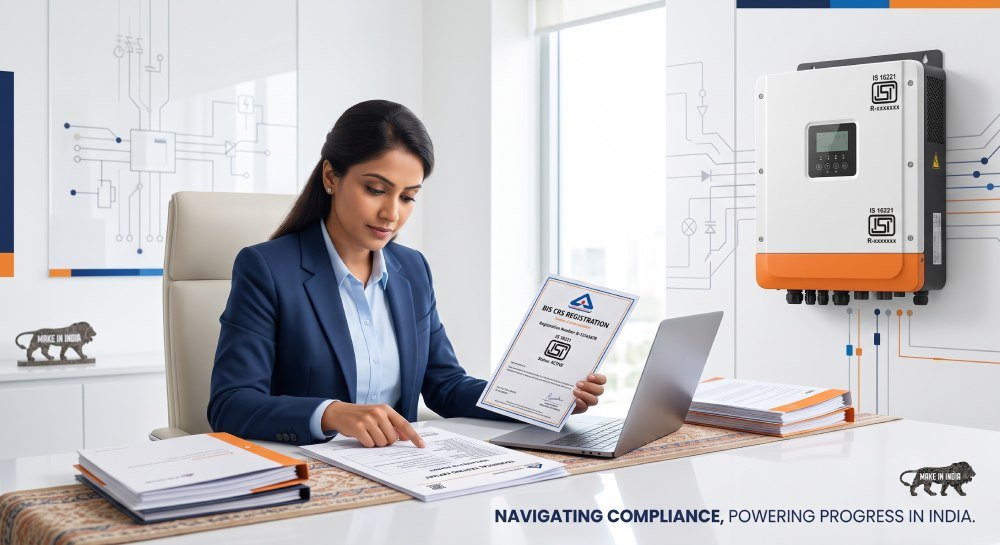
If you manufacture, import, or sell inverters in India, understanding the applicable BIS compliance requirements is important before bringing your product to market. Depending on the inverter type, rating, application, and applicable Indian Standard, the product may fall under a mandatory BIS registration or certification requirement.
Bharati Global Compliances provides end-to-end assistance for BIS CRS Registration for Inverters, including product assessment, applicable standard identification, documentation, testing coordination, application preparation, and BIS process support.
Whether you are an Indian manufacturer, importer, overseas manufacturer, OEM, distributor, or private-label brand, our compliance experts can help you identify the appropriate regulatory route for your inverter.
Talk to Our BIS Compliance Expert Today
What is BIS CRS Registration for Inverter?
BIS CRS Registration is a conformity registration mechanism applicable to products notified under India’s compulsory registration framework.
An inverter converts electrical energy from one form to another and is used in a wide range of applications, including power backup systems, electronic equipment, industrial applications, and other electrical systems.
However, not every inverter automatically falls under the same BIS requirement. The applicable compliance route depends on the exact product category, technical specifications, intended use, and current government notification.
Therefore, before starting testing or filing an application, it is important to determine:
- Exact inverter product category
- Applicable Indian Standard
- Rated capacity and electrical specifications
- Intended application
- Whether the product is covered under a compulsory requirement
- Applicable testing requirements
- Manufacturer and brand details
Bharati Global Compliances helps businesses perform this initial compliance assessment before proceeding with registration.
Why is BIS Registration Important for Inverters?
Electrical and electronic products need to meet applicable safety and quality requirements before being introduced into the Indian market.
For an inverter covered by a mandatory BIS requirement, proper compliance can help businesses:
- Meet applicable Indian regulatory requirements
- Demonstrate product safety and conformity
- Support lawful market entry
- Facilitate compliant imports
- Improve customer confidence
- Strengthen brand credibility
- Reduce compliance-related delays
- Maintain proper product documentation
For businesses importing or manufacturing inverters, checking the applicable BIS requirement before commercial launch or importation can prevent avoidable compliance problems.
Who Needs BIS Registration for Inverters?
BIS compliance may be relevant to different businesses depending on their product and applicable notification.
Indian Inverter Manufacturers
Manufacturers producing covered inverter products for the Indian market should assess the applicable BIS requirements.
Importers of Inverters
Importers should verify whether the imported inverter is covered under a mandatory BIS requirement before commercial import and sale.
Foreign Manufacturers
Overseas manufacturers supplying covered inverter products to India may need to fulfil applicable BIS requirements.
OEM & Private Label Brands
Companies selling inverters under their own brand should assess the relationship between the manufacturer, brand owner, model and registration scope.
Distributors and Suppliers
Distributors should verify that the products they source are compliant with applicable Indian regulations.
Applicable BIS Standard for Inverters
The applicable BIS Standard cannot be determined solely from the word “inverter.”
Different types of inverters may have different technical and regulatory requirements.
Depending on the product, factors that may influence the applicable standard include:
- Product design
- Input and output voltage
- Rated power
- Frequency
- Intended application
- Electrical configuration
- Standalone or grid-connected operation
- Industrial or consumer application
- Product technology
- Applicable government notification
Therefore, standard identification should be completed before product testing.
Important Compliance Note
Do not select a BIS standard only because another inverter manufacturer is using it. The correct standard should be established from the current BIS requirements and the exact technical characteristics of your product.
Bharati Global Compliances can help assess your inverter and identify the applicable compliance pathway.
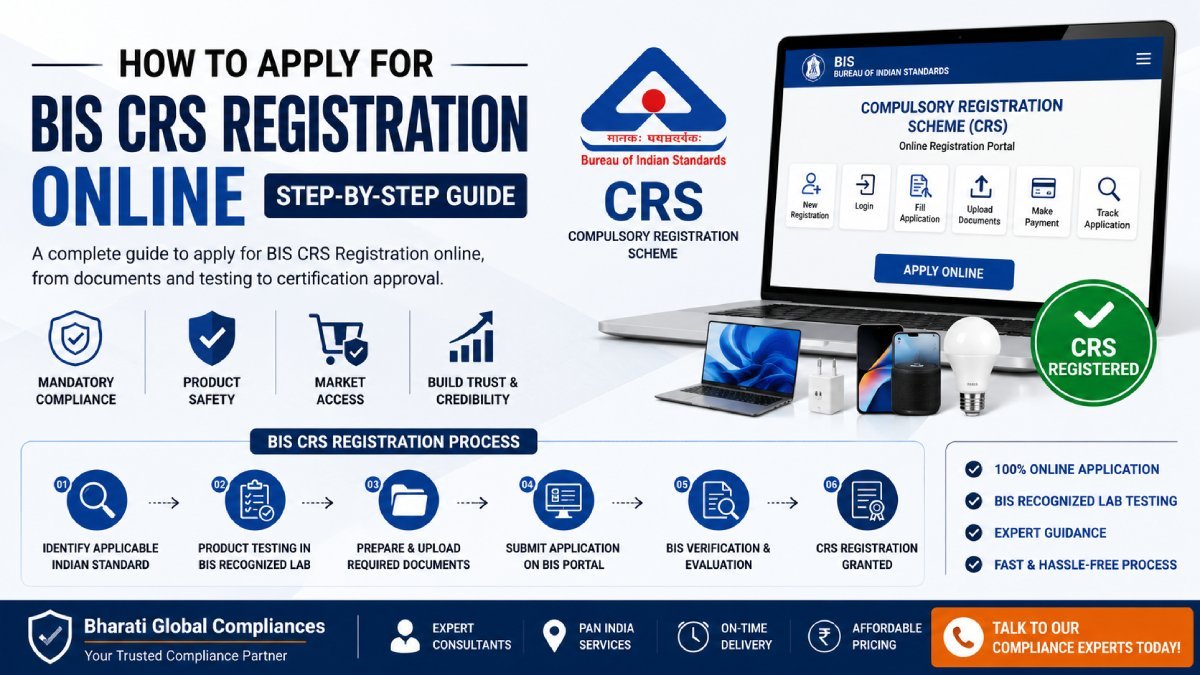
BIS CRS Registration Process for Inverter
The BIS registration process generally involves product assessment, testing, documentation and application submission.
Step 1: Product Assessment
We first understand your inverter and collect basic product information such as:
- Product name
- Model numbers
- Rated capacity
- Input/output specifications
- Technical datasheet
- Brand name
- Manufacturer details
- Intended application
Step 2: Applicable Standard Identification
Our compliance team assesses the product to determine the relevant Indian Standard and applicable regulatory requirement.
Step 3: Documentation Preparation
Required technical and business documents are collected, reviewed and organized.
Step 4: Sample Selection
The appropriate product model/sample is identified for laboratory testing according to the applicable requirements.
Step 5: Product Testing
Testing is coordinated through an applicable BIS-recognized laboratory as required.
The testing scope depends on the applicable Indian Standard and product category.
Step 6: Test Report
After completion of the required testing, the laboratory provides the applicable test report.
Step 7: BIS Application
The required registration application and supporting documents are prepared and submitted through the applicable BIS process.
Step 8: BIS Review
BIS reviews the application, supporting documentation and test report.
If clarification or additional information is required, our team assists with the response.
Step 9: Registration
After successful completion of the applicable requirements, BIS registration is granted for the approved product scope.
Step 10: Post-Registration Compliance
After registration, the manufacturer needs to follow applicable marking, labelling, product-scope and ongoing compliance requirements.
Documents Required for BIS Registration for Inverter
The exact document list depends on the product and applicable BIS scheme. Commonly required documents may include:
- Manufacturer name and address
- Factory address
- Product technical specification
- Product datasheet
- Product photographs
- Model numbers
- Input/output ratings
- Circuit diagrams
- Block diagrams
- User manual
- Product labels
- Brand/trademark documents
- Test reports
- Manufacturing details
- Authorization documents
- Company registration documents
- Declaration/undertaking documents
- Authorized signatory details
For foreign manufacturers, additional documentation and authorization requirements may apply.
Our team can review the documentation before submission to identify inconsistencies or missing information.
Testing Requirements for Inverters
Testing is an important part of BIS compliance for applicable inverter products.
Depending on the applicable standard and product type, testing may cover parameters related to:
- Electrical safety
- Insulation
- Dielectric strength
- Leakage current
- Protection against electric shock
- Temperature rise
- Input and output performance
- Mechanical construction
- Abnormal operation
- Component safety
- Protection mechanisms
- Marking and labelling
- Other standard-specific requirements
The actual testing requirements should be confirmed based on the current applicable BIS Standard and exact inverter configuration.
BIS Registration for Different Types of Inverters
The term inverter covers a broad range of electrical and electronic products.
Therefore, product-specific assessment is important.
Power Inverters
Inverters used for converting electrical power for various applications may require assessment against applicable standards.
UPS/Inverter Systems
Backup power systems should be evaluated based on their configuration, functionality and applicable standard.
Industrial Inverters
Industrial-use inverter equipment may have specific technical and regulatory requirements.
Electrical Inverters
General-purpose electrical/electronic inverter products should be assessed according to their construction and intended application.
Grid-Connected Inverters
Grid-connected products may be subject to specific requirements depending on their configuration and applicable regulations.
Not every category should be assumed to have the same BIS registration route.
BIS Registration for Imported Inverters
If you are importing inverters into India, compliance should be assessed before shipment whenever possible.
Bharati Global Compliances assists importers with:
- Product compliance assessment
- BIS applicability check
- Standard identification
- Documentation review
- Laboratory testing coordination
- BIS application support
- Manufacturer documentation
- Model and brand assessment
- Import compliance guidance
Why Start Before Import?
Starting compliance after goods have already arrived can create unnecessary business complications.
Early compliance planning helps identify potential issues with:
- Product specifications
- Model numbers
- Manufacturer details
- Testing
- Documentation
- Labelling
- Registration scope
BIS Registration for Foreign Inverter Manufacturers
Foreign manufacturers supplying inverters to India need to understand India’s product compliance requirements before entering the market.
Bharati Global Compliances supports international manufacturers with:
Regulatory Assessment
Understanding whether and how the inverter is covered by applicable Indian requirements.
Technical Documentation
Reviewing product specifications and technical documents.
Testing Coordination
Assistance with applicable laboratory testing.
Application Support
Preparation and submission assistance for the applicable BIS process.
Compliance Coordination
Support in handling documentation and procedural requirements related to the Indian market.
BIS Registration for OEM & Private Label Inverters
Many businesses source inverters from an OEM manufacturer and sell them under their own brand.
In such cases, it is important to properly assess:
- Actual manufacturer
- Brand owner
- Product model
- Manufacturing location
- Technical specifications
- Existing registration
- Registration scope
- Authorization arrangement
Simply having an OEM manufacturer’s BIS document does not automatically mean that another brand can use it without checking the applicable requirements.
Before launching a private-label inverter, get the product and registration scope assessed by a compliance professional.
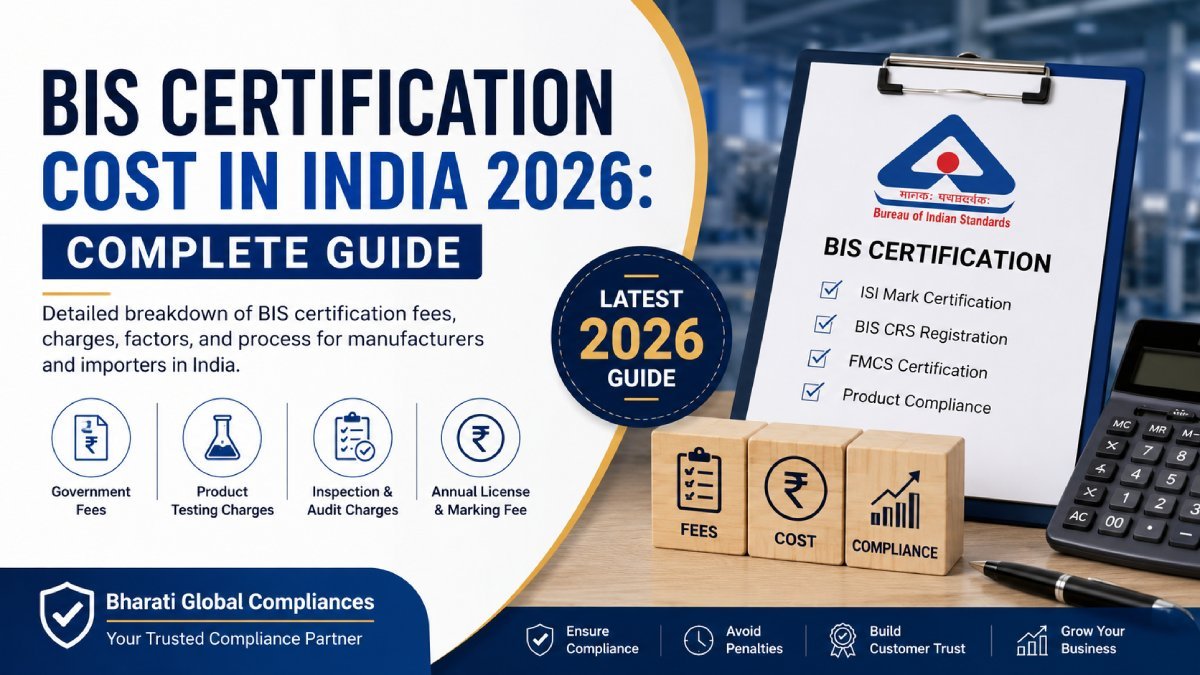
BIS CRS Registration Cost for Inverter
There is no single fixed cost for every inverter registration.
The overall cost may depend on:
- Applicable BIS scheme
- Product category
- Applicable Indian Standard
- Laboratory testing charges
- Number of models
- Product variants
- Brand requirements
- Manufacturer location
- Documentation requirements
- Additional testing
- Government/BIS fees, where applicable
- Professional consultancy charges
What Determines Testing Cost?
Testing charges may vary depending on:
- Applicable standard
- Number of tests
- Product complexity
- Laboratory
- Number of models
- Additional technical requirements
For an accurate estimate, the inverter’s datasheet, model number, rating and manufacturer details should be reviewed first.
Contact Bharati Global Compliances for a product-specific cost assessment.
BIS Registration Timeline for Inverter
The timeline depends on several factors, including:
- Product category
- Applicable standard
- Testing requirements
- Laboratory availability
- Documentation readiness
- Application processing
- BIS queries, if any
- Number of models
The general workflow is:
Product Assessment → Standard Identification → Documentation → Testing → Test Report → Application → BIS Review → Registration
A realistic timeline should be provided only after reviewing the product and testing requirements.
Benefits of BIS Compliance for Inverter Manufacturers
Regulatory Compliance
Helps businesses meet applicable mandatory product requirements.
Better Market Readiness
Proper compliance planning can make product launches more organized.
Customer Confidence
Demonstrating conformity with applicable standards can strengthen customer trust.
Import Support
Helps importers assess regulatory requirements before bringing products into India.
Brand Credibility
Proper certification/registration can strengthen the credibility of an electrical product brand.
Reduced Compliance Risk
Early identification of requirements can reduce avoidable documentation and testing problems.
Common Mistakes in Inverter BIS Registration
Choosing the Wrong Standard
Different inverter products may fall under different standards or regulatory routes.
Testing Before Confirming Applicability
Starting laboratory testing without confirming the applicable requirement can lead to unnecessary costs.
Incorrect Model Details
Model numbers and technical specifications should remain consistent across:
- Datasheet
- Product label
- Test report
- Application
- User manual
Incomplete Documentation
Missing technical documents can delay the application process.
Ignoring Product Variants
Different ratings or configurations may affect the registration scope.
Using Another Company’s Registration
A competitor’s or OEM’s BIS registration should not simply be assumed to cover your own brand or product.
Starting Compliance Too Late
Manufacturers and importers should ideally assess compliance before commercial production or import.
Why Choose Bharati Global Compliances?
Bharati Global Compliances is a New Delhi-based compliance consultancy helping manufacturers, importers, exporters, startups, OEMs and brands with regulatory certification and licensing requirements.
Our Support Includes
Expert Compliance Assessment
We help identify the applicable regulatory pathway for your inverter.
Documentation Support
Our team assists in organizing and reviewing required documents.
Testing Coordination
We support coordination with applicable testing laboratories.
BIS Application Assistance
We help prepare and manage the BIS application process.
Manufacturer & Importer Support
Support is available for both Indian and international businesses.
PAN India Service
Our compliance support is available across Delhi NCR and PAN India.
Dedicated Support
We keep the process structured and help address procedural requirements throughout the engagement.
FAQs – BIS CRS Registration for Inverter
Is BIS CRS Registration mandatory for every inverter?
No. The requirement depends on the exact inverter category, applicable Indian Standard and current government/BIS notification. Product-specific applicability should be checked before starting the process.
What is the BIS Standard for an inverter?
There is no single standard applicable to every product called an inverter. The correct standard depends on the inverter’s technical specifications, application and product category.
Is BIS required for imported inverters?
Imported inverter products should be assessed against applicable Indian mandatory requirements before commercial import and sale.
Can a foreign manufacturer obtain BIS registration?
Yes, where the applicable BIS scheme requires registration, foreign manufacturers can pursue the prescribed compliance process subject to fulfilling the relevant requirements.
Is testing required for BIS registration?
For applicable products, testing is generally an important part of the BIS registration process. The exact testing scope depends on the applicable standard.
Can one BIS registration cover multiple inverter models?
It depends on the applicable scheme, product construction, model relationship and testing requirements. The model scope should be assessed before application.
Can an importer apply for BIS registration?
The applicant/manufacturer requirements depend on the applicable BIS scheme. Importers should first determine whether the registration is to be obtained by the manufacturer or through another prescribed route.
Get BIS CRS Registration for Inverter
Planning to manufacture, import or sell inverters in India?
Don’t start testing blindly or assume that every inverter follows the same BIS standard.
Let our compliance experts assess your product and help you identify the appropriate BIS compliance pathway.
Talk to Our BIS Compliance Expert
Get Free Consultation | Request a Callback | Start Your BIS Compliance
Bharati Global Compliances
Your Trusted Compliance & Certification Partner